
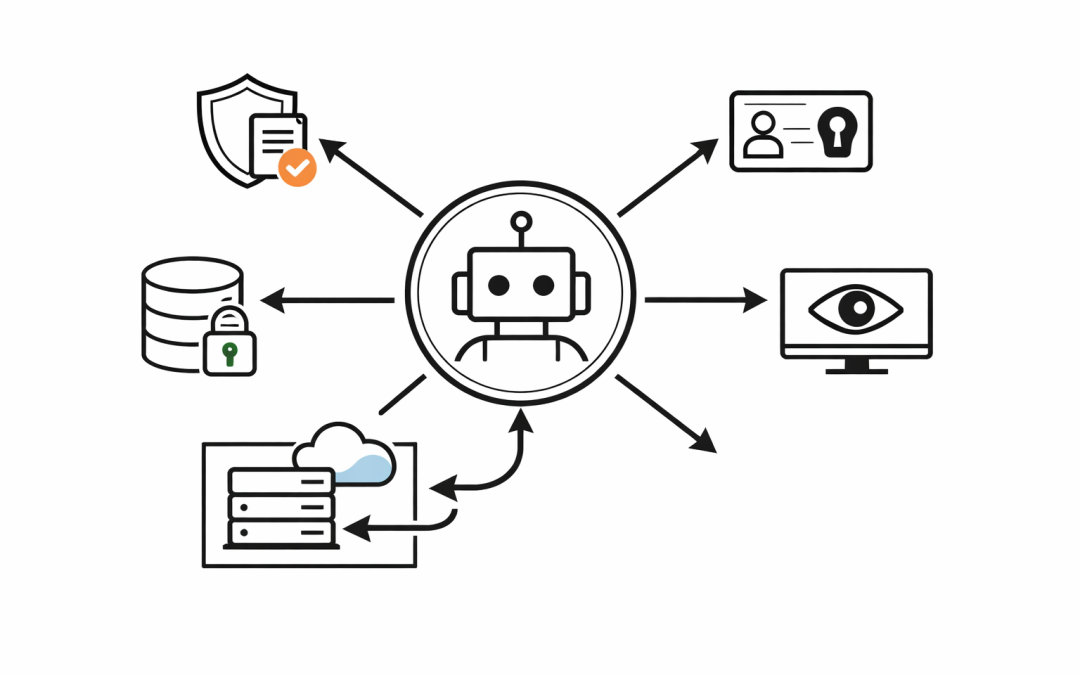
OpenClaw has rapidly become the de facto open source framework for autonomous AI agents. Developers love it. The community is thriving. And it is fundamentally changing how organisations think about deploying always-on, self-evolving AI assistants.


The problem is that OpenClaw was built for capability, not governance. And for the mid-market organisations that need AI agents to handle real business processes with real compliance obligations, that gap is becoming impossible to ignore.
Microsoft has noticed. And it is moving fast.
What OpenClaw Actually Is
OpenClaw is an open source project that lets developers build autonomous AI agents — agents that can take goals, break them into tasks, use tools, write code, and operate continuously without human supervision. Think of it as the operating system for personal AI. One command to install. One framework to build on.
NVIDIA calls it exactly that. When it launched NemoClaw at GTC 2026 in March, NVIDIA positioned OpenClaw as the substrate for agent development and NemoClaw as the security and privacy wrapper that makes it enterprise-tolerable.
NemoClaw adds NVIDIA OpenShell — a runtime that enforces policy-based privacy and security guardrails between the agent and the infrastructure it touches. Sandboxed execution. Deny-by-default access control. Privacy-aware routing that keeps sensitive workloads on local hardware using open models like Nemotron.
It is a meaningful step forward. But it is also a step that reveals how far OpenClaw alone falls short of what enterprise deployments actually require.
Why OpenClaw Alone Does Not Meet Enterprise Requirements
Autonomous agents operating in a business environment need more than a sandbox. They need identity management, data classification, compliance reporting, threat protection, and governance that integrates with the security infrastructure already in place.
OpenClaw does not provide any of these capabilities natively. NemoClaw adds important guardrails, but it operates as a standalone layer. It does not integrate with Active Directory. It does not understand Microsoft Purview data labels. It does not feed agent activity into an existing SIEM or XDR pipeline.
For organisations running Microsoft 365, Azure, and Defender, that creates an uncomfortable disconnect. The AI agents are operating outside the governance perimeter that protects everything else.
Microsoft’s Enterprise-First Response
Microsoft has responded with a comprehensive agent governance stack that directly addresses the gaps OpenClaw and NemoClaw leave open.
Microsoft Agent 365 is the centrepiece. Announced for general availability on 1 May 2026, Agent 365 is described as a control plane for agents. It gives IT, security, and business teams the visibility and tools they need to observe, secure, and govern agents at scale — using the infrastructure organisations already have.
Agent 365 is not a standalone product. It integrates directly with Microsoft Defender, Microsoft Entra, and Microsoft Purview. That integration is what makes the approach fundamentally different from NemoClaw’s bolt-on model.
Identity and access control for agents. Through Microsoft Entra, every agent gets a distinct identity with least-privilege access. Agents are not treated as ambient code running with inherited permissions. They are managed entities with explicit access policies, just like human users and service accounts.
Data loss prevention in agent workflows. Microsoft Purview data loss prevention now extends to Copilot and agent interactions. Sensitive information — PII, financial data, classified content — can be blocked from being processed or shared by agents in real time. NemoClaw’s privacy router addresses some of this concern, but it lacks the deep integration with Microsoft’s data classification engine.
Network-level prompt injection protection. Entra Internet Access now blocks malicious AI prompts across applications and agents by enforcing universal network-level policies. This moves prompt injection defence from the model layer to the infrastructure layer — a significant architectural improvement.
Unified threat detection. Microsoft Sentinel and Defender now include agent-specific capabilities. Security Copilot agents can autonomously triage alerts, investigate incidents, and coordinate responses. Agent behaviour feeds directly into the organisation’s existing threat detection and response workflow.
The Strategic Calculation Behind Microsoft’s Urgency
Microsoft is not building Agent 365 because it disapproves of OpenClaw. It is building Agent 365 because OpenClaw is gaining developer mindshare fast, and the agents that developers build on OpenClaw are going to show up inside enterprise environments whether IT teams plan for them or not.
The same pattern played out with shadow IT a decade ago. Employees brought their own cloud tools into the workplace because the official alternatives were too slow or too restrictive. IT departments either adapted or lost control. The agent era is following the same trajectory, just faster.
Microsoft’s play is to ensure that when agents arrive — whether built on OpenClaw, deployed through Copilot Studio, or embedded in third-party SaaS — the governance infrastructure is already there. Agent 365 is designed to govern any agent, not just Microsoft agents.
That is why the RSAC 2026 announcements focused so heavily on Zero Trust for AI. Microsoft is extending the verify-explicitly, least-privilege, assume-breach framework to the entire AI lifecycle — from model training and deployment to runtime agent behaviour. The Zero Trust for AI reference architecture, assessment tools, and practice guides announced in March 2026 are intended to give security teams a structured way to bring agents under governance.
What NVIDIA’s Ecosystem Does That Microsoft Does Not
To be clear, Microsoft’s approach has its own limitations. NemoClaw’s ability to run high-performance open models locally on dedicated hardware — NVIDIA GeForce RTX PCs, DGX Spark, or DGX Station — offers a data sovereignty option that Azure-centric solutions cannot match for certain workloads.
For organisations in regulated industries where data cannot leave the premises under any circumstances, that local-first architecture is not a nice-to-have. It is a compliance requirement.
NVIDIA’s ecosystem partnerships also extend across the security vendor landscape. Cisco AI Defense, CrowdStrike’s Secure-by-Design AI Blueprint, and TrendAI are all building integrations with OpenShell. Organisations that do not use Microsoft’s security stack may find NemoClaw a better fit.
What This Means for Australian Organisations
Australian mid-market organisations face a specific set of pressures that make this race directly relevant.
The Privacy Act requires demonstrable controls over how personal information is processed. When an AI agent handles customer data, the organisation needs to prove where that data went, what model processed it, and what policies governed the interaction. Both Microsoft’s and NVIDIA’s approaches provide audit capabilities, but Microsoft’s integration with Purview and Defender offers a more complete compliance story for organisations already running Microsoft workloads.
The Essential 8 framework emphasises application control, privilege management, and event logging. Agent 365’s deny-by-default access model and Sentinel integration align directly with these controls. Organisations pursuing Essential 8 maturity can map agent governance to existing compliance targets.
For organisations that are not yet deploying autonomous agents, this is still a planning priority. The SaaS platforms that mid-market businesses depend on — Salesforce, ServiceNow, Atlassian — are building agent capabilities on both Microsoft and NVIDIA toolkits. Agent features will arrive inside existing software whether organisations plan for them or not.
Practical Next Steps
Three actions organisations should consider now.
First, audit the current security stack. If the organisation is running Microsoft 365 E5 or E7, Agent 365 capabilities may already be included or available. Understanding what agent governance tools are accessible without additional procurement is the starting point.
Second, assess which business processes are candidates for agent deployment and map the data access those agents would require. The biggest governance risk is not the agent itself — it is the breadth of data the agent needs to access to do its job.
Third, evaluate whether a hybrid approach — Microsoft Agent 365 for cloud-integrated governance and NemoClaw for on-premises, privacy-sensitive workloads — is appropriate. The two stacks are not mutually exclusive, and organisations with complex compliance requirements may benefit from both.
The race to make AI agents enterprise-safe is accelerating. For mid-market organisations, the right time to choose a governance framework is before the agents arrive — not after.
CloudProInc helps Australian organisations navigate cloud, AI, and cybersecurity decisions with practical, vendor-neutral strategy. If agent governance is on the roadmap, a structured assessment is the right first step.
Discover more from CPI Consulting
Subscribe to get the latest posts sent to your email.