
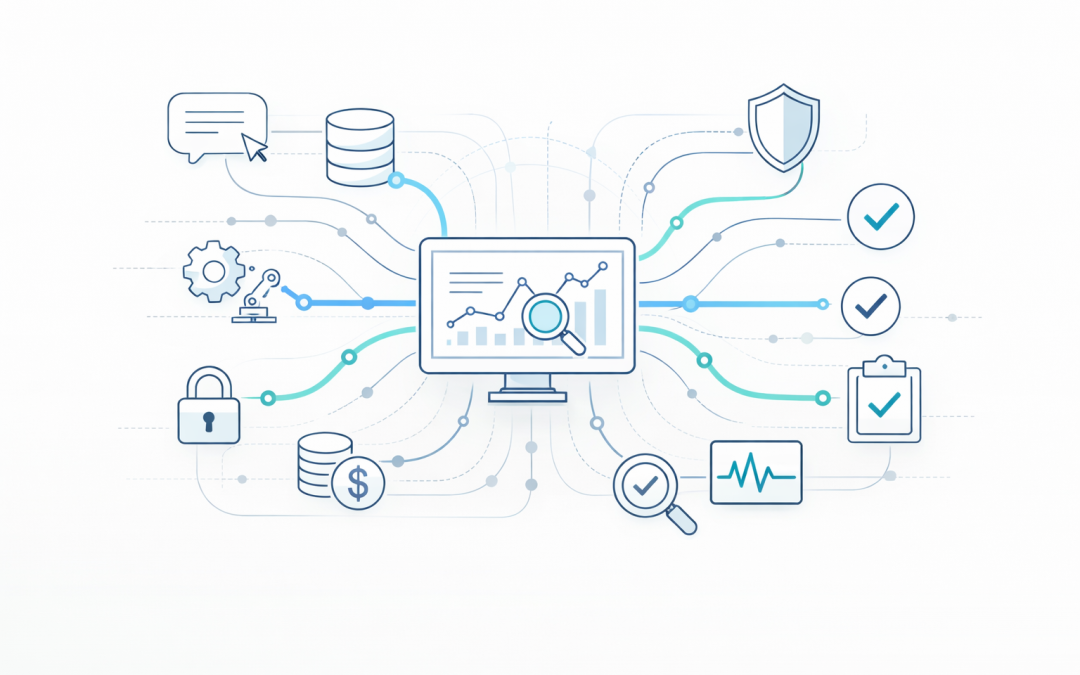
AI agents are quickly moving from proof-of-concept projects into production workflows. They call tools, retrieve documents, invoke models, write code, trigger automations, and make decisions across multiple systems.


That creates a new operational problem for platform teams: production agent traces are becoming too valuable to ignore, but too expensive and noisy to keep in full.
Intelligent sampling looks like the obvious answer. Keep the traces that matter. Reduce the traces that do not. Control observability cost without losing operational visibility.
The risk is that many organisations will trust the sampling policy before proving that it preserves the evidence they actually need.
For platform engineering and AI/ML operations teams, that is a dangerous shortcut. A sampled trace pipeline can make a production AI system look healthy while quietly discarding the exact traces needed to investigate quality failures, prompt injection attempts, privacy issues, tool misuse, latency spikes, or cost anomalies.
Before production agent traces become a source of operational truth, platform teams should validate the sampling layer itself.
Why agent traces are different from traditional application traces
Traditional distributed tracing usually follows a request through services, databases, queues, and APIs. That is still important, but agentic AI systems add several layers of complexity.
A single user request may include:
- Prompt construction
- Retrieval from a vector database or enterprise search index
- Multiple LLM calls
- Tool selection
- Tool execution
- Policy checks
- Memory reads and writes
- Human approval steps
- Retry loops
- Output filtering
- Token and cost attribution
The failure mode is not always a clean exception or HTTP 500.
An agent can return a fluent but incorrect answer. It can choose the wrong tool. It can expose sensitive context. It can loop unnecessarily and burn tokens. It can produce an output that technically succeeds but fails the business task.
That means the trace is not just a performance diagnostic. It is also part of the evidence chain for quality, safety, governance, and auditability.
For Australian organisations operating under privacy obligations, Essential Eight maturity expectations, ACSC guidance, internal risk controls, and board-level AI governance, that evidence matters.
The appeal of intelligent sampling
Production telemetry volumes can grow quickly. Agent traces are especially heavy because they often include nested spans, model metadata, tool calls, token usage, retrieval details, and evaluation results.
Keeping every trace indefinitely is rarely practical. It increases storage cost, query cost, platform noise, and privacy exposure.
Sampling helps reduce that burden.
In OpenTelemetry and similar observability architectures, teams commonly use several approaches:
- Head sampling, where the decision is made at the start of a trace
- Probabilistic sampling, where a percentage of traces is retained
- Tail sampling, where the decision is made after more of the trace is known
- Policy-based sampling, where errors, latency, attributes, tenants, endpoints, or other conditions influence retention
- Adaptive or intelligent sampling, where policies adjust based on traffic, anomaly patterns, cost, or signal value
Tail sampling is often attractive for production AI workloads because it can retain traces after seeing more context. For example, a collector can keep traces with errors, high latency, specific model names, expensive token usage, failed evaluations, or suspicious tool activity.
That is powerful. But it is not automatically safe.
The hidden risk: sampling can remove the evidence of failure
Sampling is not just a cost-control setting. It is a production control plane decision.
A poor sampling policy can create blind spots such as:
- Dropping low-frequency but high-impact failures
- Missing slow traces because the decision window is too short
- Losing spans when trace fragments arrive at different collectors
- Keeping infrastructure errors but dropping AI quality failures
- Sampling by endpoint while ignoring tenant, user group, model, or tool risk
- Removing traces that would have revealed prompt injection or data leakage attempts
- Preserving successful responses but losing failed reasoning paths
- Creating dashboards that look stable because the unstable evidence was sampled away
This is particularly important for AI agents because many failures are semantic, not mechanical.
A trace may have a 200 response code, acceptable latency, and no exception, but still represent a poor or risky outcome. If the sampling policy only prioritises technical errors, the organisation may never see the operational failures that matter most.
What platform teams should validate first
Before trusting production agent traces, platform teams should run validation against the sampling design. The goal is not to keep everything forever. The goal is to prove that the traces kept are fit for operational, security, compliance, and improvement purposes.
1. Validate that critical failures are always retained
Start by defining what must never be sampled away.
For agentic AI systems, this should include more than exceptions. Consider retaining traces where:
- A tool call fails or is denied
- A model response fails an evaluation
- A safety or policy filter triggers
- A human approval step rejects the output
- Token usage exceeds a threshold
- Latency breaches the service objective
- Retrieval returns no relevant documents
- A protected data classification is detected
- A high-risk tool is invoked
- A privileged workflow is attempted
- A user reports an incorrect or unsafe answer
These conditions should be tested with synthetic and replayed traces. Do not assume the policy works because it looks correct in YAML or in a vendor UI.
2. Validate trace completeness
Tail sampling depends on having enough of the trace available when the decision is made.
If spans arrive late, are dropped, or are routed to different collector instances, the sampling processor may make a decision using incomplete context. That can produce partial traces or incorrect retention decisions.
Platform teams should test:
- Whether all spans for the same trace reach the same collector decision point
- Whether the decision wait time is long enough for agent workflows with slow model calls
- Whether queue delays or retries create late spans
- Whether collector memory limits cause dropped traces under load
- Whether burst traffic changes sampling behaviour
- Whether trace parent-child relationships remain intact across queues, workers, and tool services
A trace that looks complete during a pilot may become incomplete during production load.
3. Validate that AI-specific metadata survives
Agent observability is only useful if the retained traces contain the right attributes.
Platform teams should confirm that sampling and redaction policies preserve safe versions of the metadata needed for investigation, such as:
- Model name and version
- Prompt or template version
- Tool name and outcome
- Retrieval source and document category
- Token counts
- Cost attribution
- Evaluation result
- Safety classification
- Tenant or business unit identifier
- Environment and release version
At the same time, they should avoid storing sensitive prompt content, personal information, secrets, or regulated data unnecessarily.
This is where Australian privacy and data handling obligations become practical engineering concerns. Sampling should not become an excuse to collect everything, and redaction should not remove the operational fields required to investigate incidents.
4. Validate representativeness, not just retention rate
A 10 percent sampling rate does not mean the retained traces are representative.
If most traffic comes from low-risk, high-volume workflows, a simple probabilistic policy may under-represent rare but important paths. That can distort dashboards, model-quality reporting, and incident review.
Platform teams should compare sampled traces against unsampled baselines during controlled windows. Look for skew by:
- Tenant
- Region
- User role
- Workflow type
- Model
- Prompt version
- Tool
- Endpoint
- Error category
- Latency band
- Token usage band
If the sample over-represents easy traffic and under-represents complex workflows, it is not suitable for production decision-making.
5. Validate cost and performance under load
Tail sampling and intelligent sampling are not free. They require buffering, memory, CPU, queueing, and backend processing.
A policy that works at 100 traces per second may fail at 5,000 traces per second. The collector may start dropping spans, decisions may lag, or memory pressure may force compromises.
Platform teams should load test the telemetry path, not just the application path.
Important signals include:
- Collector CPU and memory
- Dropped spans
- Queue length
- Export failures
- Decision latency
- Late span count
- Sampling decision volume
- Backend ingestion errors
- Cost per retained trace
- Time to query incident traces
Observability infrastructure is production infrastructure. It needs capacity planning, SLOs, alerting, and change control.
A practical validation framework
A useful validation approach is to treat the sampling pipeline like any other critical platform component.
Step 1: Define trace retention objectives
Document what the organisation needs traces for.
Common objectives include:
- Production incident response
- AI quality evaluation
- Security investigation
- Cost attribution
- Performance tuning
- Compliance reporting
- Regression testing
- Model and prompt improvement
Each objective should map to trace fields, retention rules, and access controls.
Step 2: Build a labelled test corpus
Create a test set of known trace scenarios, including successful requests, slow requests, tool failures, policy denials, hallucination examples, prompt injection attempts, high-token workflows, and privacy-sensitive cases.
This corpus becomes the benchmark for the sampling policy.
If critical examples are not retained during testing, the policy is not ready.
Step 3: Run shadow collection windows
For a limited period, collect a higher-fidelity baseline in a controlled environment or production shadow window. Compare the intelligent sample against the baseline.
The question is not only “how much did we save?”
The better question is “what important evidence did we lose?”
Step 4: Review sampling outcomes with multiple teams
Sampling policy should not be owned by only one team.
Platform engineering, application teams, AI/ML operations, cyber security, privacy, risk, and business owners may all need different evidence from traces.
A security team may care about denied tool calls. An ML operations team may care about failed evaluations. Finance may care about token cost spikes. A product owner may care about task success.
A sampling policy that satisfies only infrastructure monitoring may fail the broader AI governance requirement.
Step 5: Version and audit sampling policies
Sampling rules should be versioned, reviewed, and auditable.
Changes should include:
- Why the rule changed
- Who approved it
- What validation was performed
- Which workloads are affected
- What risks were accepted
- How rollback will work
This is especially important when traces are used for incident reconstruction, executive reporting, or compliance evidence.
What good looks like in production
A mature production setup does not rely on a single sampling percentage.
It usually has layered controls, such as:
- Low-overhead head sampling for high-volume commodity traffic
- Tail sampling for errors, latency, tool failures, policy events, and AI evaluation failures
- Higher sampling for new releases, new prompts, new models, and high-risk workflows
- Temporary full-fidelity capture during incidents or controlled review windows
- Redaction and data minimisation before export
- Clear retention tiers for operational, security, and audit traces
- Dashboards that show both application health and telemetry pipeline health
- Alerts when sampling behaviour changes unexpectedly
- Regular replay tests using known failure scenarios
Most importantly, the team can explain what the sampling policy is designed to protect, what it may miss, and when to override it.
The governance angle for Australian organisations
For Australian organisations, production AI observability should be considered part of operational resilience and cyber governance.
Agent traces may show access patterns, data movement, tool execution, policy enforcement, and system behaviour during an incident. That makes them relevant to security monitoring, privacy review, internal audit, and Essential Eight-aligned operational discipline.
The ACSC regularly emphasises the importance of visibility, logging, monitoring, and response capability across technology environments. AI agents do not reduce that need. They increase it.
If an AI agent can act across business systems, the organisation needs enough telemetry to understand what happened, why it happened, and whether controls worked.
Intelligent sampling can support that goal, but only if it is validated against real operational risks.
Key questions platform teams should ask
Before declaring a production agent observability platform ready, platform leaders should ask:
- What traces are we guaranteed to keep?
- What traces are we comfortable losing?
- How do we know the sampling policy works under production load?
- Can we reconstruct an agent failure across model calls, tools, and approvals?
- Are semantic AI failures retained, or only technical errors?
- Do security and privacy teams agree with the retained fields?
- Can we temporarily increase fidelity during incidents?
- Are sampling policies versioned and auditable?
- Are dashboards showing real health, or sampled convenience?
- When was the sampling policy last tested against known failure cases?
These questions turn sampling from a background observability setting into an explicit platform reliability control.
Final thought
Production AI agents will place new pressure on observability platforms. The volume of traces will increase, the cost of storage will matter, and the need for selective retention will become unavoidable.
But intelligent sampling should not be accepted on faith.
For platform engineering and AI/ML operations teams, the priority is to prove that sampling preserves the traces needed for incident response, AI quality improvement, security review, privacy governance, and cost management.
The organisations that get this right will not simply have cheaper observability. They will have more trustworthy production AI operations.
If your team is preparing to scale AI agents or LLM-powered workflows, now is the time to review whether your trace sampling strategy is validated, explainable, and ready for real incidents.
References and further reading
- OpenTelemetry documentation: Sampling concepts and trace sampling approaches
- OpenTelemetry Collector documentation: Tail sampling processor
- OpenTelemetry semantic conventions for generative AI systems
- Microsoft Azure AI Foundry documentation: Observability and evaluation concepts
- ACSC guidance on logging, monitoring, cyber resilience, and Essential Eight-aligned operational controls
Discover more from CPI Consulting
Subscribe to get the latest posts sent to your email.