
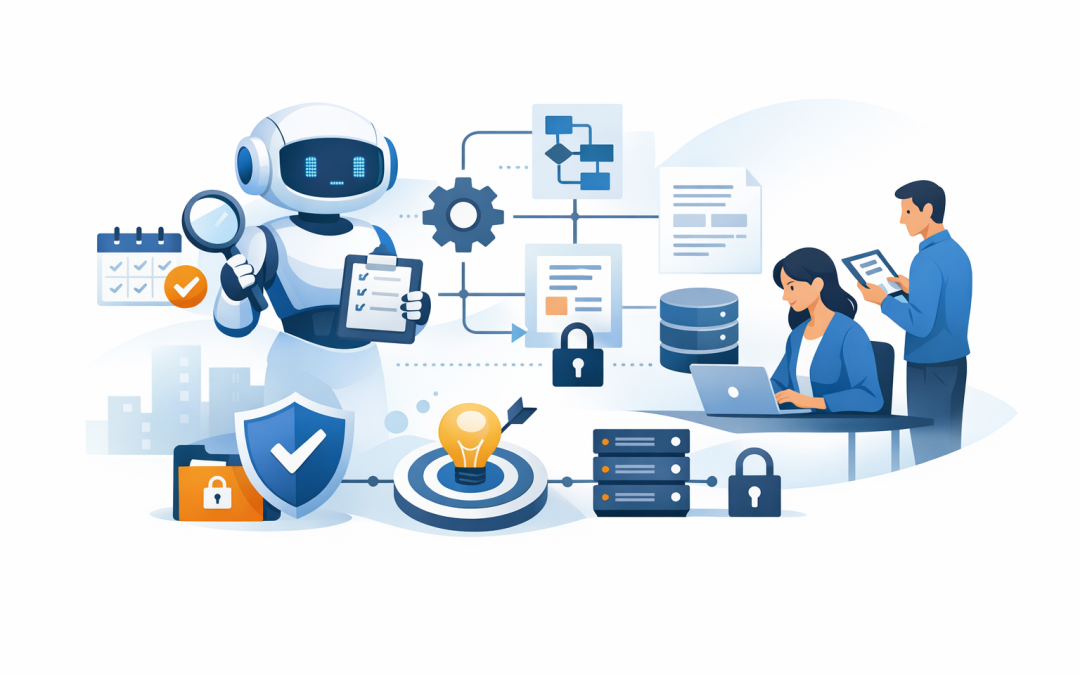
In this blog post How AI Agents Will Reshape the Modern Workplace for Business we will explain what AI agents are, how the technology works in plain English, and where they are likely to create the biggest gains for growing organisations. If your team is stuck chasing approvals, rewriting the same emails, searching across five systems for one answer, or doing work that feels far too manual for 2026, this is exactly where AI agents start to matter.
At a high level, an AI agent is not just a chatbot that gives clever answers. It is software that can understand a goal, gather the right information, decide what to do next, and then complete parts of the task for a person. That might mean drafting a customer response, pulling information from SharePoint and Teams, updating a CRM record, booking a follow-up task, or handing something to a manager for approval when the stakes are higher.
This matters because the modern workplace has a coordination problem, not just a workload problem. Most employees are not short on tools. They are short on time, context, and clean handoffs between systems. AI agents are becoming useful because they sit between your people and your business systems, reducing busywork instead of adding another app to learn. In Microsoft environments, agents can work across places your staff already use, such as Teams, Outlook, Word, and Copilot, while drawing on approved company data and actions.
What AI agents actually are
The simplest way to think about an AI agent is this: a digital team member for narrow, repeatable work. Not a replacement for your people. Not a magic brain. A specialised assistant that can handle the first 60 to 80 percent of a task and bring a human in when judgement, approval, or risk is involved.
That distinction matters. A normal chatbot answers a question. A true agent can take the next step. It can look things up, use tools, follow rules, and keep working through multiple steps until a job is done. Some agents follow a fixed process every time. Others are more flexible and decide their own sequence of actions based on the goal. The best business use cases usually sit somewhere in the middle: enough freedom to be useful, enough control to stay safe.
The technology behind AI agents in plain English
Under the hood, most workplace agents are built from a few simple ingredients.
- A language model which is the part that reads, writes, summarises, and reasons using natural language.
- Instructions which tell the agent what its job is, what good looks like, and what it must never do.
- Knowledge which gives it access to approved company content such as policies, documents, meeting notes, customer records, or product information.
- Tools and actions which let it do useful work such as search files, update systems, send emails, create tickets, or trigger workflows.
- Guardrails which set permissions, logging, approvals, and boundaries so the agent works safely inside your business rules.
That is why agents are getting better so quickly. The model provides the brain, but the real business value comes from connecting that brain to your data and your systems in a controlled way. Platforms from Microsoft, OpenAI, and Anthropic are all moving in this direction, with support for tools, workflows, memory, tracing, and human review rather than simple one-shot chat. Microsoft’s current agent tooling also supports multiple model options, including OpenAI and Anthropic models, which gives businesses more flexibility in how they design and govern solutions.
One important point for leaders: more autonomy is not always better. Even Anthropic’s own guidance says the best results often come from simpler, composable patterns rather than complex agent designs. In plain English, do not build an AI agent just because you can. Build one when a clear business process is slow, repetitive, expensive, or error-prone enough to justify it.
Five ways AI agents will transform the workplace
1. They will remove low-value admin work
This is the fastest win. Think meeting follow-ups, internal status updates, policy questions, onboarding checklists, sales admin, service triage, and routine reporting. When an agent can gather information, draft the first version, and push the task to the right person, your staff spend less time on administration and more time on work customers actually notice.
Business outcome: lower operating cost and more productive staff without increasing headcount.
2. They will make your existing systems easier to use
Most mid-sized businesses do not have a technology shortage. They have a fragmentation problem. Information sits in Microsoft 365, a CRM, an accounting platform, a ticketing system, and maybe three shared drives no one trusts.
AI agents can act as a plain-English front door to those systems. Instead of asking staff to remember where everything lives, the agent can retrieve the right information and present it in one place. That reduces delays, cuts training time for new staff, and makes your existing software investments work harder.
Business outcome: better return on the software you already pay for.
3. They will speed up decisions
Many delays inside a business are not caused by a lack of intelligence. They are caused by missing context. A manager wants to approve a purchase but needs contract history, budget status, and prior vendor issues. A sales leader wants a forecast but must wait for three teams to update spreadsheets.
An agent can gather the inputs, summarise the important points, flag exceptions, and present a recommendation. The manager still makes the decision. The difference is they make it faster, with less chasing and less guesswork.
Business outcome: faster cycle times and fewer decisions held up by admin friction.
4. They will improve employee and customer service
Internal service desks are a strong early use case. An agent can answer common IT or HR questions, guide staff through standard requests, collect the right details upfront, and escalate only the exceptions. The same pattern works in customer service, where an agent can draft responses, surface account history, and suggest the next best action for a human agent to review.
Business outcome: faster response times, more consistent service, and less pressure on support teams.
5. They will expose weak processes you should fix anyway
This is the part many leaders miss. AI agents do not just automate work. They reveal where your process is messy, undocumented, or dependent on one person who knows how things really get done.
That is useful. If an agent cannot follow the process, chances are your staff are struggling with it too. In that sense, an AI project can become a business process improvement project with a very clear return.
Business outcome: cleaner operations and less key-person risk.
A realistic mid-sized business scenario
Picture a 200-person professional services firm in Melbourne. New starters wait days for access because HR, IT, and team leaders all work from different checklists. Staff ask the same policy questions in Teams every week. Project managers spend Friday afternoons chasing status updates and turning them into client-ready reports.
A well-designed agent does not need to change the whole business to help. It can guide onboarding, collect required details, trigger the right tasks, answer approved policy questions from company documents, and assemble project updates into a first draft for review. None of that is flashy. All of it saves time, improves consistency, and reduces the risk of something important slipping through the cracks.
What leaders need to get right before rollout
The biggest risk with AI agents is not usually the model. It is governance. If you connect an agent to messy data, over-permissioned systems, or unclear approval rules, you can automate bad habits at speed.
For Australian organisations, privacy and security need to be designed in from day one. The OAIC has been clear that the Privacy Act applies where AI involves personal information, and it recommends caution about putting personal or sensitive information into publicly available generative AI tools. For many businesses with turnover above $3 million, those privacy obligations already apply.
This is also where Essential 8 matters. The Essential Eight is the Australian government’s cyber security framework that helps reduce common attack paths. It was originally designed for Windows-based environments, but its risk-based approach is still highly relevant when you are rolling out agents that touch identities, devices, data, and admin privileges. In practice, if your patching, multi-factor authentication, admin controls, and logging are weak, your AI rollout will inherit those weaknesses.
That is why practical rollout matters more than grand strategy. Start with a narrow use case. Limit what the agent can access. Keep a human approval step for anything involving finance, HR, legal commitments, customer promises, or security changes. Measure time saved, errors reduced, and user adoption before expanding.
Why the next wave will favour practical businesses
The winners will not be the companies with the biggest AI budget. They will be the ones that choose the right use cases, connect agents to the right data, and manage the risks properly. In many Microsoft-based businesses, the barrier to entry is already lower than leaders think. Microsoft 365 Copilot Chat is now included for Microsoft 365 or Office 365 users, and some agents can be enabled at no extra cost, while agents that use organisational data can be rolled out with separate consumption-based controls.
That opens a practical path for mid-sized organisations. You do not need to bet the company on AI. You can start with one painful process, prove the value, and build from there.
Final thought
AI agents will transform the modern workplace for the same reason cloud and mobility did: they remove friction from how work actually gets done. The businesses that benefit most will be the ones that treat agents as operational tools, not science projects.
At CloudProInc, we see this as a hands-on business change exercise as much as a technology project. With more than 20 years of enterprise IT experience, deep capability across Azure, Microsoft 365, Intune, Windows 365, OpenAI, Claude, Microsoft Defender, and Wiz, and a practical Melbourne-based team rather than a giant faceless MSP, we help organisations introduce AI in a way that is useful, secure, and realistic. If you are not sure whether AI agents could save time or reduce risk in your business, we are happy to take a look with you, no strings attached.
Discover more from CPI Consulting
Subscribe to get the latest posts sent to your email.