
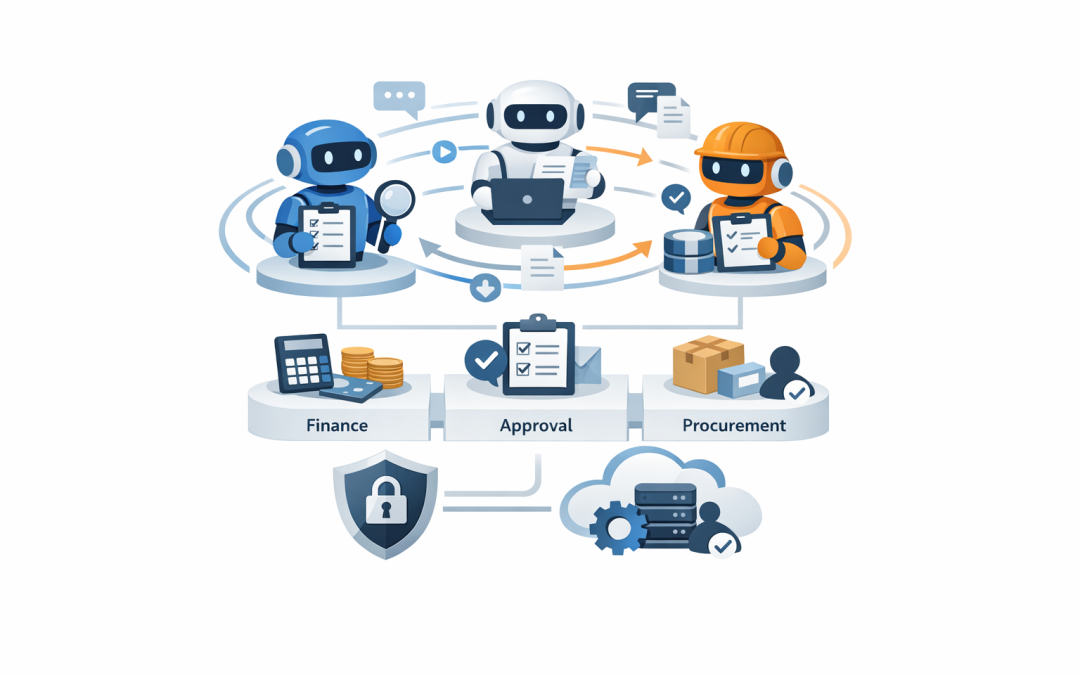
In this blog post Why A2A Protocol Matters for Practical Business AI Adoption we will explain what the Agent-to-Agent protocol is, why it matters for business leaders, and how it can help organisations use AI without creating another expensive technology mess.
Many companies are experimenting with AI right now, but the results are often scattered. One team has a chatbot for customer service. Finance is testing an automation tool. IT is looking at Microsoft Copilot. Someone else is using OpenAI or Claude to speed up reports.
Individually, these tools may be useful. The problem is that they often do not talk to each other. That means people still copy information between systems, chase approvals manually, and check whether AI-generated work is accurate.
This is where the Agent-to-Agent protocol, usually shortened to A2A, becomes important.
What is the Agent-to-Agent protocol in plain English?
A2A is an open way for AI agents to communicate with each other.
An AI agent is more than a chatbot. A chatbot usually answers questions. An agent can understand a goal, work through steps, use approved business systems, ask for help, and complete a task with human oversight where needed.
For example, one agent might check stock levels. Another might review supplier pricing. Another might create a purchase request. A2A gives these agents a common language so they can coordinate the work instead of operating as separate islands.
Think of it like email standards for AI agents. You do not need everyone to use the same email provider to send a message. The standard lets different systems communicate. A2A aims to do something similar for AI agents built by different vendors, platforms, or internal teams.
The business problem A2A is trying to solve
Most organisations do not have one neat technology stack. They have Microsoft 365, finance software, HR systems, CRM tools, ticketing platforms, cloud services, legacy applications, and spreadsheets that somehow still run important processes.
Now add AI to that mix.
Without a common communication approach, every AI project risks becoming a one-off integration. That means more custom code, more maintenance, more security reviews, and more cost every time the business wants to connect one AI workflow to another.
For a 200-person company, this can become a real problem quickly. You may save time in one department but create complexity for IT. You may improve one workflow but increase risk because data is being passed around without consistent controls.
A2A is attractive because it gives organisations a cleaner way to connect AI agents while keeping each agent’s internal logic, tools, and data boundaries protected.
How A2A works without getting too technical
At a high level, A2A lets one agent discover what another agent can do, send it a task, receive updates, and get a result back.
The agent does not need to know every detail of how the other agent works. It simply needs to understand what the other agent is allowed to do and how to communicate with it safely.
There are a few important building blocks.
- Agent discovery: An agent can publish a simple description of what it can do. This is often described as an agent card, which is like a business card for software.
- Task delegation: One agent can ask another agent to complete a specific job, such as checking an invoice, summarising a contract, or finding available meeting times.
- Progress updates: For longer tasks, agents can send status updates instead of leaving users wondering what is happening.
- Secure communication: Agents can exchange information without exposing all their internal tools, memory, or business logic.
- Different types of content: Agents can work with text, files, structured data, and other formats depending on the business use case.
A simple example might look like this:
Customer support agent: Please check whether this customer has an active support agreement.
Contracts agent: Confirmed. Agreement is active until 30 June 2027.
Customer support agent: Please create a priority ticket and attach the contract status.
Service desk agent: Ticket created and routed to the right team.
To the employee, this feels like one smooth workflow. Behind the scenes, several specialist agents have worked together.
Advantage 1 It reduces AI vendor lock-in
One of the biggest concerns for CIOs and CTOs is getting trapped in the wrong AI ecosystem.
Today, your business might prefer Microsoft Copilot because your people already live in Microsoft 365. Tomorrow, a specific workflow might work better with OpenAI, Anthropic Claude, or a specialist industry platform. In another area, you may build a custom agent inside Azure because it needs to connect securely to internal systems.
A2A helps reduce the risk of choosing one platform and being stuck with it. If agents can communicate through a common protocol, the business has more freedom to use the right tool for each job.
The business outcome is flexibility. You can make AI decisions based on value, security, and fit rather than being forced down one vendor path.
Advantage 2 It makes AI projects easier to scale
Many AI pilots look impressive in a demo but struggle in production.
The reason is usually not the AI model itself. The hard part is connecting the AI to real business processes, permissions, systems, and people. A demo can answer a question. A production workflow needs to handle exceptions, approvals, audit trails, and security.
A2A supports a more modular approach. Instead of building one giant AI system that tries to do everything, you can create smaller agents with clear responsibilities.
For example:
- A finance agent checks invoice details.
- An approval agent confirms who needs to sign off.
- A procurement agent checks supplier information.
- A Microsoft Teams agent notifies the right manager.
Each agent does its job. A2A helps them work together.
The business outcome is faster scaling. Once a trusted agent exists, it can be reused across multiple workflows instead of rebuilt from scratch.
Advantage 3 It supports better security and governance
AI agents can create risk if they are allowed to access too much information or take action without proper controls.
This is especially important for Australian organisations working toward Essential 8 maturity. Essential 8 is the Australian government’s cybersecurity framework that helps organisations reduce the risk of common cyber attacks. While A2A is not an Essential 8 control by itself, it can support better governance when designed properly.
Good agent design should include identity, permissions, logging, approval steps, and clear data boundaries. In plain English, that means each agent should only access what it needs, every important action should be recorded, and humans should remain in control of high-risk decisions.
This is where tools like Microsoft Entra ID, Microsoft Defender, Microsoft Intune, and Wiz can play an important role. Entra ID manages identity and sign-in access. Defender helps detect threats. Intune manages and secures company devices. Wiz helps find cloud security risks before attackers do.
The business outcome is reduced risk. You can adopt AI without giving every tool uncontrolled access to sensitive company data.
Advantage 4 It improves productivity across departments
The real value of AI is not just faster writing or better summaries. It is removing the manual handoffs that slow people down.
Consider employee onboarding. HR creates the employee record. IT sets up the account. The manager requests equipment. Finance approves software licensing. Security checks access requirements.
In many businesses, this still involves emails, forms, spreadsheets, and reminders.
With A2A-style workflows, specialist agents could coordinate the process. An HR agent starts the onboarding task. An IT agent prepares Microsoft 365 access. An Intune agent ensures the device is enrolled and secured. A security agent checks access against company policy. A Teams agent keeps the manager updated.
The business outcome is time saved. New starters become productive faster, and your IT team spends less time chasing routine tasks.
Advantage 5 It creates a cleaner path for compliance and auditability
Decision-makers often ask a sensible question about AI: how do we prove what happened?
That matters for privacy, cybersecurity, financial approvals, and internal governance. Under Australian privacy expectations, organisations need to be careful about how personal and sensitive information is handled. For many industries, audit trails are not optional.
A well-designed A2A environment can make workflows easier to track because tasks, responses, approvals, and agent responsibilities can be recorded in a structured way.
This does not happen automatically. It needs good architecture. But it is much easier to govern a set of defined agent interactions than a collection of random AI tools being used quietly across the business.
The business outcome is confidence. Leaders can see where AI is being used, what it is doing, and where human approval is required.
A realistic business scenario
Imagine a Melbourne-based professional services firm with 150 staff. The business uses Microsoft 365, a CRM, a finance platform, Azure-hosted applications, and several reporting tools.
The leadership team wants AI to reduce admin time, but they are worried about data leakage, uncontrolled subscriptions, and projects that never move beyond pilot stage.
A practical A2A roadmap might start with one high-value workflow: client proposal preparation.
A sales agent gathers CRM notes. A document agent drafts the proposal using approved templates. A finance agent checks pricing rules. A legal agent flags risky terms. A manager approves the final version before it goes to the client.
No single agent owns the whole process. Each agent has a narrow job, clear permissions, and an audit trail.
That is the real advantage of A2A. It does not just make AI smarter. It makes AI easier to manage in a real business.
Where A2A fits with Microsoft, OpenAI, Claude, and cloud security
For most mid-sized organisations, A2A should not be viewed as a standalone project. It should sit inside your broader cloud, security, and AI strategy.
If your business already runs Microsoft 365 and Azure, the starting point is usually identity, data protection, device management, and security monitoring. That foundation matters more than the AI demo.
From there, you can decide where agents make sense. Some may use Microsoft technologies. Some may use OpenAI models. Some may use Anthropic Claude for specific reasoning or document-heavy tasks. Some may connect to cloud security platforms such as Wiz to help identify and prioritise risks.
CloudProInc approaches this from a practical angle. As a Melbourne-based Microsoft Partner and Wiz Security Integrator with more than 20 years of enterprise IT experience, we focus on what will actually work inside your business, not just what looks good in a presentation.
Practical steps before investing in A2A
If you are considering A2A or any multi-agent AI approach, start with the business process, not the technology.
- Pick one painful workflow. Look for a process with repeated handoffs, delays, or manual checking.
- Map the systems involved. Identify where the data lives and who is allowed to access it.
- Define the human approval points. Do not automate high-risk decisions without oversight.
- Check your security foundation. Review identity, device management, data protection, logging, and cloud risk.
- Start small and measure. Track hours saved, errors reduced, turnaround time improved, or risk lowered.
This keeps the conversation grounded. The goal is not to use A2A because it is new. The goal is to reduce cost, improve speed, and control risk.
The bottom line
A2A matters because AI is moving from isolated tools to connected workers. That creates a major opportunity for productivity, but only if the connections are secure, governed, and designed around real business outcomes.
For CIOs, CTOs, and business owners, the advantage is clear: less vendor lock-in, faster automation, better security, stronger auditability, and more value from your AI investment.
If you are not sure whether your current AI, Microsoft 365, Azure, or security setup is ready for agent-based workflows, CloudProInc is happy to take a practical look. No pressure, no jargon — just clear advice on what is worth doing next and what can wait.
Discover more from CPI Consulting
Subscribe to get the latest posts sent to your email.