
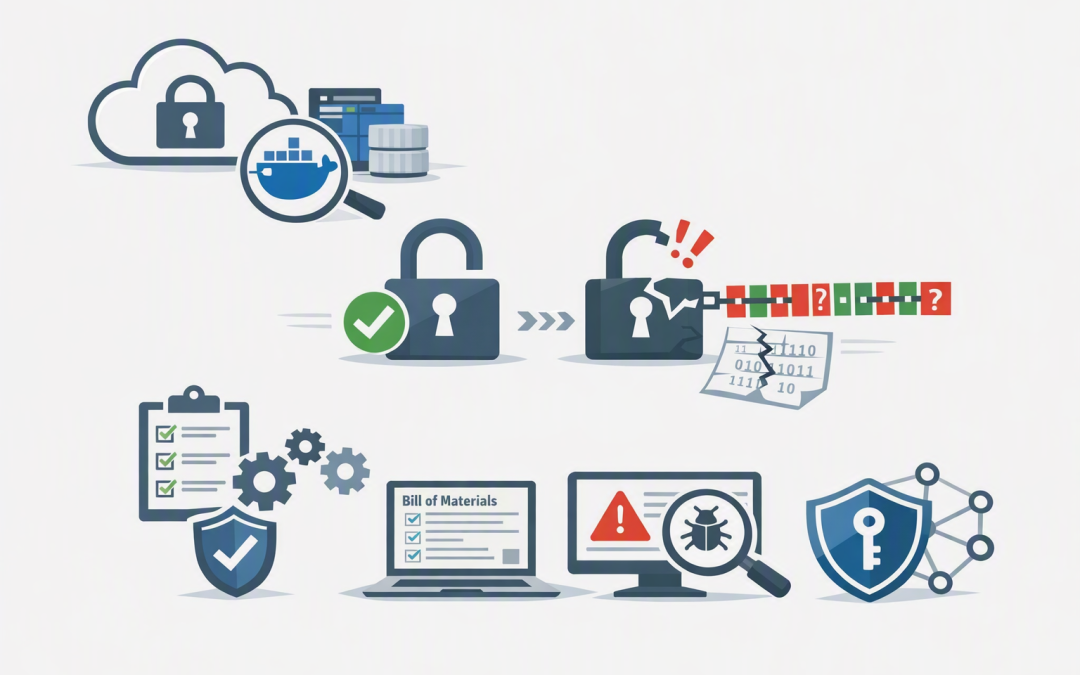
In this blog post The Azure Key Vault SDK Fix CIOs Should Ask Teams to Assess Now we will explain a critical Java software flaw, where it creates risk and what evidence CIOs should request from engineering teams.


The issue does not mean every Azure Key Vault has been compromised. It affects a specific Java software library used by some applications to work with encryption keys, and only a particular way of processing encrypted data locally. However, organisations should not dismiss it simply because Azure itself remains operational.
The business problem is visibility. Your security team may know which Azure services you use, but not which software library versions are buried inside applications, containers and third-party systems. That gap can leave a critical vulnerability running in production long after everyone assumes it has been addressed.
What Azure Key Vault does in plain English
Azure Key Vault is Microsoft’s secure service for protecting passwords, encryption keys, certificates and other sensitive information. Instead of storing a database password inside an application, for example, the application can retrieve it securely from Key Vault when needed.
The Azure Key Vault SDK is a collection of software components that developers use to connect applications to the service. SDK means software development kit. It saves engineering teams from having to create sensitive security functions from scratch.
Some Key Vault cryptographic operations are completed by the Azure service. Others can be completed locally inside the application when enough key information is available. Local processing can improve speed and reduce network calls, but it also means the SDK code running inside the application becomes part of the security boundary.
What was wrong with the Java SDK
The vulnerability is identified as CVE-2026-33117 and affects versions of the Java package com.azure:azure-security-keyvault-keys earlier than 4.10.6. Microsoft addressed the issue in version 4.10.6.
The flaw involved the local cryptographic verification path. When encrypted information is received, the software should check an authentication tag, which is a small integrity check used to confirm that the encrypted data has not been altered.
That comparison was implemented incorrectly. In affected applications, specially created encrypted input could potentially pass the local integrity check when it should have been rejected.
This is important because encryption has two jobs. It must stop unauthorised people from reading information, and it must detect if someone has tampered with that information. A weakness in the second job can undermine confidence in the first.
Operations sent to the Azure Key Vault service for processing were not affected. The exposure applies to applications using the vulnerable Java library and its local cryptographic processing. Establishing whether your systems use that path is therefore just as important as finding the package version.
Why a simple Key Vault inventory is not enough
A CIO might ask, “Do we use Azure Key Vault?” and receive a reassuring list of vaults, access controls and monitoring settings. That list will not reveal whether an application contains an affected Java dependency.
The vulnerable package could be directly included by an internal development team. It could also arrive indirectly through another component, where developers may not even realise that the Key Vault library is present.
It may be packaged inside:
- Customer portals and mobile application back ends
- Payment, identity or document-processing platforms
- Data integration services and scheduled processing jobs
- Containers running in Azure Kubernetes Service
- Vendor products developed using Java
- AI applications that encrypt prompts, files or retrieved business data
This is why an SDK vulnerability is primarily a software supply chain issue. The risk sits inside the components used to build your applications, not only in the Azure resources visible through the Azure portal.
The questions CIOs should ask engineering teams
1. Where is the package running?
Ask for a list of production, test and disaster recovery workloads containing azure-security-keyvault-keys. The answer should identify the application owner, deployed version, business purpose and type of data processed.
Do not accept “we updated the source code” as proof. The team must confirm the version inside the application or container that is actually running.
2. Do we use local cryptographic operations?
Finding an old package establishes exposure, but not the full level of risk. Engineers should determine whether the application processes cryptographic operations locally or sends them to Azure Key Vault.
Applications using CryptographyClient, locally available key information or clients that cache key material for local operations deserve closer review. The team should document the data flow rather than relying on assumptions.
3. Has version 4.10.6 or later been deployed?
For Maven projects, engineers can inspect dependencies with:
mvn dependency:tree \
 -Dincludes=com.azure:azure-security-keyvault-keys
The patched package can be set explicitly in a Maven project as follows:
<dependency>
 <groupId>com.azure</groupId>
 <artifactId>azure-security-keyvault-keys</artifactId>
 <version>4.10.6</version>
</dependency>
Teams should normally select the latest supported version that has passed compatibility testing, rather than treating 4.10.6 as a permanent target. They should then rebuild and redeploy every affected application and container.
4. Did testing prove that altered data is rejected?
A successful build is not the same as a successful security fix. Testing should confirm that encrypted data with a modified authentication tag, ciphertext or related parameter is rejected.
This gives the CIO evidence that the patched behaviour works in the organisation’s application, not merely that a version number changed in a configuration file.
5. Was the previous exposure investigated?
Upgrading closes the known software weakness, but it does not answer whether suspicious input reached the application before the update. Review application, identity, network and security logs for the relevant deployment period.
If there is evidence of attempted exploitation or unexpected cryptographic behaviour, activate the incident response process. Depending on the application, this may include key rotation, data integrity checks and an assessment of possible personal information exposure.
Australian organisations covered by the Privacy Act may also need to assess whether an incident could meet the threshold for the Notifiable Data Breaches scheme. That decision should be based on evidence and appropriate legal advice, not guesswork.
A common mid-market scenario
Consider a 200-person organisation running a Java-based customer document platform. The platform uses Azure Key Vault, passes its annual access review and appears on the company’s cloud asset register.
A dependency scan later finds that one processing service contains an older Key Vault Keys library. The development repository had already been updated, but the production container had not been rebuilt because the service was considered stable.
The practical fix is not just changing one line of code. The organisation must identify the deployed package, confirm whether local cryptography is used, test the update, rebuild the container and provide evidence that production now runs the corrected version.
That distinction can prevent weeks of uncertainty during a customer security review, cyber insurance renewal or Essential Eight assessment.
How this supports Essential Eight maturity
Patching applications is part of the Essential Eight, the Australian government’s baseline cybersecurity framework. Critical vulnerabilities involving authentication or security bypasses should be treated as priority work, even when no outage is visible.
The larger lesson is that application patching must include software libraries, container images and indirect dependencies. A monthly Windows update report will not find a vulnerable Java component embedded in a custom application.
Your engineering process should automatically scan dependencies during development, block vulnerable builds where practical and generate a software bill of materials. This is simply a searchable list of the components contained in each application.
These controls also matter as businesses connect more sensitive data to AI. Our guidance on security best practices for Azure AI services and the Microsoft security and AI checklist explains how identity, data protection and monitoring fit into the wider picture.
What good evidence looks like
A concise engineering response should include:
- A list of affected and unaffected applications
- The package version found in each deployed environment
- Confirmation of whether local cryptographic processing is used
- Proof that version 4.10.6 or later is running
- Security test results showing altered encrypted data is rejected
- Log review findings for the previous exposure period
- A plan to detect vulnerable dependencies automatically in future
This gives leadership a defensible answer. It also reduces the cost of future vulnerability reviews because the organisation is no longer starting its investigation from scratch.
The fix is small but the governance lesson is bigger
This Azure Key Vault SDK issue is limited to a particular Java package and local processing path. Yet it highlights a broader risk: cloud security depends on both correctly configured services and correctly maintained application code.
CloudProInc combines more than 20 years of enterprise IT experience with practical work across Azure, Microsoft security and Wiz cloud security. As a Melbourne-based Microsoft Partner and Wiz Security Integrator, we help organisations assess what is genuinely exposed without turning every advisory into unnecessary panic.
If you are unsure whether this library is present in your environment, or whether your current vulnerability process can find issues hidden inside application dependencies, we are happy to take a practical look with your team — no strings attached.