
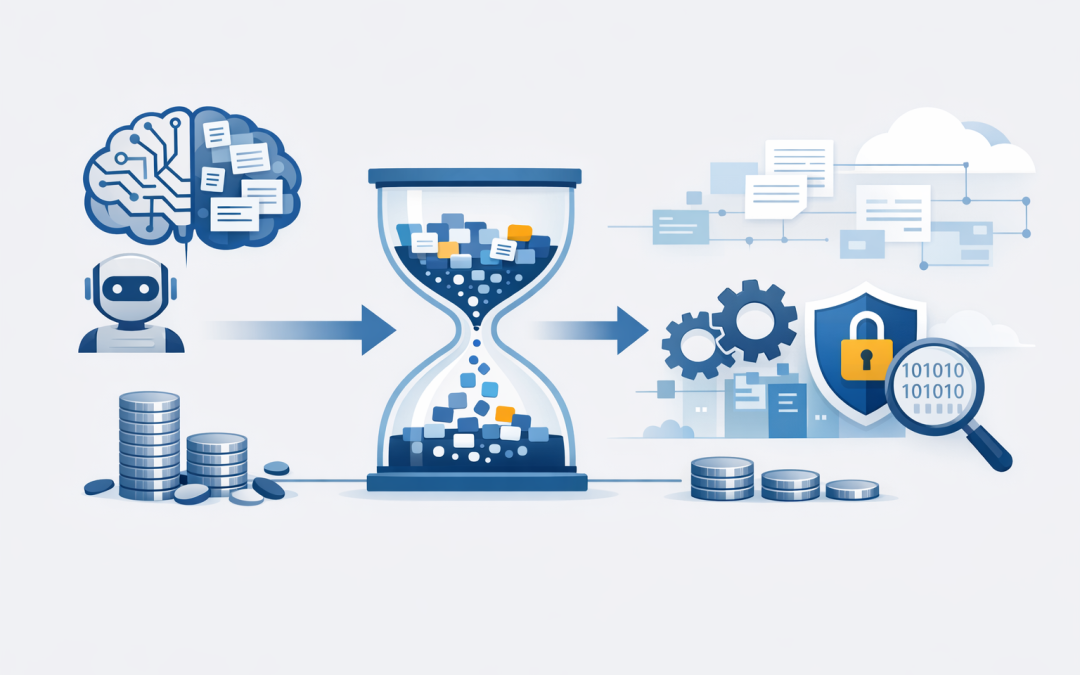
In this blog post Improving Token Efficiency in Enterprise AI Applications Today we will explain how businesses can reduce AI running costs, improve response times, and build AI tools that are easier to govern.
Many organisations start their AI journey with a promising pilot. A staff assistant answers policy questions. A sales tool drafts client emails. A support bot summarises tickets. Then usage grows, invoices rise, and no one is quite sure whether the AI is genuinely expensive or simply being used inefficiently.
That is where token efficiency matters. A “token” is a small piece of text that an AI model reads or writes. Every question, instruction, document extract, policy, conversation history, and answer is broken into tokens. In simple terms, tokens are the fuel bill for enterprise AI.
The problem is not that AI uses tokens. The problem is that many enterprise AI applications send far more information than needed on every request. A poorly designed AI assistant may resend the same long instructions, knowledge base content, security rules, and conversation history hundreds or thousands of times a day.
What token efficiency means in plain English
Token efficiency means getting the same or better business result while sending fewer unnecessary words to the AI model.
Think of it like briefing a consultant. You would not hand them a 200-page company handbook every time you asked them to write a two-paragraph client email. You would give them the relevant rules, the client context, and the outcome you want.
AI works in a similar way. The better you structure the request, the less the model has to read, the faster it can respond, and the less you pay.
For CIOs, CTOs, and IT managers, this is not just a technical tuning exercise. It affects budget control, user experience, security, and whether an AI pilot can scale across the business without becoming a cost headache.
The technology behind token efficiency
Most modern enterprise AI applications rely on large language models, often called LLMs. These are systems such as OpenAI models and Anthropic Claude that generate text, summarise information, answer questions, classify documents, and help users complete knowledge work.
When a user asks a question, the application sends the model a “prompt”. A prompt is the full instruction package. It may include the user’s question, company rules, retrieved documents, examples of good answers, security instructions, and sometimes previous conversation history.
The model reads the prompt as input tokens and generates a response as output tokens. Both matter. Long inputs cost money and can slow the system down. Long outputs can also increase cost and create review overhead.
Several practical techniques improve token efficiency:
- Prompt design means writing clear, short instructions so the model does not need repeated guidance.
- Retrieval means searching your company data first and sending only the most relevant snippets to the model, rather than dumping entire documents into the prompt.
- Prompt caching means reusing repeated instructions or context so the platform does not process the same content from scratch every time.
- Semantic caching means storing answers to common questions and reusing them when a new question has the same meaning, even if the wording is different.
- Model selection means using a smaller, cheaper model for simple tasks and reserving more powerful models for complex reasoning.
None of this means making the AI “dumber”. Done properly, token efficiency makes AI more focused, more predictable, and easier to manage.
Why token waste becomes expensive quickly
A single AI request may not look expensive. The issue is repetition at scale.
Imagine a 200-person company rolling out an internal AI assistant in Microsoft Teams. Staff use it to ask HR questions, summarise client notes, draft proposals, and search internal policies. Each request includes a large system prompt, several pages of instructions, and a chunk of company knowledge.
If that assistant is used 3,000 times a week, even small waste compounds. Re-sending the same 2,000-token instruction block every time can become a material cost. It can also make the tool feel slower, which reduces adoption.
This is one of the most common patterns we see when reviewing early enterprise AI applications. The pilot works. People like it. Then the design that was acceptable for 20 users starts to struggle with 200.
Five practical ways to improve token efficiency
1. Measure token use by business process
You cannot optimise what you cannot see. Many organisations look only at the total monthly AI bill. That is useful, but it does not tell you which workflow is driving cost.
A better approach is to track token usage by use case. For example, separate reporting for HR policy questions, customer support summaries, proposal drafting, finance analysis, and software support.
At a minimum, track input tokens, output tokens, cached tokens, response time, user department, and task type. This helps you find the business processes where efficiency improvements will have the biggest impact.
Business outcome: clearer cost allocation and faster identification of high-cost AI workflows.
2. Keep repeated instructions stable and cacheable
Many AI applications include the same base instructions in every request. These might cover tone of voice, privacy rules, escalation steps, approved data sources, and how to format answers.
If those instructions change slightly on every request, the AI platform may need to process them again. If they stay consistent, prompt caching can reduce repeated processing and improve speed.
The principle is simple: put stable content first, keep it consistent, and place changing user details later.
// Simple pattern for a more efficient AI request
// Stable instructions come first. User-specific details come last.

const stableInstructions = `
You are an internal assistant for the company.
Follow approved security and privacy rules.
Use concise business language.
If the answer is uncertain, say so and suggest escalation.
`;

const userRequest = `
User question: ${question}
Relevant department: ${department}
Retrieved policy snippets: ${relevantSnippets}
`;

const prompt = stableInstructions + userRequest;
This is not production-ready code, but it shows the design idea. The AI does not need a fresh copy of every possible policy or instruction if the application can reuse stable context and retrieve only what matters.
Business outcome: lower repeat processing costs and faster responses for common workflows.
3. Stop sending whole documents when a paragraph will do
A common mistake is giving the model too much source material. For example, a user asks, “What is our parental leave policy?” and the application sends the entire HR handbook.
A better design uses retrieval. Retrieval is a search step that finds the most relevant parts of your company data before the AI model answers. The model receives the few sections that matter, not the entire library.
This improves cost, speed, and accuracy. It also makes answers easier to audit because you can see which source snippets were used.
For regulated or security-conscious organisations, retrieval also supports better data control. You can enforce permissions so staff only retrieve information they are allowed to access.
Business outcome: fewer unnecessary tokens, better answers, and stronger access control.
4. Use the right model for the job
Not every task needs the most capable model. A high-end model may be useful for complex analysis, legal-style reasoning, or multi-step planning. It is usually overkill for simple classification, short summaries, or routing a ticket to the right team.
Good enterprise AI design often uses a mix of models. A smaller model might classify an incoming request. A stronger model might handle the final answer only when the task requires it.
This is similar to running an IT service desk. You do not send every password reset to a senior engineer. You reserve senior expertise for the work that needs it.
Business outcome: reduced AI spend without reducing the quality of important outputs.
5. Put limits around output length
Output tokens are easy to overlook. If users ask for a “detailed explanation”, the model may produce long responses that cost more, take longer to read, and sometimes create more review work.
Set clear response limits based on the task. A Teams assistant may need a 150-word answer. A board briefing may need a structured one-page summary. A technical analysis may need more detail, but only when requested.
Good prompts include instructions such as “answer in five bullet points” or “keep the response under 200 words unless the user asks for more”.
Business outcome: faster responses, lower cost, and more useful answers for busy staff.
A realistic enterprise scenario
Consider a mid-sized professional services firm with 180 staff. The business launches an AI assistant to help consultants prepare client meeting notes and draft follow-up emails.
The first version works, but each request sends a large prompt containing writing rules, compliance instructions, service descriptions, client context, and examples. As adoption grows, the tool becomes slower and the monthly AI cost becomes harder to justify.
A token efficiency review identifies three quick wins. The static writing and compliance rules are moved into a stable prompt structure. Client context is retrieved only when relevant. Long draft responses are capped unless the consultant asks for a longer version.
The user experience improves because answers arrive faster. The finance team gets clearer reporting by department and workflow. The risk team is happier because the assistant now uses approved information sources and predictable response rules.
That is the practical value of token efficiency. It is not just saving a few cents on a request. It is making AI scalable enough to use across the business.
Security and compliance still matter
Token efficiency should never mean cutting corners on security. In Australia, many organisations are working toward the Essential 8, the Australian government’s cybersecurity framework that helps reduce the risk of common attacks such as ransomware and account compromise.
AI systems should follow the same discipline. Control who can access data. Log usage. Protect sensitive information. Review prompts for privacy risks. Make sure company data is not being sent to unapproved services.
Tools such as Microsoft Defender, Microsoft Intune, Azure, and Wiz can help here. Intune manages and secures company devices. Defender helps detect and respond to threats across users, devices, and cloud services. Wiz helps identify cloud security risks before they become incidents.
For AI applications, this security layer is just as important as the model itself. A fast, cheap AI tool that exposes confidential data is not a business win.
What CloudProInc looks for in an AI efficiency review
When CloudProInc reviews an enterprise AI application, we look beyond the prompt. We assess the full path from user request to model response.
- Which business workflows are using the most tokens?
- Are repeated instructions being resent unnecessarily?
- Is the application retrieving only relevant company data?
- Are users receiving answers that are too long for the task?
- Is the right model being used for each type of work?
- Are access controls, logging, and data protection properly configured?
- Can Microsoft 365, Azure, Intune, Defender, or Wiz improve the security model?
As a Melbourne-based Microsoft Partner and Wiz Security Integrator, CloudProInc brings 20+ years of enterprise IT experience to these reviews. We work across Azure, Microsoft 365, Windows 365, OpenAI, Claude, Defender, Intune, and cloud security, so the advice is practical rather than theoretical.
Final thoughts
Enterprise AI does not have to become an unpredictable cost centre. Most token waste comes from avoidable design choices: prompts that are too long, documents that are too broad, models that are too powerful for simple tasks, and outputs that are longer than users need.
Improving token efficiency helps reduce cost, improve speed, strengthen governance, and make AI easier to scale across the organisation.
If you are not sure whether your current AI setup is costing more than it should, CloudProInc is happy to take a practical look. No hard sell, no jargon — just a clear view of where the waste, risk, and opportunities are.
Discover more from CPI Consulting
Subscribe to get the latest posts sent to your email.