
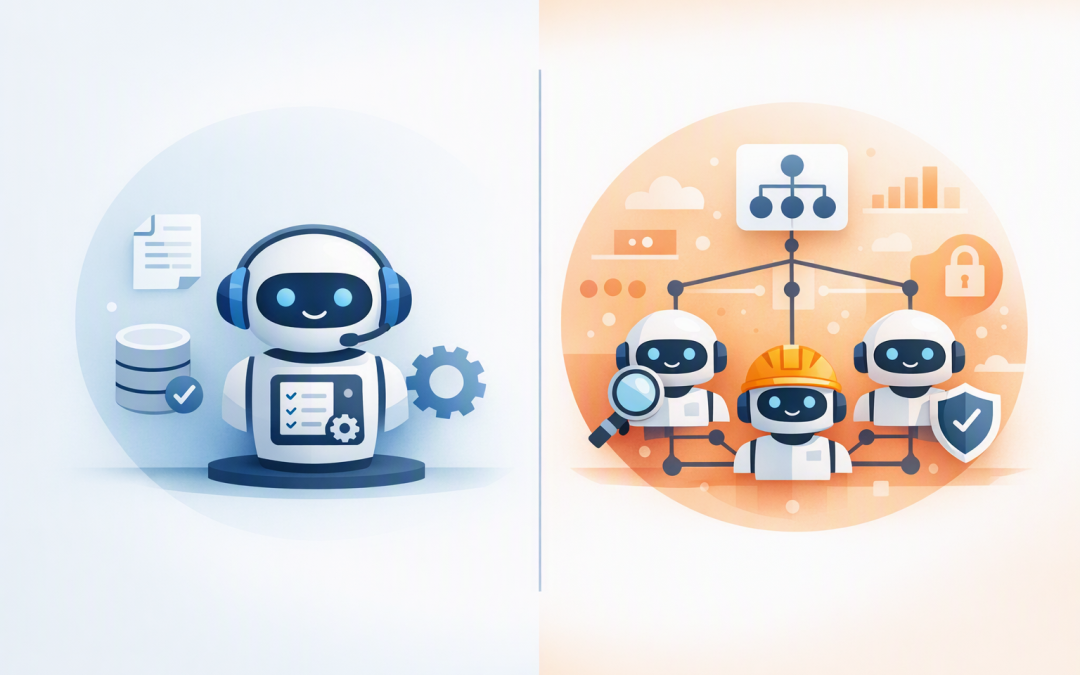
In this blog post Choosing Between Simple AI Assistants and Multi-Agent Solutions we will explain how to match the complexity of your AI setup to the business problem you actually need to solve.
Many technology leaders are being shown impressive demonstrations involving teams of AI agents working together. The natural assumption is that more agents must mean better results. In practice, that assumption can produce slower responses, higher costs, more security exposure, and a system nobody feels confident owning.
At a high level, a simple AI assistant is one digital worker handling a defined area of responsibility. A multi-agent solution is more like a team, with a coordinator assigning work to several specialist assistants. Both approaches can deliver value, but they solve different problems.
What is happening behind the screen
Most modern AI assistants are built around a large language model, which is software trained to understand and generate human language. Products and development platforms from OpenAI, Anthropic and Microsoft can provide this underlying reasoning capability.
The model is then given instructions, approved business information and tools. Those tools might allow it to search documents, read a customer record, draft an email or create a service ticket. Security rules, approval steps and activity logs should control what it can see and do.
A simple assistant uses one main set of instructions to manage this process. It may still perform several steps and connect to several systems, but one assistant remains responsible for the task and the final answer.
A multi-agent system divides the work. A coordinating agent may send contract questions to a legal specialist, pricing questions to a finance specialist and technical requirements to an engineering specialist. The coordinator then combines the results.
This coordination process is called orchestration, meaning the rules that determine which agent works, in what order and with what information. Our guide to AI agent orchestration patterns explains the main approaches in more detail.
Start with the simplest option that can do the job
The best starting point is usually not a multi-agent solution. It is the least complicated design that can reliably produce the required business outcome.
For example, imagine an internal assistant that answers staff questions about leave, expenses and company policies. If the information is stored in a controlled Microsoft 365 environment, one assistant may be able to search the approved documents and answer with links to the original policies.
Adding separate leave, expense and policy agents may sound more advanced, but it may not improve the result. It creates more instructions to maintain, more interactions to monitor and more opportunities for information to be lost between agents.
A simple assistant is often the better choice when:
- The task sits within one business area.
- The assistant uses a small number of approved systems.
- The steps are predictable and easy to test.
- One team owns the information and decisions.
- Speed, cost and consistent answers matter more than flexibility.
If you are still deciding whether the assistant should answer questions or complete work, our article on task-based and conversation-based AI agents provides a useful starting point.
When multiple agents earn their extra cost
Multi-agent solutions become useful when the work genuinely crosses different areas, permissions or types of expertise. The key word is genuinely. Organisational complexity alone is not a reason to copy your entire company structure into AI.
1. The work requires separate specialist knowledge
Consider a tender-response process. One agent could review the customer requirements, another could find approved case studies, a security agent could check compliance statements, and a commercial agent could identify pricing assumptions.
This separation can improve accuracy because each agent receives focused instructions and only the information it needs. The business outcome is faster tender preparation without expecting one general-purpose assistant to understand every department equally well.
2. Different agents need different permissions
An HR agent may need access to employee policies but not customer financial data. A finance agent may need invoice information but should not be able to read confidential HR records.
Separate agents can create clearer security boundaries. This follows the principle of least privilege, which means giving each system only the minimum access required to perform its job. It reduces the potential damage caused by an incorrect instruction, compromised account or poorly designed integration.
3. Work can happen in parallel
Some tasks become faster when specialists work at the same time. During an acquisition review, separate agents might examine contracts, security documents, software costs and operational risks concurrently before a coordinating agent prepares a summary.
This can shorten a process that previously required several teams to review documents one after another. However, the time saved must be greater than the cost of coordinating and checking all those outputs.
4. Independent checking is valuable
For higher-risk work, one agent can produce an answer while another checks it against defined rules. A contract-drafting agent, for example, could be followed by a compliance agent that flags missing clauses or unsupported claims.
This does not remove the need for human approval. It can help people focus their review on exceptions rather than reading every document from the beginning.
The hidden costs of a multi-agent system
Every additional agent introduces another model request, set of instructions, security identity and potential failure point. More agents can therefore mean higher usage costs and longer waiting times.
There is also a support cost. When the final answer is wrong, your team must determine which agent misunderstood the task, received incomplete information or passed the wrong result to another agent. That investigation is much harder without detailed activity records.
Multi-agent systems also need careful information management. Each agent should receive enough context to complete its task, but not an uncontrolled copy of every previous conversation, document and customer record.
This matters under Australian privacy requirements. Businesses should understand what personal information an AI product receives, where that information is processed, how long it is retained and whether it may be used for another purpose.
Security should also align with the Essential Eight, the Australian Government’s cybersecurity framework that many organisations use to reduce common cyber risks. Controls such as multi-factor authentication, restricted administrative access, patching and reliable backups remain important when AI is added to business systems.
A practical example for a 150-person business
Consider a 150-person professional services firm that wants AI to reduce internal administration. Its first idea is a multi-agent employee platform covering IT support, HR, finance, sales and operations.
A lower-risk approach would begin with one assistant answering common IT and policy questions using approved Microsoft 365 content. If each employee saves an average of 20 minutes per week, that represents 50 staff hours returned to the business every week.
Once the company has measured answer quality, usage, security and support effort, it can add a task-based agent for actions such as creating IT tickets. Separate HR or finance agents should only be added when different data access, ownership or approval requirements make the separation worthwhile.
This staged approach produces evidence before major investment. It also prevents the company from spending months building an impressive AI architecture that employees do not use.
Five questions to ask before choosing
- What measurable problem are we solving? Define the hours saved, delays reduced, risks controlled or service improvement expected.
- Can one assistant handle the work reliably? Test the simplest design before introducing coordination between agents.
- Do we need separate information or permission boundaries? If not, multiple agents may add structure without adding protection.
- How will we monitor cost and quality? Track usage, response time, errors, human corrections and business outcomes.
- Who owns the system after launch? Assign responsibility for instructions, access, testing, security reviews and changes.
If the solution will connect agents across different platforms or organisations, you may also need standards that let them exchange tasks securely. Our article on interoperable AI agents using A2A and Microsoft Agent Framework explores that next level of design.
Build capability in stages
A sensible AI roadmap often starts with a secure assistant, adds controlled tools, and only then introduces specialist agents where the business case is clear. You can see a practical example in our guide to building a multi-agent assistant with the OpenAI Agents SDK.
You will also need to decide whether to develop the solution internally or use an existing platform. Our build-or-buy guide for AI agents explains how support, intellectual property, integration and long-term cost should influence that decision.
Choose business value over architectural ambition
A simple assistant is not a lesser solution. If it saves employees time, provides consistent information and can be operated securely, it may deliver a better return than a complex network of agents.
Multi-agent solutions are valuable when they provide meaningful specialisation, safer permission boundaries, parallel work or independent checking. They should be introduced because the workflow requires them, not because the technology is fashionable.
CloudProInc brings more than 20 years of enterprise IT experience to these decisions. As a Melbourne-based Microsoft Partner and Wiz Security Integrator, we help organisations connect AI from OpenAI, Claude and Microsoft to Azure and Microsoft 365 while using tools such as Microsoft Defender and Wiz to manage security risk.
If you are not sure whether your AI plans need one assistant or a coordinated team of agents, we are happy to review the use case and help you find the simplest path to a measurable result, with no strings attached.
Discover more from CPI Consulting
Subscribe to get the latest posts sent to your email.