
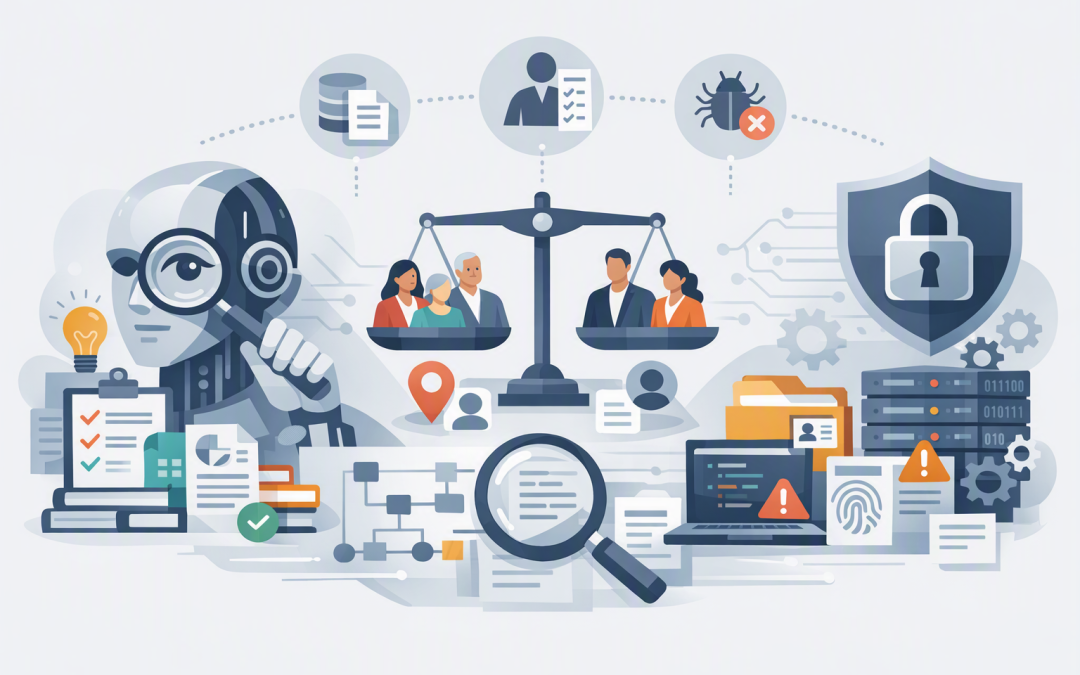
In this blog post How to Audit AI Systems for Accuracy Bias and Security Risks we will explain how to find costly mistakes, unfair outcomes and security gaps before they affect customers, employees or your reputation.


Many AI systems look impressive during a demonstration. The trouble starts when employees depend on them for real work. Answers may sound confident but be wrong, some groups may receive poorer results, or sensitive company information may become visible to the wrong person.
At a high level, an AI audit compares what the system is supposed to do with what it actually does. It tests the technology, the information feeding it, the people using it and the controls surrounding it. The goal is not perfect AI. It is reliable AI with risks the business understands and can manage.
Understand what you are actually auditing
An AI system is more than an AI model such as OpenAI or Anthropic Claude. It usually includes instructions, company data, software connections, user permissions, security controls and a process for employees to review results.
For example, an internal assistant might use a large language model, which is technology trained to understand and produce human-like text. It may also use retrieval-augmented generation, or RAG, which means finding relevant information in your approved business documents before preparing an answer.
If the answer is wrong, the model may not be the main problem. The system may have retrieved an outdated policy, received unclear instructions or accessed a document the user should never have seen.
A useful audit therefore examines three connected areas:
- Accuracy: Does the AI produce dependable answers based on approved information?
- Bias: Does it deliver consistently poorer or unfairer outcomes for particular groups?
- Security: Can someone manipulate the system, extract sensitive data or make it perform an unauthorised action?
Start with the business decision at risk
Do not begin by running hundreds of technical tests without knowing what matters. Start by documenting the business purpose, the users and the consequences of failure.
An AI tool that rewrites internal emails presents relatively low risk. A tool that recommends job candidates, approves customer refunds or summarises safety procedures needs much stronger testing and human oversight.
Record the decisions the AI supports, who is accountable and when a person must review its work. This gives executives a clear definition of acceptable risk and stops the audit becoming a technical exercise with no business outcome.
If these responsibilities are unclear, our guide on building an AI audit framework executives can trust provides a practical starting point.
Build an accuracy test using real business questions
Accuracy testing should reflect how employees and customers actually use the system. Create a controlled test pack containing normal questions, unusual requests, incomplete information and questions the AI should refuse to answer.
Each test needs an approved expected result. A legal, HR, finance or operations specialist should confirm that result rather than leaving the technology team to decide whether an answer merely sounds reasonable.
Measure more than right and wrong
Your scorecard should examine:
- Whether the response is factually correct.
- Whether it is supported by approved company information.
- Whether important context or warnings are missing.
- Whether the AI admits when it does not know.
- Whether repeated tests produce acceptably consistent results.
- Whether a human can trace the answer back to its source.
Microsoft tools can test groundedness, which means checking whether an AI answer is supported by the source material supplied to it. This helps detect invented claims, but automated scores should support rather than replace expert review.
Test bias against relevant business groups
Bias is not limited to offensive language. It can appear when an AI system consistently produces worse results for people based on gender, age, disability, location, cultural background or another characteristic.
A recruitment assistant might describe identical experience differently after a candidate’s name changes. A customer service tool may misunderstand certain writing styles. A sales system may favour metropolitan customers because its historical information contains fewer regional examples.
Use matched tests where only one characteristic changes. Compare the recommendations, tone, error rate and level of service. Testing should focus on groups relevant to the use case rather than relying on one generic fairness score.
Involve business owners, HR, legal and people familiar with affected customers. A technically accurate system can still create an unacceptable business or reputational outcome.
Try to break the AI before an attacker does
AI security testing asks what happens when a user, document or connected system gives the AI malicious instructions. One common threat is prompt injection, where hidden or direct instructions attempt to override the AI’s approved rules.
Other risks include confidential information appearing in answers, excessive access to Microsoft 365 files, unsafe software connections and poisoned data. Poisoned data means information has been deliberately changed to influence what the AI says or does. Australian cyber guidance highlights data supply chains, maliciously modified data and data drift as important AI security concerns.
Include these practical security checks
- Ask the AI to reveal confidential instructions, customer records or system information.
- Place misleading instructions inside a test document and check whether the AI follows them.
- Confirm that users can only retrieve information they already have permission to access.
- Test whether the AI can trigger emails, file changes or business transactions without approval.
- Review administrator access, software connections, logs and stored credentials.
- Check how the system responds when its data source or AI provider is unavailable.
The Essential Eight, the Australian government’s cybersecurity framework that many organisations use to reduce common attacks, remains an important foundation. Controls such as multi-factor authentication, patching, restricted administrator access and application control protect the wider environment around the AI system.
However, the Essential Eight is not a complete AI audit. AI-specific testing is still required because the system may be secure at the infrastructure level while producing unsafe answers or exposing information through poorly designed permissions.
Review privacy and data handling
Your audit should identify what information enters the AI, where it is processed, how long it is retained and whether it is used to improve a third-party model. This includes information employees paste into public AI tools without approval.
For Australian organisations covered by the Privacy Act, existing privacy obligations still apply when commercially available AI products handle personal information. The Office of the Australian Information Commissioner expects organisations to understand these data flows rather than assuming the AI provider carries all responsibility.
Check vendor terms, data locations, retention settings and deletion processes. Collect only the information required for the business task and mask personal or commercially sensitive details wherever possible.
Keep evidence that leaders and auditors can understand
An AI audit should produce more than a lengthy report. Keep an evidence trail showing the model and version tested, the instructions used, the information retrieved, the results, the person who approved them and any corrective actions.
If the AI can take actions, record what it attempted, what it completed and whether a person approved it. This becomes especially important for AI agents, which are systems able to complete multi-step tasks rather than simply answer questions.
Our article on building audit-ready AI agents securely explains how evidence trails, controlled memory and cost tracking support accountability.
A practical audit scenario
Consider a 180-person professional services company using an AI assistant to search Microsoft 365 and draft client proposals. Routine answers look good, so management plans to make the tool available to every employee.
An audit finds three issues. Some answers use superseded proposal templates, regional examples receive less complete responses, and users can discover information from folders with overly broad permissions.
The company limits the assistant to approved document libraries, corrects Microsoft 365 permissions, expands the test data and requires source links in every important answer. High-value proposals also require human approval.
The outcome is not just a safer AI tool. The business avoids rework, reduces the chance of confidential information reaching the wrong person and gains evidence that the assistant is ready to scale.
Treat the audit as a repeatable business control
An audit is a snapshot, not a permanent certificate. Models change, company information becomes outdated and employees find new ways to use the system.
Run key tests whenever the model, instructions, connected data, permissions or business purpose changes. Review a sample of real outputs regularly and track accuracy problems, security events, user complaints, manual corrections and operating costs.
This is why AI auditing must continue after the system goes live. Ongoing checks help detect declining quality before it becomes a customer, compliance or financial problem.
Turn the findings into clear business decisions
A strong audit should let leadership answer five questions:
- Is the AI producing enough reliable value to justify its cost?
- Which tasks are safe to automate?
- Where is human review still required?
- What security, privacy or fairness issues must be fixed?
- Can we prove that appropriate controls are operating?
CloudProInc combines more than 20 years of enterprise IT experience with hands-on knowledge of Azure, Microsoft 365, OpenAI, Claude, Microsoft Defender and Wiz. As a Microsoft Partner and Wiz Security Integrator based in Melbourne, we assess the AI application and the cloud environment supporting it rather than reviewing either in isolation.
If you are unsure whether an AI system is accurate, fair or properly secured, we are happy to take an independent look before a small weakness becomes an expensive problem. No strings attached.
Discover more from CPI Consulting
Subscribe to get the latest posts sent to your email.