
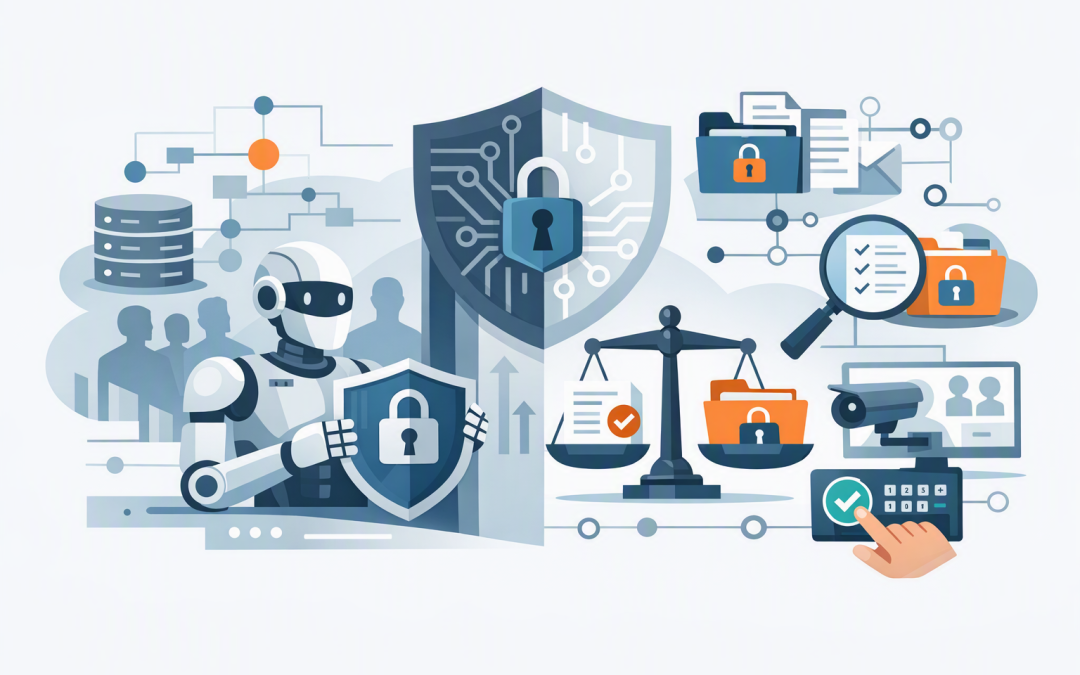
In this blog post Why Security and Governance Matter in Forward Deployed Engineering we will explain how businesses can move quickly with AI without creating avoidable security, privacy and compliance problems.


The risk often appears after a successful pilot. An AI assistant saves employees time, leaders want it rolled out, and the project moves from a controlled test to systems containing customer records, contracts, financial information and internal communications.
That is where security and governance become critical. A forward deployed engineer works closely with your people, data and business processes to turn an AI idea into a working system. Governance provides the rules for what that system may do, while security enforces those rules in practice.
What forward deployed engineering actually involves
Forward deployed engineering places an experienced engineer close to the business problem rather than behind a distant development queue. They work with operational teams, technology leaders and security stakeholders to understand the workflow, build the solution and improve it using real feedback.
This close working model is valuable because AI projects rarely fail because the language model cannot generate an answer. They fail because the system uses the wrong data, does not fit the workflow, gives users excessive access or has no clear owner when something goes wrong.
As we covered in how forward deployed engineers align business and technology teams, the role connects technical delivery to commercial priorities. Security and governance ensure that connection remains safe as the system grows.
The technology behind a forward deployed AI solution
Most business AI solutions have several connected layers. Employees may see a simple chat window, search tool or automated workflow, but much more is happening underneath.
- The user interface gives employees a controlled way to interact with the system.
- The identity layer confirms who the user is and what they are allowed to access. Microsoft Entra ID, for example, can use existing company accounts and access rules.
- The data layer connects approved sources such as SharePoint, databases, document libraries or business applications.
- The AI model, such as Azure OpenAI or Anthropic Claude, interprets requests and produces responses.
- The orchestration layer controls how the model searches for information, calls other systems and completes tasks.
- The monitoring layer records activity, identifies unusual behaviour and helps the business investigate errors or security incidents.
Many systems also use retrieval-augmented generation, commonly called RAG. In plain English, this means the AI searches approved company information and includes relevant material when preparing an answer, rather than relying only on its general training.
Each connection creates a potential risk. If permissions are too broad, the AI may reveal information the employee should not see. If actions are not restricted, an AI agent could update a record, send a message or start a process without appropriate approval.
Security must be designed before the pilot becomes popular
A common mistake is treating security as a final review. The team builds the application, demonstrates impressive results and then asks security staff to approve it just before launch.
At that point, fixing weak access controls or poor data handling can require major changes. The faster and less expensive approach is to define security boundaries before development begins.
A senior forward deployed engineer should establish which information the solution needs, where that information is stored, who may access it and whether the AI is allowed to take action. This keeps the project focused and reduces the amount of sensitive data exposed to the system.
The Australian Signals Directorate recommends considering security throughout AI design, development, deployment and ongoing operation. This lifecycle approach matters because an AI system continues to change as models, data sources, integrations and user behaviour evolve.
Governance is more than an acceptable use policy
An AI policy is useful, but a document sitting in SharePoint will not stop an unsafe action. Effective governance needs clear ownership and controls built into the technology.
Every production AI system should answer five basic questions:
- Who owns the business outcome? Someone must be accountable for whether the system is useful and appropriate.
- What data may it use? Approved sources should be documented, classified and reviewed.
- What decisions may it influence? Higher-risk decisions require stronger review and human oversight.
- What actions may it perform? Reading a policy document presents less risk than issuing a refund or changing payroll data.
- How will performance be monitored? The business needs records of access, errors, costs, unusual activity and user feedback.
This structure does not need to create months of paperwork. A practical forward deployed engineer turns it into short design decisions, approval gates and automated controls that support delivery rather than slowing it down.
Give AI only the access it genuinely needs
AI agents can now perform multi-step tasks across different systems. That makes them useful, but it also means an over-permissioned agent can create a larger problem than an inaccurate chatbot answer.
The key principle is least privilege. This means each user, application and AI agent receives only the access required for its specific job. An invoice assistant, for example, may need to read approved invoices but should not automatically receive permission to change supplier bank details.
Microsoft’s current security guidance extends identity and access controls to AI agents, tools and non-human system identities. It also recommends defining identity, scope, tool access, audit records and revocation processes before increasing an agent’s autonomy.
Protect the data, not just the AI model
The model usually receives most of the attention, but the underlying data is often the greater business risk. Poorly classified files, old permissions and uncontrolled copies can allow an AI application to surface information that was already exposed inside the environment.
This is why an AI project may need work across Microsoft 365, Azure, Intune, Defender, Purview and cloud security platforms such as Wiz. Purview helps organisations discover, classify and protect information, while Defender and Wiz can provide visibility into cloud risks and suspicious activity.
For Australian businesses, privacy obligations must also be considered before personal information enters an AI workflow. The Australian Privacy Principles require covered organisations to take active measures to secure personal information, and the Office of the Australian Information Commissioner recommends avoiding personal or sensitive information in publicly available AI tools because of the privacy risks.
Essential 8 remains part of the foundation
The Essential 8 is the Australian government’s cybersecurity framework designed to make common attacks harder. It covers practical protections including multi-factor authentication, software patching, restricted administrator access, application control and reliable backups.
Essential 8 does not provide a complete AI governance framework. However, weak identity controls, unpatched systems or excessive administrator access can undermine even a well-designed AI application.
A forward deployed engineer should therefore work within your existing Essential 8 target maturity level rather than creating an isolated AI environment. This reduces duplicated controls, supports compliance reporting and makes the solution easier for your internal team or managed provider to operate.
A practical business scenario
Consider a 200-person professional services business building an AI assistant to help employees find policies, prepare client responses and summarise project documents. The pilot works well, but the company’s SharePoint permissions have accumulated over many years.
Connecting the assistant to every available document would be quick, but it could expose salary reviews, legal files or confidential client material through ordinary employee questions.
A security-led forward deployed approach starts by mapping the approved data, correcting permissions and requiring employees to sign in with their company identity. Sensitive documents are labelled, responses are logged, and human approval is required before the assistant sends anything externally.
The business still gains faster document searches and less repetitive work. More importantly, it avoids turning an efficiency project into a privacy incident.
What good security and governance deliver
Security should not be measured by the number of controls added. It should be measured by whether the business can use AI confidently, recover from problems and explain how important decisions are made.
Done well, security and governance provide four clear outcomes:
- Lower financial risk by reducing the likelihood and impact of data exposure or unauthorised actions.
- Faster production deployment because security requirements are resolved during development rather than discovered before launch.
- Better compliance evidence through documented approvals, access records and monitoring.
- Greater employee trust because people understand what the system can do, what information it uses and when a human remains responsible.
This builds on the approach discussed in how forward deployed engineers reduce AI project risk. The goal is not to remove every possible risk. It is to make risks visible, controlled and proportionate to the value of the project.
Move quickly without losing control
Forward deployed engineering works because it brings experienced technical delivery close to the people doing the work. Without security and governance, however, that speed can create uncontrolled access, privacy concerns and systems nobody is prepared to own.
With more than 20 years of enterprise IT experience, CloudProInc combines practical AI delivery with Microsoft cloud and cybersecurity expertise. As a Microsoft Partner and Wiz Security Integrator, our Melbourne-based team helps organisations connect Azure, Microsoft 365, OpenAI, Claude, Defender, Purview and Wiz within a security model that supports real business outcomes.
If you are considering a forward deployed AI project and are not sure whether your data, permissions and governance are ready, CloudProInc is happy to take a practical look at the current environment — no strings attached.