
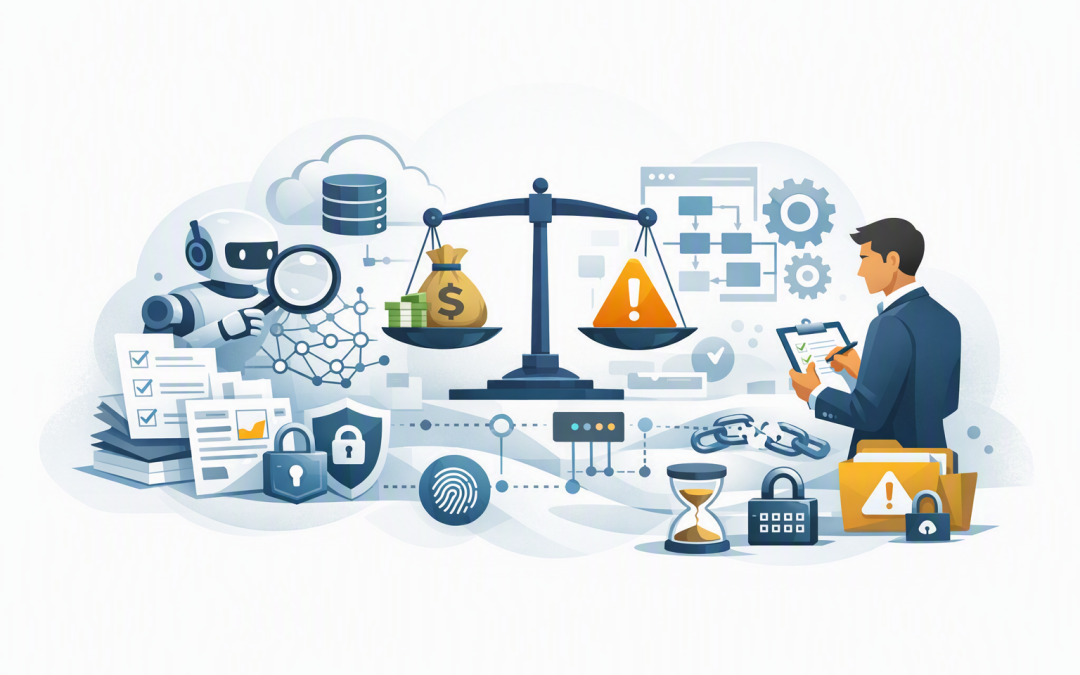
In this blog post Why Independent AI Auditing Protects Growth and Reduces Risk we will explain why an impartial review can be the difference between AI that creates measurable value and AI that quietly increases cost, exposure and executive uncertainty.


Many leadership teams are being told their AI rollout is going well. Staff are using the tools, demonstrations look impressive and no major incidents have been reported. Yet basic questions about return on investment, sensitive data, output accuracy and accountability often remain unanswered.
An independent AI audit gives decision-makers a view that is not shaped by the team that built the system, the vendor selling it or the business unit trying to justify its budget. It tests the evidence behind the claims and turns technical findings into practical business decisions.
What makes an AI audit independent
Independence does not mean bringing in an outsider who knows nothing about your business. It means the reviewer is free to challenge assumptions, report uncomfortable findings and recommend that a project be changed, paused or stopped.
The auditor should not be grading their own work. Their fee should not depend on selling more licences, increasing cloud consumption or reaching a predetermined conclusion.
A credible independent reviewer should have:
- No incentive to protect the original implementation.
- Direct access to system settings, documentation, contracts and usage records.
- Experience across AI, cloud services, identity, privacy and cybersecurity.
- A clear method for rating risks and business value.
- The ability to explain findings to executives without hiding behind technical language.
This impartiality is particularly valuable when a technology provider has designed, implemented and assessed the same system. Even capable teams can miss weaknesses when they are too close to the project.
The technology behind an AI audit
Business AI is rarely one self-contained product. A tool such as Microsoft 365 Copilot, Azure OpenAI or Anthropic Claude usually sits on top of several connected layers.
The AI model generates or analyses content. Company documents and databases may provide additional context. Identity systems decide who can access information, while connectors and application programming interfaces allow different software platforms to exchange data.
An audit examines how these layers work together. It follows the path from an employee entering a request, through the information the AI can retrieve, to the answer shown to the user and the activity recorded in system logs.
This matters because a model can be working exactly as designed while still exposing information. For example, an AI assistant may reveal an old salary document because the employee technically had access to the file, even though nobody realised that permission existed.
Testing therefore covers more than whether the AI provides a sensible answer. It examines access permissions, data handling, security settings, human approvals, output quality, monitoring and cost controls.
The business case goes beyond compliance
1. It stops weak projects consuming good money
AI spending can spread quickly across software subscriptions, consulting, cloud usage and internal staff time. Without independent measurement, activity can easily be mistaken for value.
An audit compares the original business case with actual results. Are employees completing work faster? Has service quality improved? Are people using the paid features regularly, or are licences sitting idle?
Consider a hypothetical 180-person professional services company paying A$45 per user each month for 120 AI licences. If only 35 employees use the tool regularly, the unused licences represent A$45,900 in annual spending before implementation and support costs are considered.
An independent review may recommend reducing licences, improving training or moving the budget to a use case with a stronger return. The goal is not to cut AI spending automatically. It is to spend where the results justify it.
2. It finds risks that project reporting can hide
Internal status reports usually focus on progress, adoption and delivery milestones. They may not reveal that employees are entering customer information into unapproved tools or that an AI workflow can access more data than it needs.
An independent auditor deliberately looks for failure paths. This includes privacy exposure, incorrect answers, excessive access, missing approvals, unreliable source data and weak controls over third-party providers.
These findings often sit outside the AI platform itself. Microsoft Intune, which manages and secures company devices, may show that unmanaged personal devices can reach the service. Microsoft Defender, which detects suspicious activity and cyber threats, may reveal gaps in monitoring. Wiz, a cloud security platform, may identify exposed data or risky connections in an Azure environment.
This is why AI cannot be audited in isolation. For a deeper look at the issues that can be missed, see the hidden business risks an enterprise AI audit can uncover.
3. It gives executives evidence they can defend
Boards do not need hundreds of pages describing model settings. They need clear answers about ownership, financial value, major risks and the work required to bring those risks within an acceptable level.
A strong independent audit creates an evidence trail. It records what was tested, what information was reviewed, what failed and who accepted any remaining risk.
This supports customer assurance, insurer questions, procurement reviews and regulatory discussions. It also helps organisations align their AI practices with Australian privacy obligations and government guidance for responsible AI adoption.
The Essential 8, the Australian Government’s baseline cybersecurity framework, does not replace AI governance. However, controls such as stronger sign-in protection, timely software updates and restricted administrator access provide an important security foundation for AI systems.
4. It helps management make faster decisions
AI projects often slow down because nobody can confidently say whether they are safe enough to expand. Legal, IT, security and operations teams may each hold part of the answer, but no one has the complete picture.
An independent audit brings that evidence together. Instead of a vague yes-or-no recommendation, executives receive practical options such as proceeding with low-risk teams, restricting sensitive data, adding human approval or delaying a high-impact workflow.
This builds on the governance model discussed in who should own AI governance and accountability. Management retains responsibility, while the auditor provides the evidence needed to exercise it.
5. It protects your ability to change direction
AI services are developing quickly. A system chosen today may become too expensive, fail to meet future requirements or be overtaken by a better option.
An independent review examines whether your organisation can change providers without losing critical data, workflows or control. It also checks whether contracts clearly address information use, retention, deletion, service changes and responsibility when something goes wrong.
This reduces the risk of becoming dependent on one vendor simply because leaving has become too difficult.
What a useful independent audit should deliver
The final report should be a decision tool, not a technical document that sits unread. At minimum, it should include:
- An AI inventory showing approved and unapproved tools, owners, users, data sources and providers.
- A business-value assessment comparing cost, adoption and measurable outcomes.
- A risk rating covering privacy, security, output reliability, legal exposure and operational impact.
- Evidence-based findings that explain what was tested and why it matters.
- A prioritised action plan separating urgent issues from longer-term improvements.
- A retesting schedule because models, data, users and provider settings will continue to change.
Organisations that need a repeatable structure can also review how to build an AI audit framework executives can trust. Once a system is operating, ongoing AI auditing becomes equally important.
When should you commission an independent review
An independent audit is especially useful before expanding a trial, connecting AI to sensitive information or allowing it to influence decisions about customers, employees, finance or safety.
It is also worth considering when the board wants stronger assurance, a customer requests evidence of responsible AI use, costs are rising without clear results or the original provider is the only party reporting on success.
Independent assurance creates room for confident growth
The strongest business case for independent AI auditing is not fear. It is clarity. Leaders can invest more confidently when they know which projects are producing value, which risks need attention and which claims are supported by evidence.
CloudProInc brings more than 20 years of enterprise IT experience to this work. As a Microsoft Partner and Wiz Security Integrator, our Melbourne-based team understands how AI connects with Azure, Microsoft 365, OpenAI, Claude, identity, devices and cybersecurity controls across Australian and international environments.
We take a practical, hands-on approach rather than treating an audit as a box-ticking exercise. If you are unsure whether your AI program is delivering the value and control being reported, we are happy to take an independent look and explain what we find in plain English, with no strings attached.