
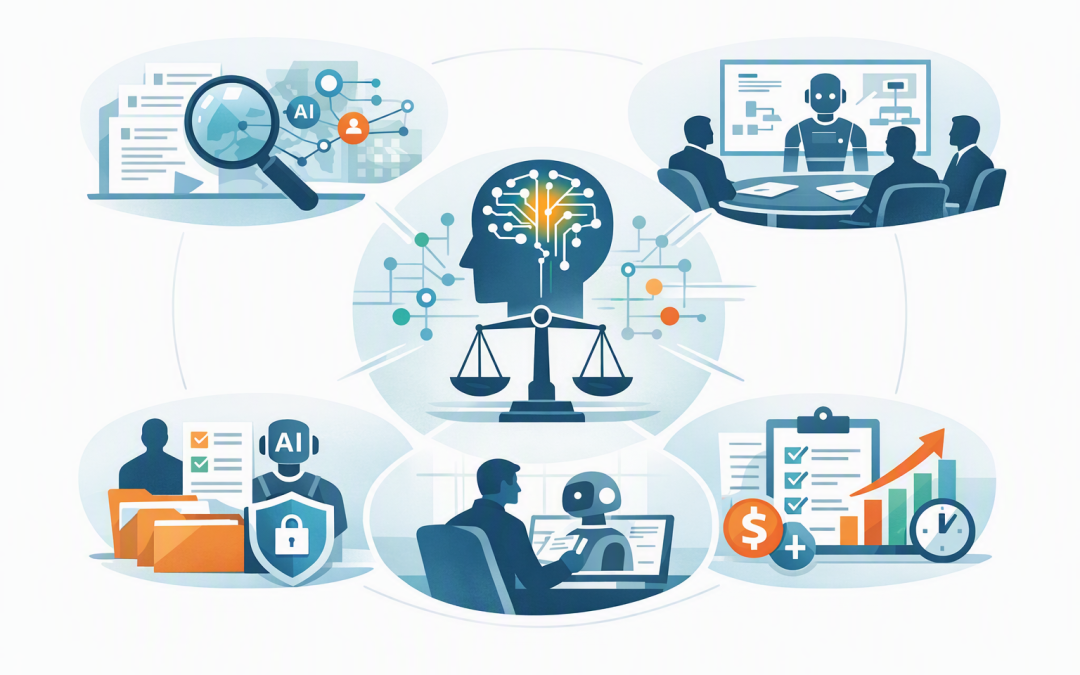
In this blog post What Boards Need to Know About AI Governance and Accountability we will explain what directors should oversee, what management must report and how to stop useful AI projects becoming unmanaged business risks.
Many boards have approved AI investment without having a clear view of what happens next. Employees are using public AI tools, software vendors are adding AI features automatically, and business teams are testing automated assistants with company data.
The issue is not whether AI should be used. The issue is whether anyone can confidently explain where it is being used, what information it can access, who checks its work and who is accountable when something goes wrong.
AI governance in plain English
AI governance is the set of rules, responsibilities and checks that control how an organisation selects, builds, buys and uses artificial intelligence. It is similar to financial governance: the board does not approve every invoice, but it expects clear authority, reliable reporting and controls against misuse.
The underlying technology matters because modern AI does not simply follow fixed instructions. Systems such as Microsoft Copilot, OpenAI and Anthropic Claude use models trained to identify patterns in large amounts of information and generate a likely response to a user’s request.
An AI agent goes further. It can use connected business systems to complete multiple steps, such as reading an email, checking a customer record, drafting a response and updating a workflow. That creates productivity gains, but it also means a mistake can travel further before a person notices.
Boards do not need to understand the mathematics behind these models. They do need to understand the flow of information, the decisions being influenced and the controls placed between an AI-generated recommendation and a real business action.
The board remains accountable even when AI is outsourced
A common assumption is that risk sits with Microsoft, OpenAI, Anthropic or another technology provider. Those companies are responsible for their platforms, but your organisation remains responsible for how the technology is configured and used.
If an AI recruitment tool unfairly rejects candidates, a customer chatbot exposes private information or an automated pricing system disadvantages a group of customers, the board cannot simply point to the software vendor.
Existing Australian privacy, consumer protection, employment, discrimination, copyright and corporate laws may still apply. Australia’s AI guidance also places strong emphasis on accountability, risk assessment, data protection, testing, human oversight, transparency and record keeping.
Organisations should also prepare for automated decision-making transparency obligations commencing on 10 December 2026. These obligations may require covered organisations to explain in their privacy policies how computer programs use personal information to make decisions that significantly affect people’s rights or interests.
Five questions every board should be asking
1. Where are we already using AI
Before approving another project, ask for an AI register. This should list approved AI tools, experimental systems, AI features embedded in existing software and any automated process that influences decisions.
The register should identify the business owner, purpose, information accessed, users affected, technology provider and risk level. Without this basic inventory, the board is governing an unknown environment.
2. Who owns each business outcome
The CIO can manage technology controls, but should not carry every AI risk. A human resources executive should own an AI-assisted recruitment process, while the finance leader should own an AI system used for forecasting or credit decisions.
Each AI use case needs one named executive who is responsible for its outcome. Technology, legal, privacy and security teams support that owner rather than replacing them.
3. Which decisions must remain human
Not every AI output needs manual approval. Using AI to summarise an internal meeting is very different from allowing it to reject a job applicant, approve a payment or provide health-related advice.
Boards should require risk tiers. Low-risk uses can move quickly, while systems affecting people, money, safety, legal rights or sensitive information need stronger testing and meaningful human review.
Meaningful review means the person has enough information, authority and time to challenge the AI. A manager clicking “approve” on hundreds of recommendations is not genuine oversight.
4. Can management prove the controls work
A policy document is not evidence that AI is safe. Boards should ask how access is restricted, how sensitive information is protected, how outputs are tested and how unusual activity is detected.
This is where existing technology controls become important. Microsoft Entra ID manages user identities and access. Microsoft Intune manages and secures company devices, while Microsoft Defender and Wiz identify security weaknesses and suspicious activity across cloud environments.
The Australian government’s Essential Eight, a cybersecurity framework that many organisations use to reduce common attacks, also provides an important security foundation. It does not replace AI governance, but weak access control, unpatched software and excessive administrator privileges will make any AI deployment harder to trust.
5. How will we know whether AI is worth the risk and cost
Boards should not accept activity as a measure of success. The number of Copilot licences issued or AI pilots launched says little about business value.
Ask for measures tied to outcomes, such as hours saved, faster customer response times, fewer processing errors, lower support costs or improved sales conversion. These should be considered alongside incidents, incorrect outputs, privacy concerns, user complaints and the amount of work still requiring human correction.
What useful board reporting looks like
A practical AI dashboard does not need to be lengthy. It should help directors see whether adoption, value and risk are moving in the right direction.
- AI inventory: Approved systems, trials, retired tools and any unapproved services discovered.
- Risk profile: High-risk use cases, outstanding assessments and controls that have not been completed.
- Business value: Measured savings, productivity gains, service improvements and total operating costs.
- Data exposure: The types of company, customer and employee information available to each system.
- Incidents: Incorrect decisions, confidential data exposure, security events, complaints and near misses.
- Accountability: The executive owner for every material system and the date of its next review.
This reporting should connect with existing cyber, privacy and operational risk reporting. AI should not become a separate governance island that directors only discuss during an annual strategy session.
A scenario boards should recognise
Consider a 200-person professional services business where different teams begin adopting AI independently. Marketing uses a public writing tool, sales adds an AI meeting assistant, human resources tests candidate screening, and finance experiments with automated invoice processing.
Each project appears small. Together, they create multiple subscriptions, overlapping functions, unclear data handling and no agreed process for checking results.
A sensible response is not to ban everything. The business creates an AI register, removes duplicate tools, approves enterprise versions with better data protection and assigns an executive owner to each important use case.
Low-risk productivity tools proceed quickly. Recruitment and finance systems receive additional testing, documented human review and regular performance checks. The result is lower software waste, faster approval of worthwhile projects and clearer accountability when questions arise.
Governance should enable progress rather than stop it
Poor governance slows AI adoption because every project becomes a new debate. Good governance gives teams a known path from idea to approval, with requirements based on the level of risk.
For a practical rollout approach, see why businesses need governance before Copilot and AI agent rollouts. Organisations planning more autonomous systems can also use our enterprise AI agent governance checklist.
As the number of models and AI services grows, central oversight also becomes more important. Our guide to Microsoft AI Foundry and unified AI governance explains how technology leaders can gain better visibility across models, deployments and risk.
What the board should request next
- Prepare an inventory of every approved, experimental and unapproved AI system.
- Assign a business owner and risk rating to each material use case.
- Define which decisions require human review or cannot be automated.
- Confirm privacy, security, testing, record-keeping and incident response controls.
- Report measurable value and risk to the board at an agreed frequency.
The goal is not perfect control before anyone can use AI. It is to make deliberate decisions, keep evidence and ensure the organisation can explain what its systems are doing.
CloudProInc brings more than 20 years of enterprise IT experience to this work. As a Melbourne-based Microsoft Partner and Wiz Security Integrator, we help organisations connect AI governance with practical controls across Microsoft 365, Azure, OpenAI, Claude, Defender, Intune and Wiz.
If your board is asking who is accountable for AI and the answer is still unclear, we are happy to review your current position and identify the most important next steps — no strings attached.
Discover more from CPI Consulting
Subscribe to get the latest posts sent to your email.