
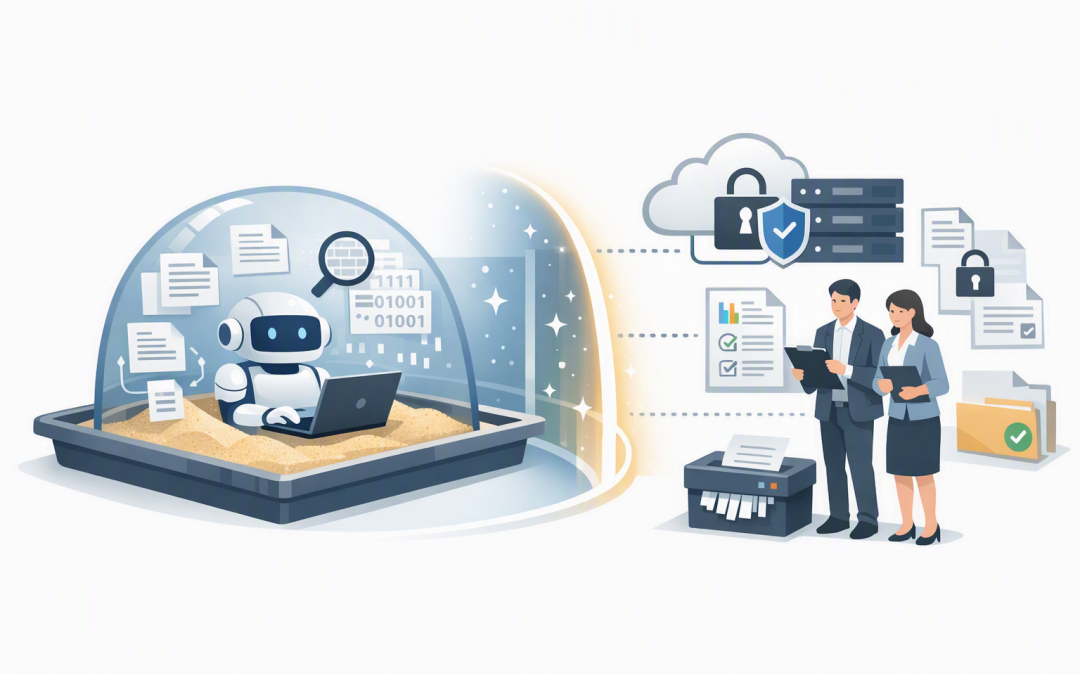
In this blog post How Sandbox Agents Speed Up Secure Data Room Document Analysis we will explain how businesses can review large document collections faster without giving artificial intelligence unrestricted access to confidential systems or trusting it to make critical decisions on its own.


The problem is familiar. A transaction, audit, insurance review or compliance project creates a data room containing thousands of contracts, spreadsheets, scanned forms and policy documents. Senior employees then spend days searching for dates, clauses, obligations and inconsistencies while deadlines continue to tighten.
What is a sandbox agent?
A sandbox agent is an AI worker placed inside a temporary, controlled computing environment. It can read approved files, run analysis code and produce reports, but it does not automatically receive access to your wider network, email, finance platform or production systems.
Think of it as giving a capable analyst a secure project room containing copies of the documents they need. The analyst can organise and examine those files, but cannot wander through the rest of the building or change the original records.
We previously explained why business AI agents need secure sandboxes. Data-room analysis is one of the clearest use cases because the work involves both highly sensitive information and repetitive file processing.
How the technology works behind the scenes
A useful document-analysis agent normally combines several technologies. The AI model provides the reasoning, while the sandbox supplies a controlled place to process files and run tools.
1. Approved documents enter a temporary workspace
The system copies only the authorised documents into an isolated workspace. Access can be read-only, meaning the agent can examine the files but cannot alter or delete the originals.
This workspace may be created for one task, one user or one transaction. Once the work is complete, it can be deleted according to the organisation’s retention policy.
2. Document extraction converts files into usable data
Optical character recognition, usually shortened to OCR, converts text in scanned documents and images into machine-readable text. Services such as Azure AI Document Intelligence can also identify tables, headings, form fields and relationships between labels and values.
For example, it can recognise that “Contract expiry” is a field and “30 June 2027” is its value. This is much more useful than returning a large block of unstructured text.
3. The AI agent interprets and compares the results
An OpenAI or Anthropic Claude model can then examine the extracted content. It might compare termination clauses across hundreds of supplier contracts, identify missing insurance certificates or create a list of agreements containing change-of-control provisions.
The agent can also write and run small pieces of code inside the sandbox. This allows it to clean spreadsheets, standardise dates, remove duplicate records and produce a structured output such as a CSV file or review workbook.
4. Results leave the sandbox through controlled channels
The final report can be reviewed before it is downloaded, uploaded to an approved location or passed into another business workflow. The agent should not be allowed to email people, update source systems or approve transactions unless those actions have been separately authorised.
This separation between the agent’s working files and its long-term chat context is important. Our guide to conversation memory and sandbox memory explains why temporary project files should not become permanent AI memory by accident.
What can a sandbox agent extract?
The strongest use cases involve finding consistent facts across a large number of documents. Common examples include:
- Contract start dates, expiry dates and renewal periods
- Payment terms, pricing schedules and annual increases
- Termination, liability and change-of-control clauses
- Employee names, roles, salaries and leave balances
- Insurance policies, limits and expiry dates
- Property leases, rent reviews and option periods
- Financial tables spread across PDFs and spreadsheets
- Missing signatures, schedules or supporting documents
- Duplicate files and conflicting document versions
- Personal or sensitive information requiring extra protection
The output is not limited to a summary. A well-designed agent can create a clause matrix, exception register or due-diligence checklist with a reference back to the source document and page.
That evidence trail matters. Decision-makers need to know where an answer came from, especially when legal, financial or compliance consequences are involved.
The business outcome is fewer hours spent on first-pass review
Consider a 200-person company preparing for an acquisition review. Its data room contains 4,500 files, including supplier contracts, customer agreements, employment records and scanned insurance documents.
Without automation, several managers and external advisers may spend days opening files and copying information into spreadsheets. Highly paid people are performing necessary work, but much of it is basic searching and data entry.
A sandbox agent can complete the first pass in batches. It can classify the documents, extract agreed fields and flag low-confidence results for human review. Instead of reading every page, the deal team can focus on unusual clauses, missing documents and commercially significant exceptions.
The result is not “AI replaces the lawyer” or “AI approves the deal.” The practical result is that lawyers, finance leaders and executives spend more time on judgement and less time finding information.
Security controls matter more than the model
A sophisticated AI model inside a poorly controlled environment is still a business risk. Confidential data-room projects need clear controls around who can start an analysis, which files can be accessed and where results can be stored.
At a minimum, the design should include:
- Least-privilege access so the agent receives only the permissions needed for the current task.
- Read-only source access to prevent changes to original documents.
- Restricted internet access so confidential content cannot be sent to unapproved services.
- Temporary storage with documented deletion and retention rules.
- Activity logging covering file access, tools used and outputs created.
- Human approval before reports are distributed or business systems are updated.
- Confidence thresholds that route unclear or incomplete results to a person.
- Protection against malicious instructions hidden inside uploaded documents.
These controls support the intent of the Essential Eight, the Australian government’s cybersecurity framework that many organisations use as their security baseline. In particular, sandboxing supports restricted administrative access and tighter control over which applications and scripts are permitted to run.
It can also help organisations demonstrate reasonable technical and organisational measures for protecting personal information under Australian privacy requirements. However, using a sandbox does not automatically make an AI workflow compliant. Data location, retention, vendor terms, permissions and human oversight still need to be assessed.
A practical workflow for safer document extraction
- Define the questions. Specify the fields and exceptions the business actually needs.
- Approve the data set. Remove irrelevant documents and confirm who is authorised to access the remaining files.
- Create a fresh sandbox. Use a separate temporary environment for each matter or transaction.
- Extract and validate. Process the files, test a representative sample and measure accuracy before scaling up.
- Review exceptions. Send low-confidence results and high-risk findings to qualified staff.
- Export and close. Save approved outputs, retain the audit record and securely remove temporary files.
A simplified policy might look like this:
{
 "source_access": "read_only",
 "approved_folder": "transaction-2026",
 "internet_access": "blocked",
 "allowed_outputs": ["csv", "xlsx", "pdf"],
 "human_review_required": true,
 "delete_workspace_after_completion": true
}
The exact technology will vary, but the principle remains the same: narrow access, controlled tools, visible activity and human approval at important decision points.
Where sandbox agents still need human help
Document extraction is not perfect. Poor scans, handwritten notes, complex tables and inconsistent contract language can reduce accuracy. AI can also produce a confident answer from incomplete evidence.
For that reason, the agent should identify uncertainty rather than hide it. A useful output says, “The renewal date appears to be 30 June 2027, but the referenced schedule is missing,” instead of presenting the date as unquestionable fact.
High-impact legal, financial, employment and compliance findings should always be verified by the appropriate professional. For more detail on controlling agent permissions and approvals, see our framework for designing secure tool use for Claude agents.
Start with one valuable question
The best first project is not “analyse everything.” Start with one document category and a measurable business question, such as identifying every supplier contract that renews within the next six months.
CloudProInc combines more than 20 years of enterprise IT experience with practical knowledge of Azure, Microsoft 365, OpenAI, Claude, Microsoft Defender and Wiz cloud security. As a Melbourne-based Microsoft Partner and Wiz Security Integrator, we focus on building controlled AI workflows that solve a real business problem without creating a larger security problem.
If your team is spending days manually reviewing data-room documents, or you are unsure whether AI can handle them safely, we are happy to assess the workflow and identify a sensible starting point — no strings attached.
Discover more from CPI Consulting
Subscribe to get the latest posts sent to your email.