
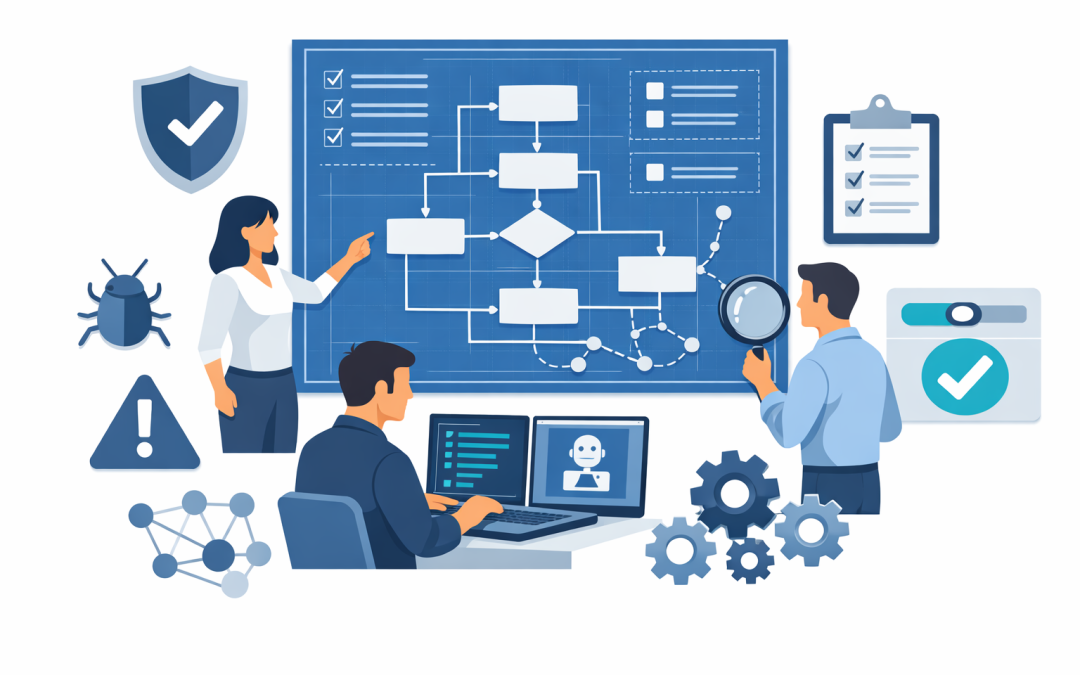
Something fundamental is changing in how enterprise software gets built. Development teams that once measured productivity by lines of code committed are now measuring it by something entirely different — the quality of the specifications they write before any code exists.


This is not a theoretical trend. It is happening now, across organisations of every size, and the implications for how businesses plan, resource, and govern software delivery are significant.
The Problem That Triggered the Shift
For the past year, AI coding assistants have been embedded in developer workflows across thousands of organisations. The initial promise was straightforward: developers describe what they want, and AI writes the code.
It worked — to a point.
What organisations discovered was a pattern that Microsoft’s own engineering teams refer to as “filling the gaps.” When a developer provides a vague or incomplete instruction, the AI agent fills in the blanks with its best guess. Sometimes those guesses are correct. Sometimes they introduce subtle bugs, skip edge cases, or produce code that compiles perfectly but behaves incorrectly under production conditions.
The more complex the task, the worse this problem becomes. Agents building multi-step features from loose descriptions would insert placeholder logic, skip error handling, or make architectural decisions that conflicted with the existing codebase — all while appearing to work flawlessly on the surface.
Why Specifications Became the Fix
The solution that emerged was not a new tool or a better model. It was a return to a discipline that software engineering had always valued but rarely enforced — writing detailed specifications before writing code.
The difference now is that the specification is not just a document for human developers to interpret. It is the primary input for AI agents that execute the actual implementation.
A well-written specification for an agent-driven workflow includes clear outcomes (what the feature should do), non-goals (what it should explicitly not do), edge cases, acceptance criteria, and the smallest testable delivery unit. When these elements are present, AI agents produce dramatically more reliable output. When they are missing, the agent fills the gaps — and the results are unpredictable.
This is the core of what practitioners now call spec-driven development. The specification becomes the product. The code is simply the output.
What This Means for Enterprise Dev Teams
The shift from code-first to spec-first changes the composition, workflow, and governance model of development teams in ways that business leaders need to understand.
The Role of Senior Engineers Is Changing
Senior engineers are spending less time writing implementation code and more time reviewing agent-generated output. Reading code is becoming more important than writing it. The skill that matters most is the ability to evaluate whether generated code matches the intent of the specification — and to spot the cases where the agent made assumptions that were not explicitly stated.
This is a significant shift in how engineering value is measured. Organisations that continue to evaluate developer performance by commit volume or feature velocity will miss the point entirely.
Product Managers Need to Write Differently
Product requirements documents (PRDs) have traditionally been written for human developers to interpret. In an agent-powered workflow, the specification must be precise enough for an AI agent to execute without ambiguity. This does not mean product managers need to write code. It means they need to write with a level of specificity that eliminates guesswork.
The gap between “what the business wants” and “what the technical team builds” has existed for decades. AI agents do not close this gap automatically. They amplify it. An imprecise requirement becomes an imprecise implementation at machine speed.
Cross-Team Collaboration Is Increasing
A positive outcome that organisations are reporting is increased collaboration between teams that previously operated in silos. When specifications become the shared language between product, engineering, testing, and security, everyone works from the same document. Web teams, backend teams, API teams, and QA teams are sharing best practices on how to write specifications that agents can execute reliably.
This cross-pollination is not trivial. It is reshaping how organisations structure their development function.
Governance Must Keep Up
AI-generated code is now flooding pull requests at a rate that manual review processes were never designed to handle. Organisations need governance frameworks that account for agent-generated output — including automated security scanning, code review by AI reviewers, and clear policies on what an agent can and cannot merge without human approval.
Human-in-the-loop is not optional. The role of the human is shifting from writing the code to approving it, but that approval step must be deliberate and well-governed.
The Tooling Is Already Here
Microsoft and GitHub have invested heavily in tooling that supports this shift. GitHub Copilot’s coding agent can now take a well-structured spec, plan the implementation, execute changes across multiple files, run tests, and submit a pull request for review — all autonomously.
Custom agents and custom instructions allow teams to encode their organisation’s coding standards, architecture patterns, and compliance requirements into the agent’s workflow. The agent does not just write code. It writes code that conforms to the organisation’s rules.
GitHub Advanced Security combined with Copilot Code Review provides an automated safety net that scans agent-generated code for vulnerabilities before it reaches production. For organisations operating under compliance frameworks, this combination is rapidly becoming a baseline requirement.
What Australian Organisations Should Consider
For mid-market Australian organisations evaluating their AI-assisted development strategy, three questions matter right now.
First, are development teams equipped to write specifications that AI agents can execute? Most teams will require training and process change to shift from vague requirements to precise, agent-ready specifications.
Second, does the organisation have governance in place for AI-generated code? Security scanning, code review automation, and human approval workflows need to be defined before — not after — agent-driven development scales across the business.
Third, is the development workflow designed for iteration? The most successful teams treat the AI interaction as a conversation, not a single prompt. They iterate on specifications, refine agent output, and capture decisions in the spec itself. Teams that issue one instruction and expect perfect output will be disappointed.
The Shift Is Already Underway
The organisations that move early on spec-driven development will have a structural advantage. Their teams will ship more reliably, their governance will be tighter, and their ability to onboard new developers — human or AI — will be faster.
The ones that wait will find themselves trying to retrofit governance onto agent-generated codebases that were built without it. That is a far harder problem to solve.
The specification is the product now. The sooner an organisation’s development practices reflect that reality, the better positioned it will be as AI agents become the default way software gets built.
CPI Consulting helps Australian organisations design and implement AI-assisted development workflows, governance frameworks, and Microsoft-aligned tooling strategies. To explore how spec-driven development could reshape delivery within your organisation, reach out to our team.