
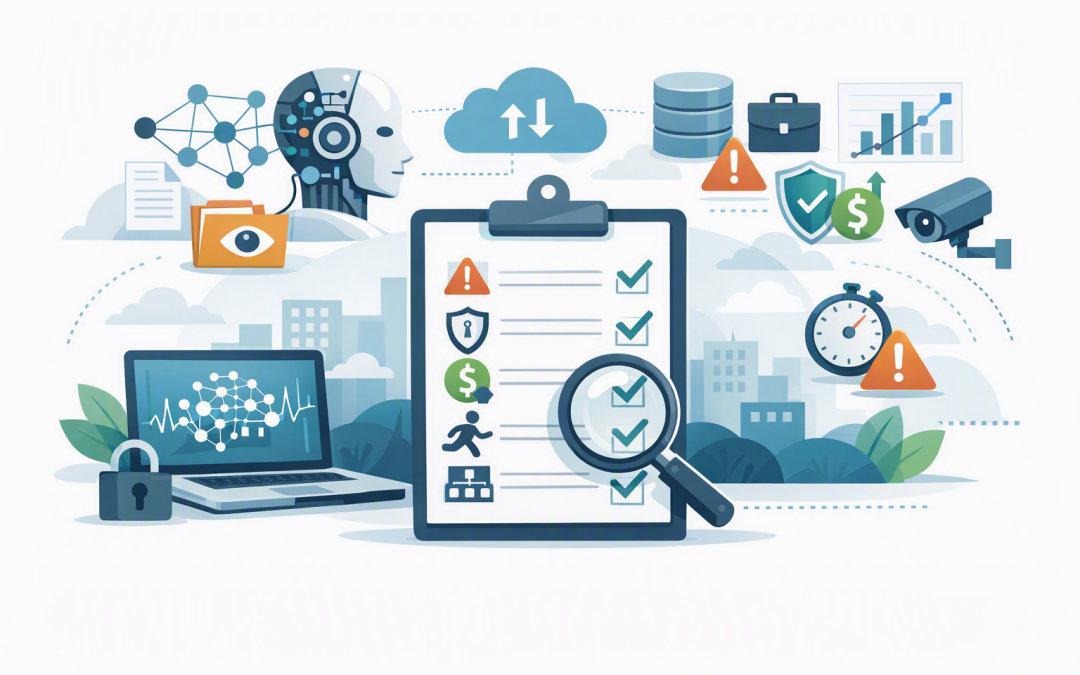
In this blog post Why AI Auditing Must Continue After Your AI System Goes Live we will explain why an AI tool that looked safe, accurate and affordable at launch can quietly become expensive or risky months later.


AI auditing is the regular process of checking whether an AI system still works as intended. It examines business value, output quality, security, privacy, costs, user behaviour and the actions the system is allowed to take.
This matters because AI is not conventional software. Traditional software generally follows fixed instructions, while generative AI produces answers based on patterns, context and probability. Its behaviour can shift as users, business data, connected systems and AI models change.
Passing the deployment review is only the beginning
Most organisations perform some form of testing before an AI application goes live. They check whether it answers common questions, connects to the right systems and avoids obviously inappropriate responses.
That initial review is essential. Our guide to conducting an AI audit before scaling explains how to identify weaknesses before they affect more people or data.
However, a successful launch does not guarantee reliable performance six months later. An AI system may be connected to new information, receive a model update, attract different users or begin handling tasks that were never included in the original assessment.
The key question changes from “Was this system safe when we launched it?” to “Can we prove it is still safe, useful and financially worthwhile today?”
How an AI application changes after deployment
The AI model, such as an OpenAI or Anthropic Claude model, is only one part of the application. Most business AI systems also include instructions, company data, user permissions, security controls and connections to tools such as Microsoft 365, customer management platforms or finance systems.
Some applications use a process often called grounding. This means the AI searches approved business information before answering, rather than relying only on its general training. The quality of the answer therefore depends on whether that business information remains accurate, current and appropriately protected.
AI agents introduce another layer. An agent can perform actions, such as creating a support ticket, updating a customer record or drafting an email. Our pre-production AI agent risk assessment covers the initial controls, but those permissions and actions must continue to be reviewed after launch.
Monitoring and auditing answer different questions
Monitoring shows what is happening inside an AI application. It can track usage, response times, errors, operating costs and whether safety filters are being triggered.
An audit goes further. It asks whether the observed behaviour is acceptable, whether controls are working and whether the system still supports the original business purpose.
For example, monitoring might show that monthly AI usage has doubled. An audit determines whether that increase represents productive adoption, unnecessary use, automated misuse or an unexpected integration consuming resources.
If you are establishing operational measures, our article on monitoring AI applications after deployment explains what to track. Ongoing auditing turns those measurements into management decisions.
Five issues an ongoing AI audit should uncover
1. Falling answer quality
An internal assistant might begin giving outdated answers because the policies it searches have changed. A customer-facing tool may perform well for common questions but struggle when new products or services are introduced.
An audit should test representative conversations, compare answers with approved information and review user feedback. The business outcome is fewer mistakes, less rework and greater confidence among employees and customers.
2. Uncontrolled access to sensitive information
AI systems often inherit access from Microsoft 365, Azure and other connected platforms. If permissions are too broad, the AI may retrieve information that a particular employee should not see, even when the employee did not deliberately search for it.
Regular auditing should examine data sources, user permissions, tool connections and unusual access patterns. This reduces the chance of confidential employee, customer, legal or financial information being exposed.
3. Costs that no longer match the value
Generative AI services are commonly charged according to usage. Costs can rise when prompts become longer, more employees adopt the tool or automated processes repeatedly call the model.
An audit should compare spending with measurable outcomes such as hours saved, enquiries resolved or processing time reduced. If the business cannot identify the value being created, usage may need to be redesigned rather than simply expanded.
4. Controls that users have learned to bypass
Employees will naturally find faster ways to use a new system. They may paste sensitive material into unapproved tools, rely on AI-generated answers without checking them or create informal workarounds when the approved application feels slow.
Auditing should include user behaviour, not just technical settings. Better training, clearer policies and simpler approved tools often reduce risk more effectively than adding another warning message.
5. Gaps in governance and accountability
When an AI system produces a damaging answer or takes the wrong action, someone needs the authority to investigate and respond. “The AI did it” is not an acceptable explanation to customers, executives or regulators.
Each important AI system should have a named business owner, an escalation process and documented limits. A practical AI audit framework for executives turns these responsibilities into evidence leaders can understand.
A realistic example of risk appearing after launch
Consider a 180-person professional services company using an AI assistant to answer internal policy and project questions. At launch, the assistant is limited to a small set of approved documents and saves employees hundreds of hours searching for information.
Over the following months, more document libraries are connected. Several contain duplicated policies, outdated pricing and confidential project notes. Usage also expands beyond the original team, but the permissions and test cases are not reviewed.
The application still appears healthy because it remains online and responds quickly. A quarterly audit, however, identifies inconsistent answers, unnecessary access and rising usage costs before they become a reportable privacy incident or customer issue.
The solution is not necessarily to remove the AI. The company can clean up its information, correct permissions, introduce approval steps for higher-risk tasks and retain the productivity gains.
What should be recorded for an effective audit
A useful evidence trail does not require recording every conversation forever. In fact, excessive logging can create an additional privacy and security risk.
The appropriate records depend on the system, but they commonly include:
- The AI model and version used.
- The approved instructions given to the model.
- The information sources searched before an answer was produced.
- Tools used and actions attempted by an AI agent.
- User identity and access level where appropriate.
- Human approvals for sensitive or irreversible actions.
- Quality, safety, cost and performance measures.
- Incidents, complaints, corrections and follow-up actions.
For AI agents that store information or maintain a form of memory, the design must also support reliable evidence. Our article on building audit-ready AI agents with Azure Cosmos DB explains how secure records can support investigation without creating uncontrolled data stores.
How often should AI systems be audited
There is no single schedule for every organisation. A low-risk writing assistant should not receive the same level of scrutiny as an AI agent that can access customer records, approve transactions or change business systems.
A practical starting point is:
- Monthly operational reviews for quality, usage, incidents and unexpected cost changes.
- Quarterly formal audits for systems handling important business processes or sensitive information.
- Change-triggered audits after model updates, new data connections, permission changes or major workflow modifications.
- Immediate reviews after a security event, privacy complaint, harmful output or unexplained automated action.
The frequency should increase with the potential impact. It is better to apply deeper auditing to a few high-risk systems than produce a large checklist that treats every AI tool as equally important.
AI auditing also supports Australian compliance
Australian organisations remain responsible for how AI uses personal and sensitive information. Where applicable, the Privacy Act and Australian Privacy Principles continue to apply when information is collected, sent to an AI service, stored or disclosed.
The Essential Eight, the Australian Government’s baseline cybersecurity framework, can strengthen areas such as access control, system updates and data protection. However, it does not replace AI-specific governance covering output quality, human oversight, approved use and accountability.
An ongoing audit brings these areas together. It gives executives evidence that security controls, privacy obligations and responsible AI practices are operating in the real environment, not merely documented in a policy.
Keep the value and control the risk
AI auditing is not about slowing innovation or expecting every answer to be perfect. It is about checking that the system continues to deliver the productivity, cost and service improvements that justified the investment.
CloudProInc combines more than 20 years of enterprise IT experience with practical expertise across Azure, Microsoft 365, OpenAI, Claude, Microsoft Defender and Wiz. As a Melbourne-based Microsoft Partner and Wiz Security Integrator, we help organisations connect AI auditing with the security and governance controls they already use.
If you are not sure whether your deployed AI systems are still accurate, secure and worth the cost, we are happy to take a practical look at the evidence with you — no strings attached.
Discover more from CPI Consulting
Subscribe to get the latest posts sent to your email.