
In this blog post Why the Agent Loop Is the Foundation of Reliable AI Solutions we will explain why some AI projects remain useful demonstrations while others become dependable business systems. If your AI can produce an impressive answer but cannot consistently complete a task, handle an exception or explain what it did, the missing piece may be the agent loop.


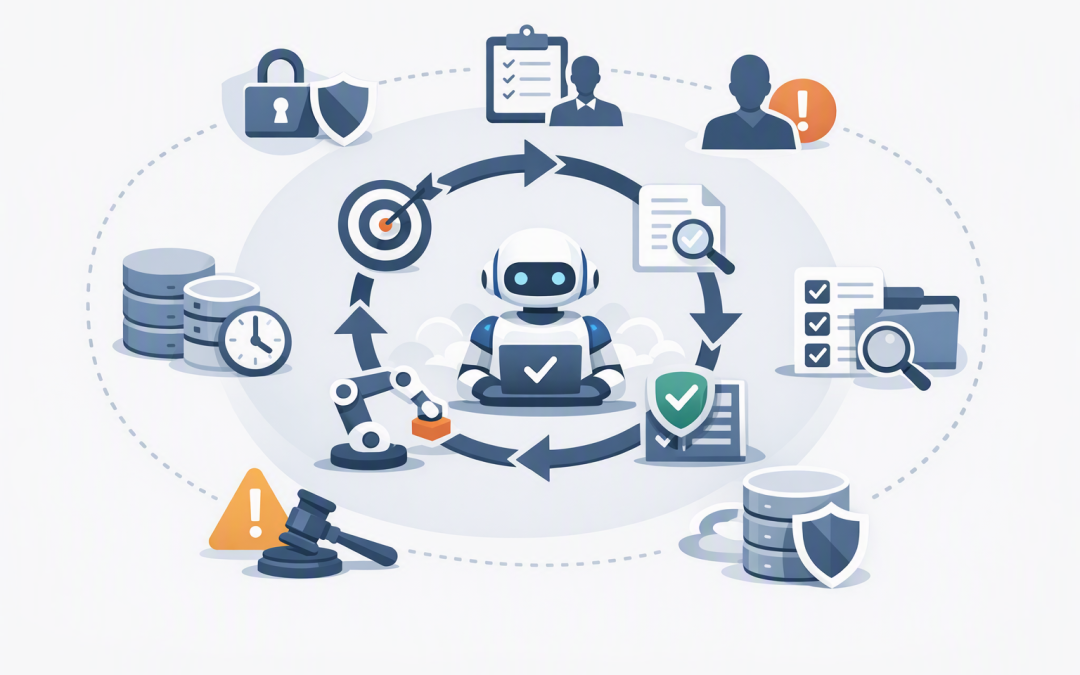
At a high level, an agent loop is the repeating process an AI agent follows to understand a goal, decide what to do next, take an approved action, check the result and continue until the task is complete. It works more like a capable employee following a controlled checklist than a chatbot producing a one-off response.
This loop is the foundation of reliability because it creates clear points where your business can apply permissions, checks, approvals, spending limits and stopping rules. The intelligence may come from OpenAI, Anthropic Claude or another model, but the loop determines how that intelligence behaves inside your organisation.
What the agent loop actually does
A normal AI chatbot receives a question and returns an answer. An AI agent may need to search company information, check a customer record, update a business system, create a document and ask a person to approve the final action.
The agent loop breaks that work into manageable steps:
- Understand the goal. The agent identifies the requested outcome, such as resolving a support request or preparing a supplier comparison.
- Review the available context. It checks relevant instructions, previous steps and authorised company information.
- Choose the next action. It decides whether to search, calculate, draft, update a system or ask for help.
- Use an approved tool. It performs the action through a controlled connection to a business system.
- Check the result. It confirms whether the action succeeded and whether the output meets the required rules.
- Continue, stop or escalate. It either moves to the next step, finishes the task or sends an exception to a person.
Our guide to automating multi-step business processes with the agent loop explores this workflow in more detail. The important point for decision-makers is that reliability comes from controlling every trip around the loop, not simply selecting the most powerful AI model.
Why a smart model is not enough
AI models do not behave exactly like traditional software. Give conventional software the same data and rules, and it should produce the same result. An AI model can interpret the same instruction differently depending on the wording, context and information available.
That flexibility is useful when work involves emails, documents and unclear requests. It also means the model should not be trusted to manage the entire process without external controls.
For example, an agent asked to “resolve this invoice issue” might need to locate the invoice, compare it with a purchase order, contact the supplier and update the finance platform. A good answer is not enough. Each action needs to be permitted, checked and recorded.
The loop creates five layers of business reliability
1. It keeps track of progress
Multi-step work can run for several minutes, hours or even days. The agent must remember what has already happened, what information has been collected and what remains outstanding.
This saved progress is known as state. In plain English, it is the case file the agent uses to avoid starting again or repeating completed work.
If a service becomes unavailable halfway through a process, a reliable loop can pause and resume from the last confirmed step. That reduces manual rework and prevents customers from receiving duplicate messages or transactions.
2. It limits what the AI can do
An agent should only have access to the systems and actions needed for its specific job. A customer service agent may need to read orders and draft responses, but it may not need permission to delete records or issue unlimited refunds.
This is the principle of least agency. Giving an agent fewer, carefully selected powers reduces the damage that could result from a mistake, misleading instruction or compromised account.
For Australian organisations following Essential 8, the Australian Government’s baseline cybersecurity framework, this supports the broader goal of restricting powerful access. An AI project should strengthen existing security controls rather than create a new way around them.
3. It checks outcomes before continuing
A weak agent assumes every action worked. A reliable loop checks the response from each system before moving on.
If the agent creates a user account, for example, it should confirm that the account exists, the correct licence was applied and the requested security settings are active. If a check fails, the agent should retry safely or create a support ticket rather than pretending the task is complete.
The retry must also be designed so it cannot accidentally perform the same irreversible action twice. A temporary network problem should not result in two refunds, two orders or two accounts.
4. It knows when a person must approve an action
Human approval should be based on risk, not added randomly. Reading a public product document may be low risk, while sending a legal response, changing payroll data or approving a large credit clearly deserves review.
The loop can pause before a sensitive action and present the relevant facts to an authorised employee. That person can approve, reject or amend the proposed step without manually repeating the agent’s earlier work.
This approach improves productivity without removing accountability. It is particularly important when an agent processes personal information covered by Australian privacy obligations.
5. It provides evidence of what happened
When an automated decision affects a customer, employee or financial record, “the AI did it” is not an acceptable explanation. The organisation needs a record of the instructions, information sources, tools used, approvals received and results returned.
This monitoring sits within the broader agent harness behind reliable AI workflows. The loop is the repeating work cycle, while the harness is the surrounding control system that manages security, monitoring, recovery and cost.
A practical example for a 200-person business
Consider a 200-person professional services company receiving 1,000 internal requests each month. Staff spend an average of eight minutes reading, checking and routing each request, which adds up to roughly 133 hours of administrative work.
An agent loop could classify each request, collect missing details, check the relevant policy and route it to the correct team. Straightforward requests could be completed automatically, while unusual, expensive or sensitive cases would be sent to a person.
If the loop safely handled 70 per cent of the routine workload, it could remove around 93 hours of initial processing each month before allowing for oversight. The business outcome is not simply “using AI.” It is faster response times, fewer routing mistakes and more time for employees to handle work that genuinely requires judgement.
What the technology looks like underneath
The core logic is easier to understand than many AI architecture diagrams suggest. A simplified agent loop might look like this:
receive the business goal
load the case history and approved instructions

while the task is not complete:
 ask the AI model to propose the next step
 check that the proposed action is allowed

 if human approval is required:
 pause and request approval

 run the approved tool
 validate the result
 record what happened

 if the result is unsafe or unclear:
 stop and escalate to a person

save the final outcome and audit record
Production systems need more than this simplified example. They also require secure identities, time limits, retry rules, cost controls, data protection, monitoring and a reliable place to store progress.
For organisations using Microsoft Azure, these components can be combined with Azure identity, security and monitoring services. Our article on designing durable Azure AI agents explains how controlled identities, saved progress and approvals help agents survive interruptions without losing control.
Questions leaders should ask before approving an AI agent
- What exact business outcome is the agent responsible for?
- Which systems and data can it access?
- Which actions can it complete without approval?
- How does it confirm that each step succeeded?
- What prevents it from repeating an expensive action?
- When does it stop and ask a person for help?
- Can we review a complete record of its decisions and actions?
- How will we measure time saved, errors reduced and operating cost?
If these questions do not have clear answers, the organisation probably has an AI demonstration rather than a reliable operational solution.
Build the loop around the business risk
The best agent loop is not necessarily the most complex one. It is the simplest loop that can complete the required work safely, recover from predictable problems and produce a measurable result.
CloudProInc brings more than 20 years of enterprise IT experience to this work. As a Microsoft Partner and Wiz Security Integrator, our Melbourne-based team designs practical AI solutions across Azure, Microsoft 365, OpenAI, Claude, Microsoft Defender and Wiz for organisations in Australia and internationally.
If you are considering an AI agent but are not sure whether the proposed design will remain reliable outside a demonstration, we are happy to review the loop, permissions and business case with you — no strings attached.
Discover more from CPI Consulting
Subscribe to get the latest posts sent to your email.