
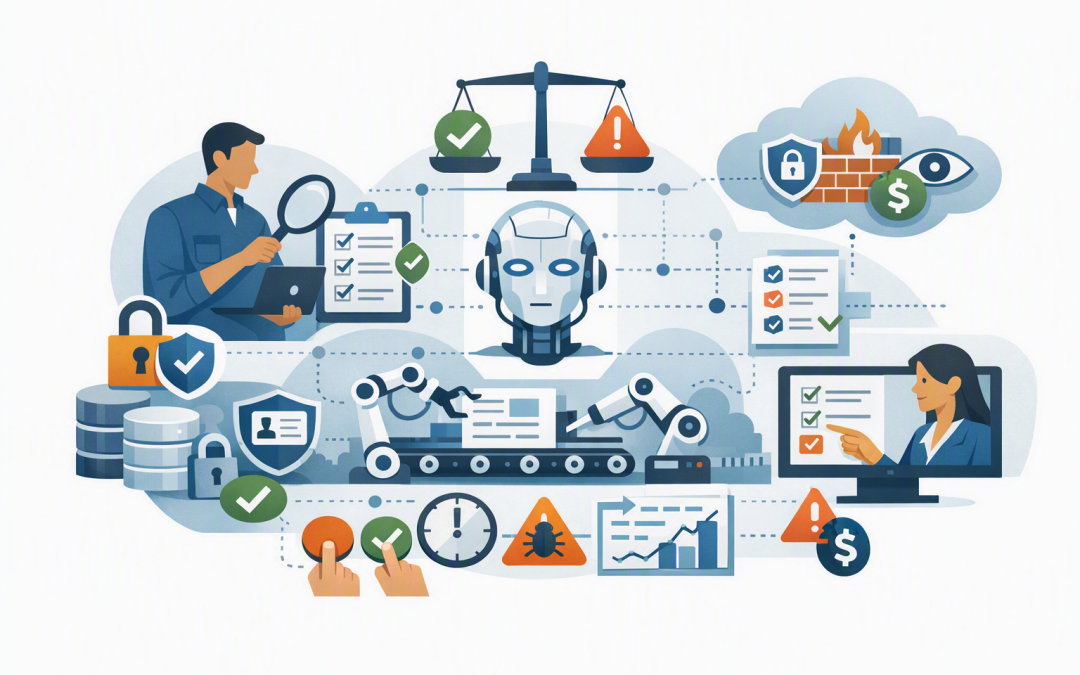
In this blog post How Forward Deployed Engineers Reduce the Risk of AI Projects we will explain how embedded, hands-on engineering helps organisations avoid wasted budgets, privacy problems and unreliable AI systems. If your business has an impressive AI pilot but nobody is confident enough to put it into daily use, this is probably the gap you are facing.


At a high level, a forward deployed engineer is a senior technical specialist who works directly with your business teams. Rather than producing a strategy document and leaving, they stay close to the project, connect the AI to real workflows and fix problems before those problems affect customers, employees or sensitive data.
Why promising AI projects become risky
Building an AI demonstration is relatively easy. Turning it into a secure and dependable business system is much harder.
A demonstration might answer questions from a few documents. A production system must identify the user, respect their access permissions, find current information, protect personal data, control costs and behave safely when someone asks an unexpected question.
This is why AI projects often stall between experimentation and useful business adoption. We covered that delivery gap in why forward deployed engineers make AI transformation succeed. The risk question goes one step further: how do you stop an AI system from creating a larger problem than the one it was meant to solve?
The technology behind a business AI system
Tools such as OpenAI and Anthropic Claude use large language models. In plain English, these models analyse patterns in enormous amounts of text and generate a likely response to a question or instruction.
The model is only one part of the finished system. A reliable business AI service normally includes several connected layers:
- The AI model, which understands instructions and produces a response.
- Business data retrieval, which finds relevant information from approved documents, databases or Microsoft 365 instead of relying only on the model’s general knowledge.
- Identity and permissions, which confirm who the user is and what information they are allowed to see.
- Integrations, which connect the AI to systems such as a service desk, customer database or finance platform.
- Safety controls, which block unsuitable requests, sensitive information and unauthorised actions.
- Monitoring and testing, which show whether answers remain accurate, useful, secure and affordable.
A forward deployed engineer works across this complete chain. That matters because most serious failures happen between the layers, not inside the AI model itself.
They stop the wrong problem being automated
One of the biggest AI risks is not technical. It is spending months automating a process that is poorly understood, rarely used or unsuitable for AI.
A forward deployed engineer observes how people actually work before building anything significant. They ask which decisions require human judgement, where information comes from, what errors would cost the business and how success will be measured.
This process may reveal that a proposed company-wide assistant should begin as a smaller tool for drafting service desk responses. The narrower project can be tested faster, has a smaller security footprint and gives management evidence before more money is committed.
It also strengthens the connection between business and delivery teams, which we explore in how forward deployed engineers align business and tech teams.
They control what information the AI can access
An AI assistant becomes useful when it can work with company information. That same access creates risk if customer records, employee files, contracts or financial data are exposed to the wrong person.
A forward deployed engineer maps the data before connecting it. They identify where information is stored, who owns it, whether it contains personal details and how long prompts and responses should be retained.
In a Microsoft environment, this can include Microsoft Entra ID, which controls user identities and access, along with Azure security controls that keep AI services away from the public internet. Microsoft Defender and Wiz can then help identify cloud weaknesses and unusual activity, while Intune manages and secures the devices employees use to access the service.
For Australian organisations, this work supports obligations under the Privacy Act and Australian Privacy Principles. The Essential Eight, the Australian government’s baseline cybersecurity framework, remains important, but it does not replace AI-specific controls such as model testing, data boundaries and human review.
They test reliability before employees depend on it
AI can produce an answer that sounds confident but is incomplete or wrong. This is sometimes called a hallucination, meaning the model has generated plausible information that is not supported by the facts.
A forward deployed engineer creates a test set based on real business questions. The answers are checked for accuracy, relevance, privacy, appropriate language and correct handling of situations where the system does not know.
They can also use retrieval-augmented generation, usually shortened to RAG. This means the AI searches an approved company knowledge source before answering, helping it base the response on current business information.
For higher-risk tasks, the system should not act alone. A manager might need to approve a payment change, customer refund or employment decision before anything happens. Human approval is a safety control, not a sign that the AI project has failed.
They reduce the risk created by AI agents
An ordinary AI assistant produces text. An AI agent can also use software tools and take actions, such as opening a support ticket, updating a record or sending a message.
That ability can save significant time, but it increases the consequences of a mistake. A malicious document or cleverly written instruction could attempt to manipulate the agent into revealing information or taking an unauthorised action. This is known as prompt injection.
A forward deployed engineer limits each agent to the minimum permissions required. They separate low-risk actions from sensitive ones, validate information before it reaches another system and maintain an audit trail showing what the agent did.
The business outcome is controlled automation. Employees gain time without quietly giving an AI system unlimited access to important operations.
They keep costs and performance visible
AI costs can rise unexpectedly when usage grows, prompts become unnecessarily large or a system repeatedly searches too much information. A cheap pilot may become an expensive production service if nobody monitors how it is being used.
A forward deployed engineer tracks cost per task alongside business value. They may select different models for different jobs, shorten unnecessary prompts, cache repeated information and place limits around excessive usage.
They also plan for outages, model changes and supplier changes. This practical ownership is one reason senior engineering involvement can improve delivery, as discussed in how a senior forward deployed engineer improves AI project delivery.
A practical example
Consider a 200-person professional services business planning an AI assistant for internal policies. The initial pilot looks impressive, but testing reveals three problems: it uses outdated documents, managers can retrieve sensitive HR information and nobody knows what each question costs.
A forward deployed engineer narrows the first release to IT and general workplace policies. They separate restricted document libraries, apply existing Microsoft 365 permissions, create a set of approved test questions and require the assistant to show which source supports each answer.
Monitoring is added for usage, cost and failed responses. HR content remains outside the system until the privacy, access and approval requirements are properly designed.
The result is not simply a better chatbot. The business gets a controlled service that can reduce repetitive questions without exposing confidential information or approving an open-ended budget.
A simple risk gate before production
Before an AI service is released widely, leadership should be able to answer five questions:
- What measurable business problem does this solve?
- What information can the AI access, and who approved that access?
- How has accuracy and unsafe behaviour been tested?
- Which actions require human approval?
- Who monitors cost, performance and security after launch?
If these answers are unclear, the project is not ready for production. More features will not fix missing ownership and controls.
Lower risk leads to faster AI adoption
Forward deployed engineers do not remove every possible AI risk. They make risks visible, testable and manageable while the system is still small enough to change.
That approach protects the budget, reduces security and privacy exposure, and gives employees confidence that the tool will help rather than create extra work. It is also how AI moves from an interesting trial to the measurable value the business expects.
CloudProInc combines more than 20 years of enterprise IT experience with practical expertise across Azure, Microsoft 365, OpenAI, Claude, Defender and Wiz. As a Melbourne-based Microsoft Partner and Wiz Security Integrator, we help organisations build AI systems that fit their existing security, cloud and compliance environment.
If you are unsure whether an AI pilot is ready for wider use, or whether the current design is creating risks nobody has measured, we are happy to take a practical look with you — no strings attached.