
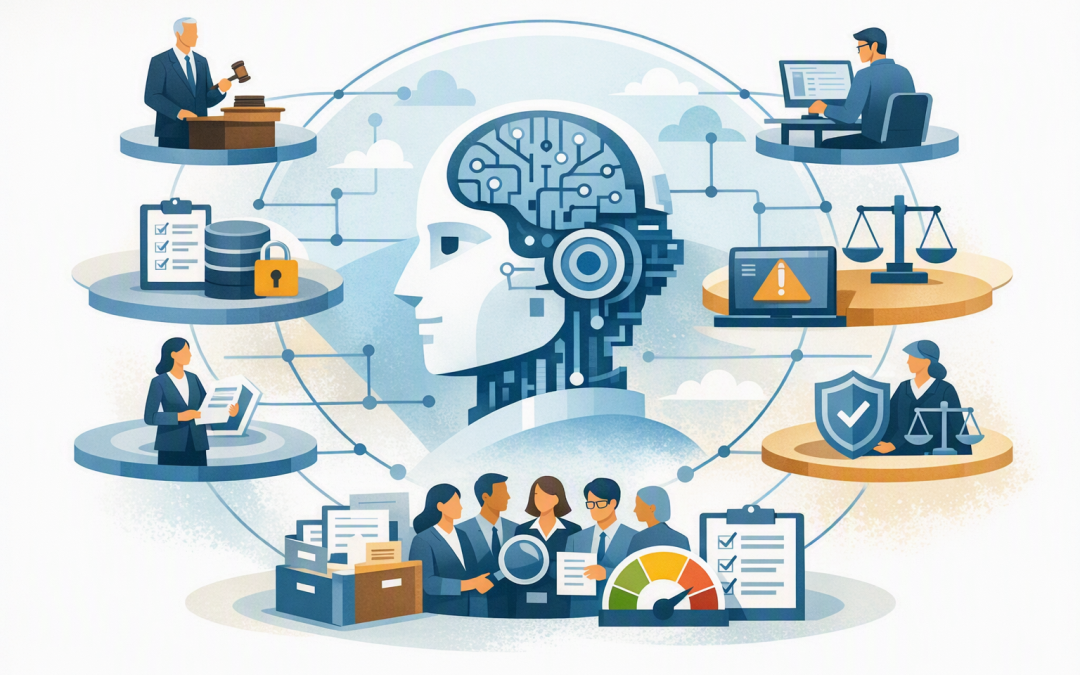
In this blog post Who Should Own AI Governance and Accountability in Your Business we will explain who should make AI decisions, who should manage the risks, and how to avoid leaving accountability in the gap between IT, legal and business teams.


That gap is already causing problems. Employees are using AI to summarise meetings, draft proposals, analyse customer information and automate everyday tasks, while senior leaders often assume somebody else is checking the privacy, security and accuracy risks.
The short answer is that AI governance needs one executive owner, supported by a small cross-functional group. IT should manage the technology, but it should not carry sole responsibility for business decisions made with AI.
What AI governance actually means
AI governance is the set of decisions, rules and checks that controls how your organisation selects, builds and uses artificial intelligence. It covers who may use AI, what information it may access, which tasks it may perform and who is accountable when something goes wrong.
This is not about creating a thick policy document that nobody reads. Good governance helps the business adopt useful AI faster because employees know what is approved, managers know what requires review, and executives can see whether the investment is producing value.
Australia’s current Guidance for AI Adoption places accountability at the beginning of responsible AI use. It also calls for organisations to understand impacts, manage risk, share important information, test systems and maintain meaningful human control.
For a broader view of executive oversight, see our guide on what boards need to know about AI governance and accountability. The board oversees the risk and direction, but day-to-day ownership must sit with management.
Why the technology creates an ownership problem
Traditional software follows instructions written by developers. Modern generative AI, including OpenAI models, Anthropic Claude and Microsoft 365 Copilot, uses large language models. These are systems trained to recognise patterns in large volumes of information and produce a likely response.
That means an AI answer can sound confident while being incomplete or wrong. The same AI tool can be low risk when rewriting an internal email and high risk when assessing a job applicant, preparing financial advice or responding directly to a customer.
AI tools also connect to business data. Microsoft 365 Copilot, for example, can work with information a user is already permitted to access across documents, email, meetings and collaboration spaces. If old permissions are too broad, AI can make that existing problem much easier to discover and exploit.
AI agents add another layer. An agent is an AI system that can carry out several steps, use connected tools and potentially take actions on a user’s behalf. Giving an agent access to customer records, finance systems or cloud infrastructure is very different from allowing a chatbot to draft marketing ideas.
This is why governance cannot be assigned to one technical administrator. The risk depends on the business process, the data involved and the consequences of a poor decision.
The executive team should own the overall framework
For most organisations with 50 to 500 employees, the CEO, COO or another nominated executive should be the accountable owner of AI governance. This person does not need to understand how an AI model is built.
They do need enough authority to settle disagreements, approve acceptable risk levels and stop unsafe projects. Without executive backing, AI governance usually becomes an optional IT checklist that business teams work around when it feels inconvenient.
The executive owner should be responsible for:
- Setting the organisation’s goals and risk appetite for AI.
- Approving the AI policy and assigning clear responsibilities.
- Ensuring high-risk uses receive legal, privacy and security review.
- Reporting significant AI risks and outcomes to the board.
- Confirming that AI projects have measurable business value.
This creates one clear point of accountability while allowing specialists to perform the actual reviews.
The CIO should operate governance but not own every outcome
The CIO or IT leader is usually best placed to run the governance process. IT can maintain the approved tool list, manage identity and access, review suppliers, monitor usage and apply security controls.
Tools such as Microsoft Purview, which identifies and protects sensitive information, and Microsoft Defender, which detects security threats, can help enforce those decisions. Microsoft Intune, which manages and secures company devices, can also reduce the chance of employees moving business information into unapproved AI applications.
For custom AI built in Azure or Microsoft AI Foundry, technical teams can record which models, data sources and connected systems are being used. Platforms such as Wiz can provide visibility into cloud risks and incorrect security settings across the environment.
However, the CIO should not decide whether AI is suitable for approving customer credit, ranking employees or changing a safety-critical process. Those are business decisions with legal, financial and human consequences.
Every AI use case needs a business owner
The most important role is often the one businesses forget. Every AI use case should have a named business owner who is accountable for its purpose, performance and impact.
If HR uses AI to help screen applications, the HR leader owns the outcome. If finance uses an AI agent to prepare forecasts, the finance leader owns the process. IT remains responsible for secure operation, but the relevant department must confirm that the result is accurate, fair and appropriate.
The business owner should answer five questions:
- What business problem are we solving?
- What information will the AI access?
- What happens if its answer or action is wrong?
- Where must a person review or approve the result?
- How will we measure value, errors and complaints?
If nobody can answer these questions, the use case is not ready for production.
Create a small AI governance group
You do not need a large AI department. A monthly governance group is usually enough for a mid-sized organisation, provided its members have clear authority and responsibilities.
A practical group may include:
- Executive sponsor who owns the overall framework and resolves major decisions.
- CIO or IT manager who manages platforms, access, suppliers and technical controls.
- Cybersecurity representative who reviews data exposure, system access and attack risks.
- Privacy or legal adviser who considers the Privacy Act, contractual duties and sector requirements.
- Business owner who is accountable for each proposed use case and its results.
- People or HR leader who covers workforce impacts, training and acceptable use.
Smaller companies can combine several of these roles. The goal is not to fill seats. It is to ensure that commercial value, technology, security, privacy and people are considered before a high-impact system goes live.
A scenario that shows why shared ownership matters
Consider a 200-person professional services firm introducing an AI assistant to prepare client reports. IT checks the vendor’s security and enables access, but nobody is formally responsible for the report content or the data being entered.
Within weeks, staff begin placing confidential client material into prompts. A manager also sends an AI-generated recommendation without checking several incorrect assumptions.
Under a clear ownership model, the operations director would own the use case, IT would control the platform, the privacy lead would approve data handling, and team managers would require human review before reports reached clients. The same tool could still save hours, but with much less chance of a privacy incident or damaged client relationship.
Start with an AI register and approval levels
An AI register is a simple record of the AI tools and use cases operating across your business. It should list the owner, purpose, data used, supplier, risk level, required human checks and review date.
Not every use needs a committee meeting. A three-level approval model keeps the process practical:
- Low risk includes brainstorming, rewriting non-sensitive text and summarising approved internal material.
- Medium risk includes analysing internal business information or producing work that affects customers.
- High risk includes employment, financial, legal, health, safety or automated decisions with significant consequences.
Low-risk uses can follow pre-approved rules. Medium-risk uses need a business owner and documented checks. High-risk uses need executive, privacy, security and legal approval, with ongoing monitoring.
This approach extends the practical controls covered in why SMBs need AI governance before Copilot and AI agent rollouts. It also creates the evidence needed for an AI audit framework executives can trust.
AI governance should strengthen existing security
AI governance does not replace cybersecurity. The Essential Eight, the Australian Government’s set of baseline strategies for reducing common cyber threats, still matters.
Strong identity controls, limited administrator access, prompt security updates, protected backups and well-managed devices provide the foundation for safer AI. An AI policy cannot compensate for weak access permissions or sensitive files shared with the entire company.
The most effective approach connects AI governance with your existing risk, privacy, security and procurement processes. That reduces duplicated work and makes governance part of normal business operations rather than a separate compliance project.
The best owner is a team with one accountable leader
AI governance should not belong to IT alone, legal alone or an enthusiastic employee experimenting with new tools. One executive should own the framework, the CIO should operate the technical controls, and a business leader should own every use case.
That model gives your organisation speed without losing control. It also makes it easier to prove that AI is saving time, reducing costs or improving service rather than simply adding another subscription and another source of risk.
CloudProInc helps organisations establish practical AI governance across Microsoft 365, Azure, OpenAI and Claude environments. As a Melbourne-based Microsoft Partner and Wiz Security Integrator with more than 20 years of enterprise IT experience, we focus on controls that work in day-to-day operations, not governance paperwork for its own sake.
If ownership of AI in your business is still unclear, we are happy to help you map the roles, risks and first practical steps — no strings attached.