
In this blog post When to Reuse a Live AI Sandbox and When Your Team Should Start Fresh we will explain how to balance speed, cost and security when AI agents need a working environment.


The decision sounds simple. Keep the existing sandbox if the work is continuing, or create a new one if it is not. In practice, businesses often reuse environments for too long, allowing old files, temporary permissions and software changes to influence new work.
Starting fresh every time is not automatically better. Constantly rebuilding an environment can increase costs, slow employees down and force an AI agent to repeat work it has already completed. The right approach depends on whether the value of continuity is greater than the risk of carrying old state forward.
What is a live sandbox?
A live sandbox is an isolated digital workspace where an AI agent can safely work with files, run approved software and test actions. It is separated from production systems, reducing the chance that a mistake will affect live business operations.
Unlike a simple chatbot, an AI agent using a sandbox may create spreadsheets, extract information from documents, install approved software components, review code or generate a website prototype. The sandbox can retain these working files and settings while the task continues.
This retained condition is often called state. In plain English, state is everything the workspace currently remembers, including its files, running processes, installed tools and temporary settings. Our guide to run state, session state and secure sandbox snapshots explains the differences in more detail.
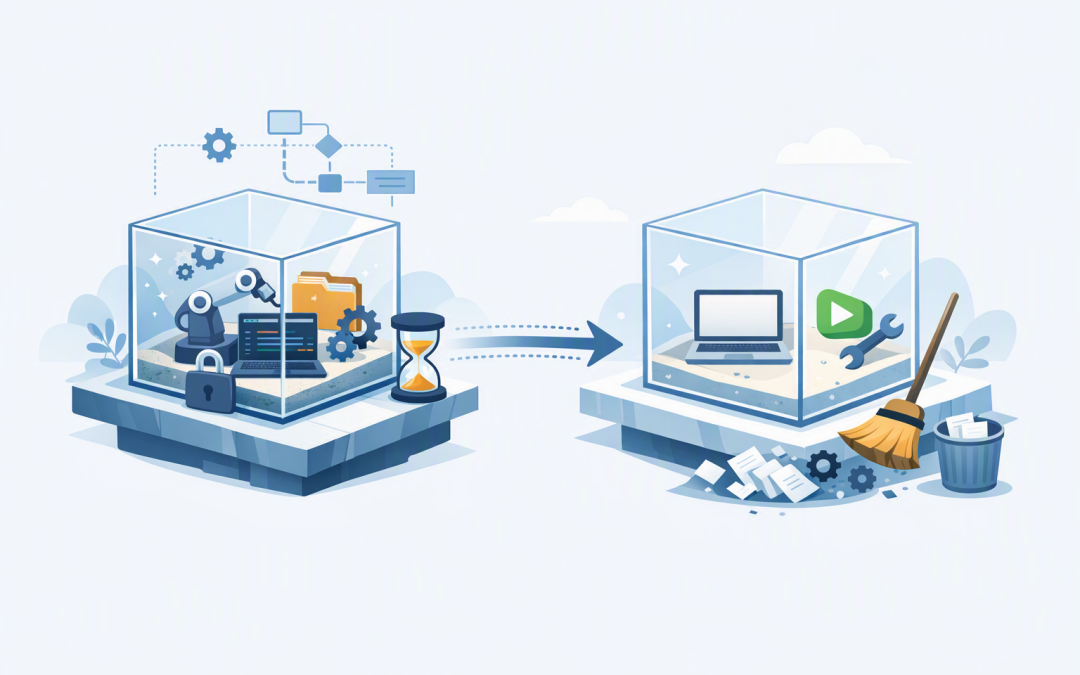
Reusing a live sandbox means allowing an agent or authorised user to continue in that existing workspace. Starting fresh means destroying or closing the old environment and creating a clean one from an approved starting configuration.
Reuse a sandbox when continuity has clear business value
1. The same team is continuing the same piece of work
Reuse usually makes sense when the business owner, security boundary and purpose of the work have not changed. A development team reviewing the same application over several days should not have to rebuild its workspace after every session.
The existing sandbox may already contain approved files, testing tools and intermediate results. Keeping it alive reduces duplicated work and helps the agent maintain momentum.
This is particularly useful for code reviews, data preparation and website prototypes. As discussed in our article on using sandbox agents for code review and website prototypes, isolated workspaces allow fast experimentation without giving the agent uncontrolled access to production.
2. Rebuilding the environment is slow or expensive
Some workspaces need approved software, large reference files or specialised configurations. Recreating all of this for every task can consume computing resources and employee time.
Imagine a software team that spends 15 minutes preparing a clean testing environment. If ten people repeat that process several times a day, the lost time quickly becomes more expensive than keeping a controlled workspace available for the duration of the project.
Reuse can therefore lower operating costs, provided the sandbox has an expiry date, activity logging and limits on what it can access.
3. The agent is completing a controlled multi-step process
An AI agent may need to collect documents, extract information, compare results and produce a final report. Closing the sandbox between every step could remove useful working files and force the agent to begin again.
In this situation, reuse should be tied to the business process rather than to the employee’s entire history. The environment might stay active for one audit, one customer proposal or one software release, then be closed when that work is complete.
This is also why conversation memory and sandbox memory should be managed separately. An agent may need the files created during a task without needing to retain every previous chat or instruction.
Start fresh when the trust boundary changes
1. A different customer, department or project is involved
A sandbox used for one customer should not automatically be reused for another. Even if the new task looks similar, hidden files or cached information from the previous project could be exposed accidentally.
The same principle applies inside the business. A workspace containing payroll information should not be reused for a general marketing task. Creating a clean environment reduces the risk of confidential information crossing between teams.
2. The sandbox handled sensitive data or temporary credentials
Temporary credentials are short-lived digital keys that let a system access an approved service. They should expire quickly, but businesses should not assume that expiry removes every copy, log or downloaded file from a sandbox.
Start fresh after tasks involving financial records, employee information, legal documents, customer databases or administrative access. This provides a clearer end to the task and makes it easier to demonstrate that sensitive material was removed.
A sandbox is a safety control, not a complete security strategy. It still needs restricted access, monitoring and clear data-handling rules, as explained in when a business AI agent needs a secure sandbox.
3. Nobody can confidently explain the current state
If your team does not know what software was installed, which files were downloaded or what commands the agent previously ran, do not keep reusing the environment. An unknown state is a business risk.
Old software components can produce inconsistent results. Forgotten files can expose information. Background processes may also continue consuming resources, creating cloud costs with no business benefit.
When the sandbox can no longer be trusted or explained, starting fresh is usually cheaper than investigating every possible change.
4. The output is moving into production
Production is the live environment used by employees or customers. Work should not move directly from a long-running experimental sandbox into production without being tested in a clean environment.
A fresh validation sandbox confirms that the result works because the instructions and approved software are correct, not because of an undocumented file or setting left behind. This reduces failed releases and makes results easier to reproduce.
A simple decision policy for your team
Businesses do not need to leave this decision entirely to developers or AI agents. A plain-language policy can determine whether reuse is allowed.
Reuse the sandbox only when:
- The business owner is unchanged
- The project and data classification are unchanged
- No security incident has occurred
- The environment is within its approved lifetime
- Activity has been logged and can be reviewed

Start fresh when:
- The customer, team or purpose changes
- Sensitive data or privileged access was used
- The current state cannot be verified
- Final testing or production release is beginning
- The sandbox has reached its expiry time
The approved lifetime might be a few hours for sensitive financial work, several days for an internal analysis project or a few weeks for a controlled development cycle. There is no single correct duration for every workload.
What this looks like in a 200-person business
Consider a 200-person professional services company using AI agents to prepare reports from customer documents. Keeping one permanent sandbox for every customer would create unnecessary cost and make access difficult to control.
Creating a completely new workspace for every individual document would create the opposite problem. Employees would wait for repeated setup, and the agent would lose useful working files between steps.
A better design is to create one sandbox for each approved customer engagement. The workspace can be reused while the same authorised team is completing that engagement, with automatic shutdown when it is inactive.
When the engagement ends, the business stores the approved output in its document system, retains the required activity logs and deletes the sandbox. The next customer starts with a clean environment.
This approach improves productivity without allowing customer information to spill into unrelated work. It also gives management a clearer view of which environments are active and what they are costing.
Reuse should never mean permanent
Every reusable sandbox should have an owner, a defined purpose and an expiry date. It should also be built from an approved configuration so that a clean replacement can be created quickly.
For Australian organisations working towards the Essential 8, the Australian Government’s cybersecurity framework that many organisations use to reduce common cyber risks, sandbox controls should support broader security practices. These include limiting administrative access, keeping software updated, controlling which applications can run and maintaining reliable backups.
Model selection should be treated as a separate decision. Choosing between models based on cost, speed and quality can improve the economics of the workload, while the sandbox policy controls how the model’s working environment is retained. Our guide to selecting models for Microsoft Foundry projects covers that part of the design.
The right answer is controlled reuse
Reusing a live sandbox can save time, reduce repeated setup costs and help AI agents complete complex work. Starting fresh protects the business when data, users, projects or security conditions change.
The goal is not maximum reuse or maximum isolation. It is controlled reuse, supported by expiry rules, access limits, activity logs and clean starting configurations.
CloudProInc brings more than 20 years of enterprise IT experience to practical AI and cloud projects. As a Microsoft Partner and Wiz Security Integrator, our Melbourne-based team helps organisations design secure AI environments across Microsoft Azure, Microsoft 365, OpenAI, Claude, Microsoft Defender and Wiz.
If you are not sure whether your AI sandboxes are being retained for too long, rebuilt too often or costing more than they should, we are happy to take a practical look at your current setup — no strings attached.