
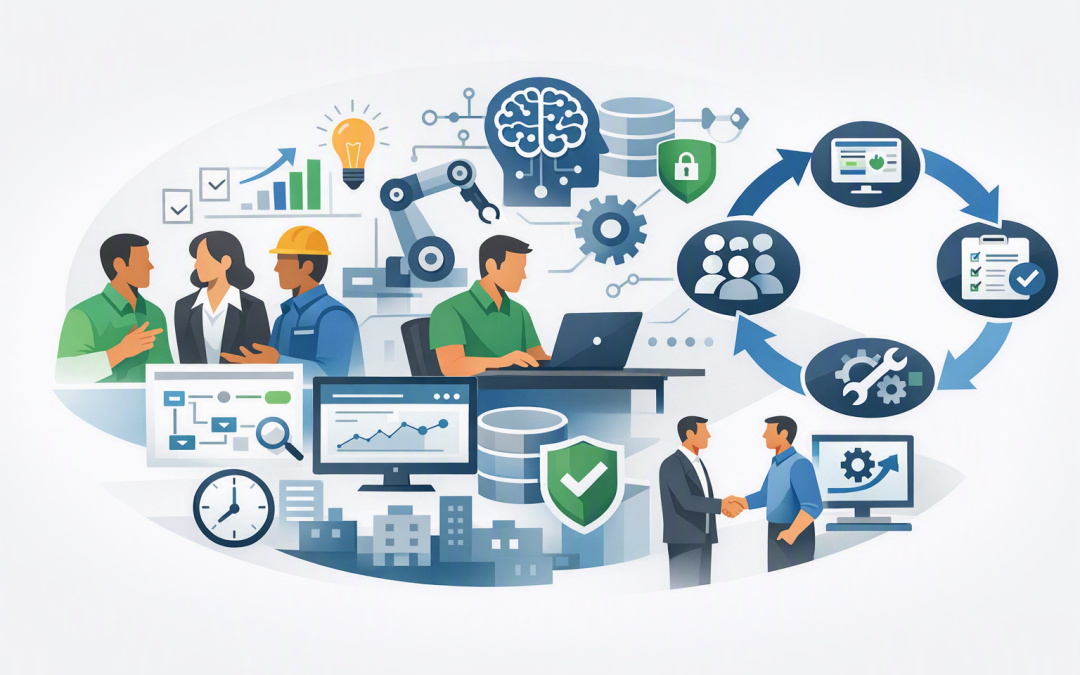
In this blog post How Forward Deployed Engineers Align Business and Tech Teams we will explain how this hands-on role brings decision-makers, operational teams and technical specialists together to deliver useful AI systems.


Many AI projects do not fail because the technology is poor. They fail because the business team describes a broad goal, the technical team builds what it thinks was requested, and nobody checks whether the result fits the way employees actually work.
A forward deployed engineer closes that gap. Rather than receiving a specification and disappearing to write code, they work alongside both groups from the initial problem through to deployment, adoption and measurement.
The role sits between business needs and technical delivery
A forward deployed engineer is a senior technical specialist who works closely with the people experiencing a problem. Their job is to understand the business outcome, design the system, build or configure it, and adjust it using feedback from real users.
This is different from simply installing an AI tool. It is also broader than traditional software development because the engineer helps define what should be built before deciding how to build it.
Our guide to what a senior forward deployed engineer does covers the wider role. The important point here is that they are responsible for keeping business priorities and technical decisions connected.
They start with the operational problem
A business leader might say, “We want an AI assistant for customer service.” That sounds clear, but it leaves several important questions unanswered.
- Are slow response times the real problem?
- Are employees spending too long searching for accurate information?
- Is the business trying to reduce costs, improve service quality or both?
- Which customer information can the AI system access?
- Who is accountable when an answer is incomplete or incorrect?
The forward deployed engineer works with managers and frontline employees to turn the broad idea into a specific workflow. For example, the real opportunity may be an internal assistant that finds approved information and drafts a response for an employee to review.
That smaller, better-defined use case may deliver value sooner and carry less risk than allowing AI to respond directly to customers.
How they work with business teams
Business teams understand customers, policies, exceptions and the informal steps that keep daily operations moving. However, much of that knowledge may not appear in process documents.
A forward deployed engineer gathers this information through workshops, interviews and observation. They ask practical questions such as where work gets delayed, which tasks are repeated, what errors cost the business and which decisions require human judgement.
They agree on measurable outcomes
“Use AI” is not a useful project target. A better target might be reducing the average time required to prepare a customer response from 20 minutes to five minutes while maintaining an agreed quality standard.
Clear measures help leaders decide whether the system is worth expanding. They also prevent a technically impressive demonstration from being mistaken for a successful business project.
They identify exceptions early
Most business processes look simple until someone describes the unusual cases. A standard request may be easy to automate, while complaints, refunds, sensitive records or high-value customers require different handling.
The engineer documents these exceptions before they become expensive surprises. This reduces rework and helps the business decide where human approval must remain.
How they work with technical teams
Once the business problem is clear, the forward deployed engineer translates it into technical requirements. They work with internal IT staff, security teams, software developers, data specialists and external providers.
This does not mean taking control away from the IT team. A good forward deployed engineer gives technical teams clearer priorities, faster access to business feedback and a senior engineer who can help remove delivery obstacles.
They may coordinate areas including:
- Connecting the solution to existing business systems.
- Controlling which employees and AI services can access company information.
- Checking the quality and reliability of AI-generated outputs.
- Recording system activity for security reviews and troubleshooting.
- Planning updates, support responsibilities and employee training.
This hands-on delivery focus is one reason the role differs from a traditional architecture position. Our comparison of forward deployed engineers and solutions architects explains where the responsibilities overlap and where they separate.
The technology behind forward deployed AI systems
The forward deployed engineer is a role rather than a single technology. In AI projects, however, the systems they build usually contain several connected layers.
The AI model
The model is the technology that interprets instructions and produces an answer. This could involve OpenAI technology, Anthropic Claude or another approved model selected for the business task.
The engineer tests whether the model can perform the required work reliably. The most powerful model is not automatically the best choice if a smaller or more controlled option delivers the required result at a lower cost.
Business information and system connections
The model may need access to approved documents, product information, service records or internal procedures. Secure connections allow it to retrieve the right information without giving it unrestricted access to everything the company stores.
These connections are often where projects become difficult. Information may be duplicated, outdated or spread across Microsoft 365, Azure, customer systems and shared drives.
Identity and security controls
The system must know who the user is and what that person is allowed to see. Microsoft Intune, which manages and secures company devices, Microsoft Defender, which detects threats, and cloud security platforms such as Wiz can help protect the wider environment around the AI service.
For Australian organisations, the design should also support Essential 8, the Australian Government’s cybersecurity framework that many organisations use to reduce common security risks. This can include strong sign-in protection, timely software updates and tight control over administrator access.
Testing and monitoring
AI output can vary, so testing cannot stop when the system produces one good answer. The engineer creates repeatable checks using realistic business examples, then monitors quality, cost, speed, security events and user adoption after launch.
This feedback loop is central to how a forward deployed engineer turns AI ideas into measurable results.
What collaboration looks like in practice
Consider a 180-person professional services company whose consultants spend several hours each week preparing client reports. Management wants AI to write the reports automatically, while IT is concerned about confidential client information leaving approved systems.
The forward deployed engineer first observes how reports are created. They discover that writing is not the main delay. Employees spend most of their time finding information across emails, meeting notes and project folders.
Instead of automating the entire report, the first version securely gathers relevant material, prepares a structured summary and flags missing information. A consultant reviews the content before anything is sent to the client.
The business team defines what a useful report looks like. The technical team controls identity, access and data connections. Security specialists review how confidential information is handled, while the engineer builds the workflow and adjusts it based on employee feedback.
The business outcome is not simply “we deployed AI.” It is less time spent searching for information, faster report preparation and lower risk because a qualified employee remains responsible for final approval.
A forward deployed engineer creates one delivery team
The best results occur when business and technical teams are not communicating through long documents and occasional status meetings. They work together in short cycles, reviewing working versions of the system and making decisions while changes are still affordable.
A practical delivery rhythm usually includes:
- Define the business problem and expected financial or operational outcome.
- Map the existing workflow, information sources and security risks.
- Build a small working version using realistic data.
- Test it with the employees who will use it.
- Measure the result, correct problems and expand only when justified.
This approach helps prevent months of spending on a system that employees avoid or that security teams cannot approve.
The role should strengthen your existing teams
A forward deployed engineer should not become the only person who understands the solution. They should document decisions, involve internal IT staff and transfer practical knowledge throughout the project.
For some organisations, this capability belongs in a permanent internal role. Others need it only for a major AI project or a period of rapid change. Our guide on whether to hire or contract a senior forward deployed engineer outlines the trade-offs.
Turning shared understanding into business results
Forward deployed engineers are valuable because they prevent business goals, user needs and technical delivery from drifting apart. They help everyone agree on the problem, build a secure working system and judge success using outcomes rather than enthusiasm.
CloudProInc brings more than 20 years of enterprise IT experience to this work. As a Melbourne-based Microsoft Partner and Wiz Security Integrator, we combine hands-on knowledge of Azure, Microsoft 365, OpenAI, Claude and cybersecurity without the layers of a giant, faceless provider.
If your business and technical teams are struggling to turn an AI idea into a secure, measurable result, we are happy to review the situation and help identify the next practical step — no strings attached.