
In this blog post Why Grok Voice 2.0 Speed Raises the Bar for Customer Service we will explain why faster voice AI matters beyond making conversations sound smoother. When callers repeatedly hear awkward pauses, receive the wrong answer or have to start again with a human agent, service costs rise and customer trust falls.


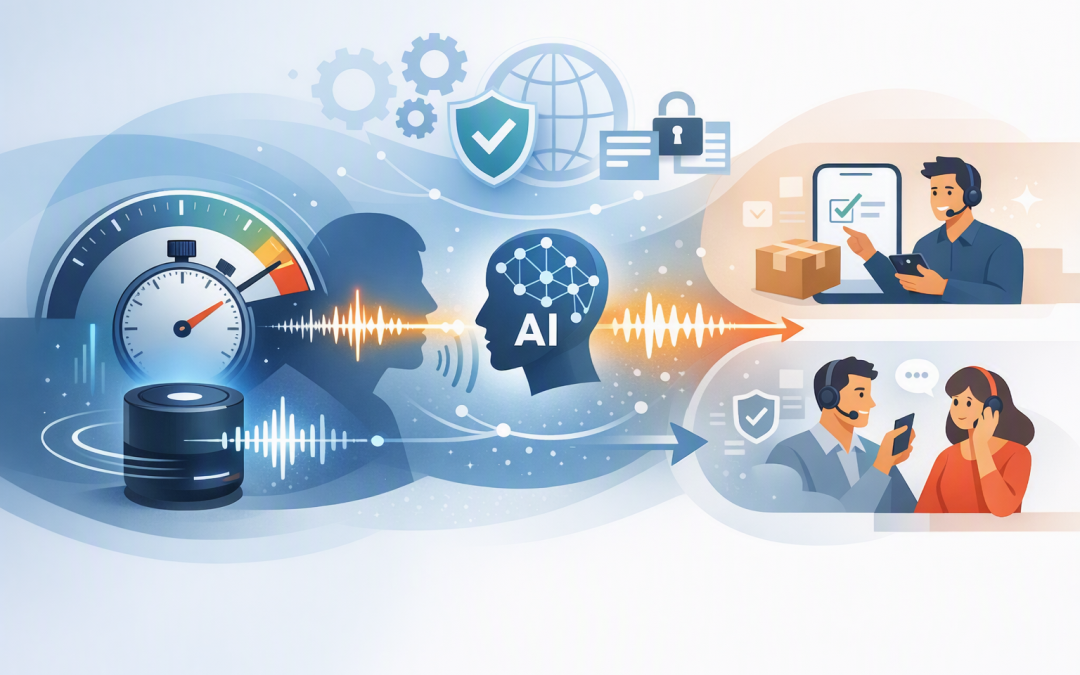
Grok Voice Think Fast 2.0, commonly shortened to Grok Voice 2.0, reduces the reported time before the system begins speaking from 1.25 seconds to about 0.70 seconds. That may sound like a small improvement, but conversation is highly sensitive to delay. A pause of even one or two seconds can make callers talk over the system, repeat themselves or assume the call has failed.
What Grok Voice 2.0 actually does
Traditional voice assistants often use three separate technologies. One converts the caller’s speech into text, another works out the answer, and a third converts that answer back into spoken audio.
Each step adds waiting time and creates another place where information can be misunderstood. It is similar to passing a customer question through three different employees before anyone can respond.
Grok Voice 2.0 uses a more direct speech-to-speech approach. It listens, interprets the request and begins forming a spoken response as part of a connected process. It can also reason while speaking, rather than waiting until every word of the answer has been prepared.
The system uses voice activity detection, which simply means it identifies when someone has started or stopped speaking. It also supports two-way conversation where the customer can interrupt naturally instead of waiting for the machine to finish a long script.
This is the technology behind the lower latency. Fewer hand-offs between separate systems mean less delay, fewer failure points and a more natural call.
Why 0.70 seconds changes customer behaviour
Most organisations evaluate customer service technology by looking at call volume, staffing costs and average handling time. They often overlook the delay between each customer statement and the system’s reply.
That delay affects the entire interaction. A slow agent encourages interruptions. Interruptions create transcription errors. Those errors lead to irrelevant answers, repeated questions and eventual escalation to a human.
Reducing latency can therefore improve several business outcomes at once:
- Fewer abandoned calls because customers receive an immediate sign that the system is working.
- Shorter conversations because callers do not need to repeat information.
- More successful self-service because the exchange feels less frustrating.
- Lower support costs when routine enquiries are completed without a human agent.
- Better customer satisfaction because the conversation feels responsive rather than mechanical.
Our earlier article on how Grok Voice 2.0 makes customer service faster and smarter covers the broader capability improvements. The important next question is how technology leaders turn those improvements into measurable operational results.
Speed only matters when the answer is useful
A confidently delivered wrong answer is still a bad customer experience. CIOs should not approve a voice AI project based on response time alone.
Grok Voice 2.0 also reports stronger transcription in noisy environments and across 24 languages. This matters for Australian organisations dealing with mobile callers, warehouse noise, poor telephone connections and a wide range of accents.
The model is designed to ask one question at a time and use shorter responses. That is useful because customer service calls usually work better when the agent confirms one detail before moving to the next.
It can also connect to business tools. For example, a voice agent could check an order, book an appointment in Outlook, update a customer record or start a refund request.
However, access must be tightly controlled. A voice agent that can read an order should not automatically have permission to issue an unlimited refund. Callers may also try to trick the agent into ignoring its instructions, so financial actions and sensitive account changes need clear limits and, where appropriate, human approval.
The business case should focus on resolved calls
Consider an illustrative 200-person services company receiving 4,000 customer calls each month. Its first voice bot answers basic questions, but slow responses and poor hand-offs mean only 55 per cent of calls are completed without staff assistance.
If a faster and more accurate system lifts that completion rate to 65 per cent, around 400 additional calls could be resolved without joining the human support queue. The value comes from reduced staff workload, shorter customer waiting times and more capacity for complex cases.
This is why cost per minute can be misleading. At launch, Grok Voice Think Fast 2.0 is listed at US$0.08 per audio minute, but model fees are only one part of the total cost.
Integration, call routing, monitoring, security and human escalation all affect the final result. Technology leaders should measure cost per successfully resolved call, not simply the cheapest AI minute.
Production controls still decide whether the project succeeds
A fast demonstration is not the same as a dependable customer service system. Production agents need approved information, secure connections, ongoing testing and a reliable way to transfer customers to people.
This is closely related to the production controls discussed in our article on moving AI customer service agents into production. The underlying model may change, but the governance requirements remain.
For Australian organisations, voice calls and transcripts may contain personal information. Before launch, businesses should document what is collected, why it is needed, where it is processed, who can access it and when it will be deleted.
Customers should be told when they are speaking with AI and when calls are recorded. A privacy impact assessment is also sensible before customer data is connected to a third-party voice service.
The Essential Eight, the Australian government’s cybersecurity framework for protecting business systems, provides an important security baseline. However, it does not replace AI-specific controls such as answer testing, tool restrictions, conversation monitoring and human intervention.
What CIOs should test before committing
A controlled pilot is safer than replacing an entire contact centre at once. Start with a high-volume, low-risk task such as appointment management, order status or basic account enquiries.
- Measure the complete delay. Include telephone routing, business system lookups and audio playback, not just the model’s published response time.
- Test real call conditions. Use background noise, interruptions, different accents and poor-quality mobile connections.
- Check completed actions. Confirm that bookings, updates and transfers happen correctly, not merely that the spoken answer sounds convincing.
- Set clear escalation rules. Complaints, vulnerable customers, payment disputes and unusual requests should reach a person quickly.
- Track business outcomes. Monitor resolved calls, average handling time, repeat contacts, customer satisfaction and total cost.
Voice quality also affects trust. Organisations needing tighter control over pronunciation, pacing and brand tone may want to compare the approach with customised voice synthesis using Azure Speech and SSML, which provides detailed rules for how generated speech sounds.
Faster voice AI creates a new minimum standard
Grok Voice 2.0 does not remove the risks of customer service automation. It does make slow, rigid voice bots harder to justify.
The new benchmark is not simply whether an AI agent can answer a phone call. It is whether it can respond naturally, understand real-world speech, complete approved tasks, protect customer information and hand over gracefully when it reaches its limits.
CloudProInc helps organisations compare and test AI options across Grok, OpenAI, Anthropic Claude and Microsoft Azure without assuming one model is right for every workload. As a Melbourne-based Microsoft Partner and Wiz Security Integrator with more than 20 years of enterprise IT experience, we focus on the practical details that determine whether an AI project reduces costs or creates another support problem.
If you are not sure whether voice AI is ready for your customer service environment, we are happy to help you assess one narrow use case, the likely return and the security controls required — no strings attached.