
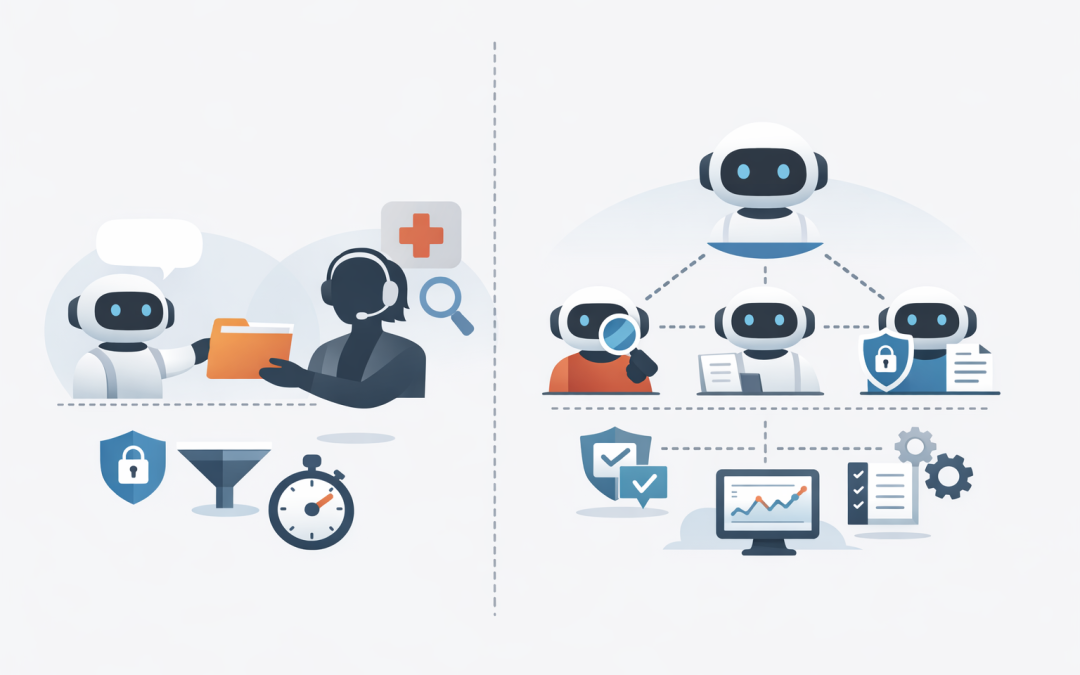
In this blog post How to Choose OpenAI Agent SDK Handoffs or Agents as Tools Safely we will explain two ways AI agents can divide work, why the difference matters, and how to choose the pattern that gives your business the right balance of control, cost and speed.


The simple version is this: with a handoff, one AI agent transfers responsibility to another. With agents as tools, a central agent stays responsible and calls specialists for help. Both approaches can work, but choosing the wrong one can create duplicated work, inconsistent answers and unexpected AI costs.
What technology sits behind these patterns
The OpenAI Agents SDK is a software development kit for building AI systems that can follow instructions, use business tools and delegate work. An agent combines an AI model with a defined role, access to approved tools and rules governing what it can do.
For example, an employee support agent might answer Microsoft 365 questions, check a service-management system and escalate account problems. Rather than expecting one large agent to understand every process, organisations can create specialists for areas such as finance, human resources, IT support and security.
The Agents SDK includes a runner that manages this process. It sends the request to an agent, executes approved tool calls and continues until the system produces a final answer. If a handoff occurs, the runner continues with the newly selected agent.
This is a form of AI agent orchestration, meaning the rules that determine which agent works, when it works and who remains accountable. We explain the broader options in AI Agent Orchestration Patterns Explained for Business Leaders.
How an OpenAI Agent SDK handoff works
A handoff changes who owns the conversation. A general triage agent might identify that a request concerns payroll, then transfer the conversation to a payroll specialist. That specialist becomes the active agent and handles the next part of the interaction.
This is similar to a receptionist transferring a caller to the correct department. Once transferred, the receptionist is no longer writing every response.
Handoffs work well when the specialist needs to ask follow-up questions, maintain a distinct role or manage a longer process. Examples include an IT incident moving to a security agent, an employee request moving to HR, or a customer dispute moving to a complaints specialist.
By default, the receiving agent can see the earlier conversation. The SDK also supports filters that control what information is passed across. This matters when the history contains personal, financial or commercially sensitive information that the next agent does not need.
How an agent used as a tool works
With agents as tools, a central manager agent keeps control of the conversation. It calls a specialist agent for a bounded task, receives the result and then decides how to use it in the final response.
Think of an operations director asking a finance analyst for one calculation. The analyst provides the figure, but the operations director still owns the report and communicates the decision.
This pattern is useful when the final answer must have one consistent voice or combine several specialist inputs. A proposal agent could ask one specialist to review pricing, another to check contract risk and another to confirm technical requirements before producing a single recommendation.
The trade-off is that the manager may need to make additional AI model calls. These calls consume tokens, which are the chunks of text processed and billed by the model. Nested specialist runs can therefore add cost and response time if the design is not carefully controlled.
The business differences that matter
1. Ownership of the final answer
Choose a handoff when the specialist should become responsible for the interaction. Choose agents as tools when one manager must remain responsible for the final answer.
This is more than a technical preference. Clear ownership reduces contradictory advice and makes it easier to investigate why an AI system made a recommendation.
2. Control over sensitive information
A handoff may pass conversation history to the next agent, so businesses need rules about what information can move between specialists. Do not give every agent access to every document, customer record or internal system simply because it is convenient.
Agents used as tools can provide tighter boundaries because the manager can send a narrow question rather than the full conversation. However, this benefit only exists if the workflow is deliberately designed around minimum access.
The Australian government’s Essential 8 cybersecurity framework does not prescribe how AI agents should be orchestrated. However, the same risk-management mindset applies: limit access, separate responsibilities and maintain records of important actions.
3. Cost and response time
Handoffs can be efficient when a request clearly belongs to one specialist. The original agent routes the work, and the specialist continues without the manager repeatedly reviewing every step.
Agents as tools may require the manager to call several specialists and then process their outputs. That additional checking can be valuable for high-impact work, but it may be wasteful for simple requests such as checking an order status.
4. Consistency and governance
A manager-agent pattern makes it easier to enforce one response format, brand voice and approval process. This is valuable for board reports, customer communications and regulated workflows.
Handoffs offer greater specialist independence, but each agent needs clear instructions and guardrails. Guardrails are automated checks that prevent unsafe inputs, unsupported claims or unauthorised actions. Production systems also need monitoring, testing and human approval for high-risk decisions, as discussed in our guide to building production AI agents with Claude API and Agent SDKs.
A practical 200-person company scenario
Consider a 200-person professional services company building an internal employee assistant. Staff use it for leave questions, Microsoft 365 support, security incidents and expense policies.
If every request is handed off, employees may experience sudden changes in tone and repeated questions. Entire conversation histories may also be passed to departments that do not need them.
If every specialist is used as a tool, the central agent becomes a bottleneck. Even simple password or policy questions may trigger multiple model calls, increasing costs and slowing answers.
A better design is mixed. Straightforward IT and HR conversations can be handed to specialists that need to interact directly with employees. Short tasks such as checking a policy clause or classifying a security alert can be handled by agents used as tools.
The business outcome is faster support without giving every agent broad access or paying for unnecessary AI processing.
What the code looks like
The following simplified Python examples show the structural difference. Production code would also need authentication, logging, access controls, error handling and testing.
A handoff to a specialist
from agents import Agent, Runner

security_agent = Agent(
 name="Security specialist",
 instructions="Handle suspected security incidents and explain safe next steps."
)

triage_agent = Agent(
 name="Employee support",
 instructions="Answer general questions and transfer security incidents.",
 handoffs=[security_agent]
)

result = Runner.run_sync(
 triage_agent,
 "I clicked a suspicious Microsoft 365 login link."
)

print(result.final_output)
Here, the triage agent can transfer the interaction. The security specialist then takes responsibility for the conversation.
Calling a specialist as a tool
from agents import Agent, Runner

policy_agent = Agent(
 name="Policy specialist",
 instructions="Review company policies and return a short factual summary."
)

manager_agent = Agent(
 name="Employee assistant",
 instructions="Own the final response and use specialists when required.",
 tools=[
 policy_agent.as_tool(
 tool_name="review_policy",
 tool_description="Check an internal policy for relevant requirements."
 )
 ]
)

result = Runner.run_sync(
 manager_agent,
 "Can I use a personal laptop for client work?"
)

print(result.final_output)
In this example, the policy specialist returns information to the employee assistant. The employee assistant remains responsible for the final response.
Use both patterns when the workflow demands it
Most mature systems will not choose one pattern for everything. A triage agent might hand a security incident to a dedicated security agent, which then calls separate investigation or policy agents as tools.
For workflows spanning OpenAI, Claude, Microsoft services and other platforms, the next question is how those agents communicate without creating vendor lock-in. Our guide to cross-platform multi-agent workflows with A2A explains that broader architecture.
A decision checklist for technology leaders
- Who should own the final answer? Use a handoff for specialist ownership and an agent tool for central ownership.
- Does the specialist need the full conversation? If not, send only the minimum information required.
- Is the task short and clearly defined? It is probably a good candidate for an agent used as a tool.
- Will the specialist need follow-up questions? A handoff may provide a more natural experience.
- Can the workflow affect money, access or people? Add deterministic rules and human approval rather than relying entirely on AI judgement.
- Are cost and response time being measured? Track model calls, token use, handoff frequency and failed routes before expanding.
Choose based on accountability, not novelty
Handoffs are best when a specialist should take over. Agents as tools are best when a central agent needs specialist input while keeping control. The right choice depends on accountability, data access, cost and the experience you want employees or customers to have.
With more than 20 years of enterprise IT experience across Azure, Microsoft 365, OpenAI, Claude and cybersecurity, CloudProInc focuses on practical designs that can be secured and supported after the demonstration is over. If you are unsure whether your agent architecture is adding unnecessary cost or risk, our Melbourne-based team is happy to review it with you — no strings attached.
Discover more from CPI Consulting
Subscribe to get the latest posts sent to your email.