
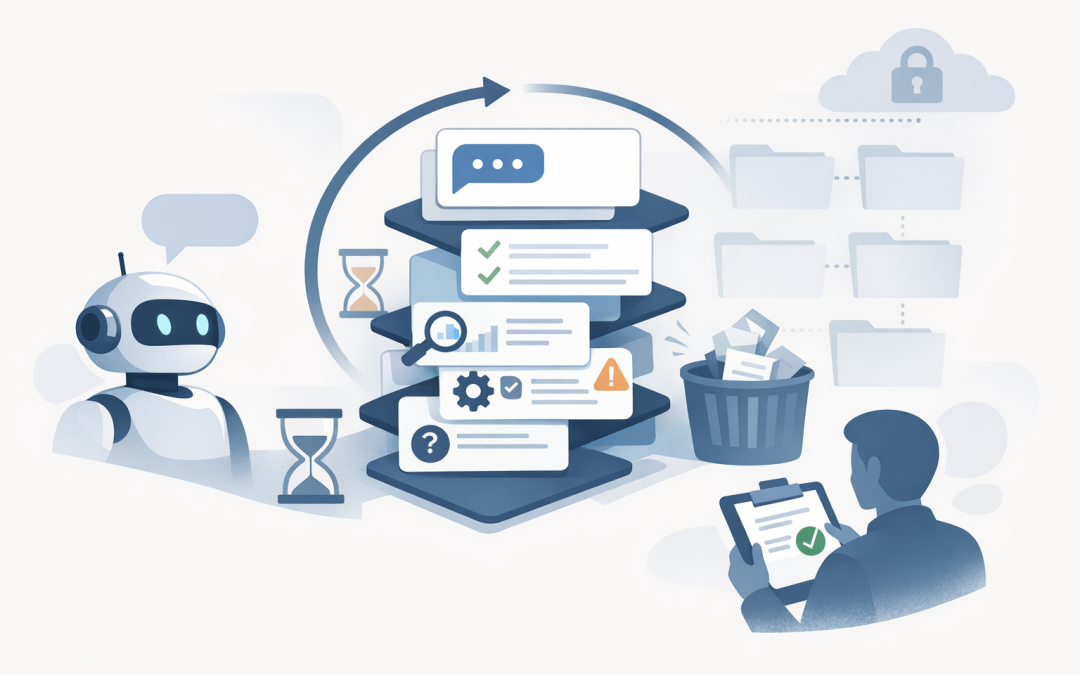
In this blog post What Multi-Turn State Means for Your OpenAI Agent in Practice we will explain how an agent keeps track of an ongoing task, why that continuity matters, and what your team must control before using it with business data.


Without multi-turn state, every interaction starts from scratch. An employee can spend ten minutes explaining a customer problem, approve the next step, and then discover that the agent has forgotten the original request.
At a high level, multi-turn state gives an OpenAI agent a working file for the current conversation. It can refer to earlier messages, its previous answers and the results returned by connected business systems instead of asking the user to repeat everything.
What multi-turn state actually means
A “turn” is one step in an interaction. A user asks a question, the agent replies or performs an action, and the conversation moves to the next turn.
State is the information carried from one turn to the next. Depending on how the agent is built, this may include:
- The user’s previous messages and clarifications.
- The agent’s earlier answers and recommendations.
- Tool calls, such as a request to search a customer record.
- Results returned by tools or business systems.
- Decisions, approvals and unresolved steps in a workflow.
Consider an employee asking an agent to investigate an overdue invoice. The first turn identifies the customer. The second checks the finance system. The third drafts an email, and the fourth asks the employee to approve it.
If the agent loses state between those turns, it may search for the wrong account, repeat work or send an email without the correct context. The issue is no longer an inconvenient chatbot response. It becomes a business process risk.
State is not the same as long-term memory
Multi-turn state normally supports the task happening now. Long-term memory is information retained for future conversations, such as a customer preference, an employee’s role or the outcome of a previous case.
A useful comparison is a meeting. State is the set of notes being used during the meeting. Memory is the approved information filed afterward for future use.
This distinction matters because not everything in a conversation should become permanent memory. Draft ideas, incorrect assumptions and sensitive personal information may need to be discarded rather than remembered.
We explore durable memory in more detail in how Microsoft Foundry Agent Memory makes AI agents more useful. Multi-turn state comes first because an agent must reliably complete today’s task before it can benefit from remembering information tomorrow.
Why decision-makers should care
Employees spend less time repeating information
An agent that understands the previous turn can handle follow-up instructions such as “use the second option” or “send that to the account manager”. The employee does not need to re-enter the customer name, document or objective.
Across a service desk, finance team or internal operations function, removing a few minutes of repeated explanation from hundreds of tasks can create a meaningful productivity gain.
Multi-step work becomes more reliable
Useful agents rarely answer only one question. They collect information, consult business systems, compare options, request approval and then take an action.
State allows the agent to keep those steps connected. It can also preserve the result of a specialist agent when work is handed between agents, an approach covered in our guide to building a multi-agent assistant with the OpenAI Agents SDK.
Cost and response time need active management
Keeping state does not make conversation history free. As more information is carried forward, the model may need to process more tokens, which are the small chunks of text used for processing and billing.
A long, unfiltered history can increase cost, slow the response and distract the agent with outdated details. Strong implementations trim irrelevant information or use compaction, which compresses a lengthy history into a smaller form while preserving the important context.
Model choice also matters. Straightforward follow-up work may not require your most expensive model. Our article on the changing cost model for enterprise agent workloads explains why routing simpler tasks to a smaller model can improve the business case.
Conversation state becomes governed business data
Once state includes customer details, contracts, financial records or internal decisions, it must be protected like any other business information. Your team needs to decide where it is stored, who can retrieve it, how long it is retained and how it can be deleted.
Australian organisations should assess this against their privacy obligations and security controls. The Essential 8, the Australian Government’s baseline cybersecurity framework, does not replace AI governance, but its focus on access control, secure administration and system protection remains highly relevant.
The technology behind multi-turn state
An OpenAI model does not automatically understand every previous interaction in your application. Your software must provide a controlled way to connect the turns.
There are three common approaches.
- Replay the history. Your application stores earlier messages and sends the relevant history with each new request. This provides control but requires careful handling of tool results, long conversations and sensitive data.
- Chain responses. With the OpenAI Responses API, your application can pass the identifier of the previous response. This tells OpenAI which earlier response the new turn continues.
- Use a session or conversation. The OpenAI Agents SDK can manage conversation history through a session, while server-managed conversations can provide shared continuity across application services.
Here is a simplified Python example using a previous response identifier:
import os
from openai import OpenAI

client = OpenAI()

AGENT_RULES = """
You are an accounts support agent.
Never send an email without employee approval.
Only use customer information returned by approved tools.
"""

first_turn = client.responses.create(
 model=os.environ["OPENAI_MODEL"],
 instructions=AGENT_RULES,
 input="Review the overdue invoices for Contoso and suggest the next step."
)

second_turn = client.responses.create(
 model=os.environ["OPENAI_MODEL"],
 instructions=AGENT_RULES,
 previous_response_id=first_turn.id,
 input="Draft the email, but do not send it."
)

print(second_turn.output_text)
The important line is previous_response_id=first_turn.id. It connects the second request to the first so the employee does not need to explain which customer or invoices they mean.
Notice that the business rules are also sent again. When chaining responses this way, top-level instructions should be supplied on each request rather than assuming the previous rules will automatically carry forward.
A practical 200-person business scenario
Imagine a 200-person professional services company introducing an internal IT agent. Employees use it to report problems, check approved software and request access.
Without state, the agent repeatedly asks for the employee’s device, location and issue. If the request is handed to a specialist security agent, parts of the original conversation may be lost.
With controlled multi-turn state, the agent collects the details once, checks the device record, runs the approved troubleshooting steps and presents a summary to the service desk. A human still approves any high-risk change.
The business outcome is not simply a more natural conversation. It is shorter support calls, fewer repeated checks, clearer audit records and less risk of an automated action being performed with missing information.
Five controls to put in place before launch
- Set a clear boundary. Define when a conversation begins, when it ends and when its state must be reset.
- Keep users separated. Never allow one employee’s conversation state to appear in another employee’s session.
- Store only what is needed. Do not retain entire conversations when a short approved summary will support the next step.
- Require approval for high-impact actions. Sending messages, changing access or updating financial records should not depend on conversational context alone.
- Test long conversations. Confirm what happens when the history becomes large, a tool fails or the task is handed to a person.
If you use multiple specialist agents, choose one state strategy rather than combining several without a clear design. Uncontrolled duplication can increase processing costs and cause an agent to act on conflicting versions of the conversation. Multi-agent designs should be introduced where the value justifies the added complexity, as discussed in when multi-agent orchestration pays off.
Start with continuity, then add intelligence
Multi-turn state is what turns a one-off AI answer into a usable business workflow. Done well, it reduces repetition, supports safer automation and gives employees a more consistent experience.
Done poorly, it carries old mistakes forward, exposes sensitive information and quietly increases cost. The goal is not to make an agent remember everything. It is to make it retain the right information for the right amount of time.
CloudPro Inc brings more than 20 years of enterprise IT experience to practical AI, Azure and Microsoft security projects. As a Melbourne-based Microsoft Partner and Wiz Security Integrator, we help organisations design agents around real business processes, governance requirements and measurable outcomes.
If you are unsure whether your OpenAI agent is carrying too much context, forgetting important details or storing information it should not, we are happy to take a practical look at the design — no strings attached.
Discover more from CPI Consulting
Subscribe to get the latest posts sent to your email.