
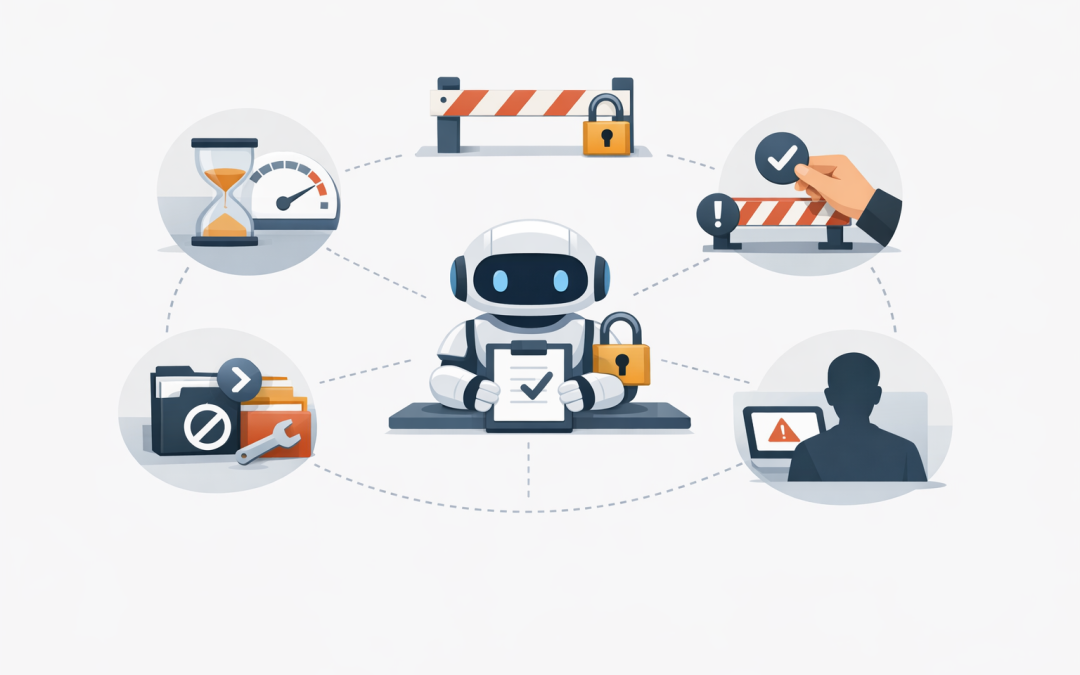
In this blog post Why Business AI Agents Should Follow the Principle of Least Agency we will explain how to give an AI agent enough freedom to deliver value without allowing it to create unnecessary cost, security exposure or operational risk.


The principle is simple. An AI agent should receive only the decision-making freedom, system access and time it needs to complete a clearly defined job. It should not be able to keep exploring, changing records or contacting people simply because the technology makes those actions possible.
This matters because AI agent projects often begin with a productivity goal and quietly grow into something much riskier. A tool designed to summarise customer emails may eventually be allowed to update records, issue refunds and send replies without anyone reconsidering the controls.
What least agency means in practical terms
Most IT leaders already understand least privilege. It means giving a person or system the minimum access required to do its job.
Least agency goes further. It limits not only what an AI agent can access, but also what it can decide, how many actions it can take, how long it can operate and when it must ask a person for help.
For example, an accounts payable agent may need to read invoices and compare them with purchase orders. That does not mean it should also be able to create suppliers, change bank details or release payments.
Least agency turns that distinction into a design rule rather than relying on the agent to make the right choice every time.
The technology behind a business AI agent
An AI agent combines an AI model, instructions, business data and tools. The model may come from OpenAI or Anthropic Claude, while the tools connect it to systems such as Microsoft 365, Azure, a customer database or a finance platform.
The AI model acts as the reasoning layer. It interprets the request, reviews the available information and chooses what to do next. Tools are the agent’s hands: they allow it to search files, create tickets, update records, send messages or trigger business processes.
An orchestration layer manages the steps between the model and those tools. It can apply rules, request approval, record activity and stop the agent when a limit is reached. Our guide to AI agent orchestration patterns that reduce risk and cost explains how these workflows can be structured.
The important point is that safety cannot depend on a prompt saying, “Please be careful.” Controls must sit around the model and technically prevent actions that are outside the agent’s job.
Five controls that put least agency into practice
1. Give every agent one clear job
An agent described as a “general business assistant” has an unclear boundary. A better definition is “review incoming support requests, categorise them and draft a response for an employee to approve.”
The narrower definition makes performance easier to measure. It also reduces the chance of the agent wandering into finance, legal, HR or security decisions it was never designed to handle.
This is also why choosing between task-based and conversation-based AI agents matters. A predictable task should usually begin with a predictable workflow, not unlimited autonomy.
2. Separate reading from acting
Reading information and changing information carry very different risks. An agent that reads a customer record to prepare a briefing is less dangerous than one that can alter the record or send a customer message.
Start with read-only access wherever possible. Add write access only after the business case, testing and approval process are clear.
This staged approach can produce useful results sooner. Employees receive faster research and better drafts while the business avoids handing control of critical systems to an unproven process.
3. Limit tools, data and memory
An agent should see only the data required for its current task. A sales proposal agent may need approved product information and the relevant customer account, but it does not need access to every customer, employee file or financial report.
The same principle applies to memory. Persistent memory can help an agent remember preferences or business context, but unnecessary memory creates privacy and accuracy risks. Our article on building AI agents that remember business context safely covers this area in more detail.
Restricting data also reduces the impact of a compromised account, incorrect instruction or misleading document.
4. Require approval for high-impact actions
Not every action needs human approval. Requiring an employee to approve every search or draft would remove much of the productivity benefit.
Approval should be based on business impact. Sending an internal summary may be automatic, while changing payment details, deleting records, publishing content or contacting a customer should require confirmation.
Risk-based approval keeps routine work moving while ensuring a responsible person remains accountable for consequential decisions.
5. Set limits on time, cost and repetition
AI agents can enter loops, repeat searches or keep calling paid services when they cannot complete a task. Without limits, a small mistake can become an unexpected bill or a flood of duplicate actions.
Set maximum run times, tool calls, retries and spending limits. The agent should stop and escalate when it cannot complete the job within those boundaries.
These limits improve reliability as well as cost control. A process that repeatedly fails should become visible to the IT team instead of continuing quietly in the background.
What an agent control contract can look like
The controls do not need to begin as a complicated technical document. A plain-English contract can help business owners, security teams and developers agree on the boundaries before development starts.
Agent: Supplier invoice checker

Can read:
- Approved invoice mailbox
- Purchase orders for the relevant supplier

Can do:
- Compare invoice and purchase order details
- Flag mismatches
- Draft an approval note

Cannot do:
- Create or modify suppliers
- Change bank account details
- Release payments

Human approval required:
- Any supplier detail change
- Any payment above $5,000

Stop conditions:
- More than two failed checks
- More than ten tool calls
- Missing purchase order or supplier record
The development team can then enforce these boundaries through separate agent identities, restricted permissions, approved tool lists, validation rules and activity logs.
A practical scenario for a 200-person business
Consider a 200-person company introducing an agent to manage service requests. The original plan allows the agent to read emails, reset passwords, create user accounts, order equipment and close support tickets.
That design may look efficient, but one incorrect decision could lock out an executive, create an unauthorised account or order equipment for a fraudulent request.
A least-agency design starts smaller. The agent categorises requests, collects missing details, checks approved procedures and prepares the next action. It may automatically handle low-risk requests, while identity changes, purchases and account creation require employee approval.
The company still reduces repetitive support work, but its exposure is far lower. It can expand the agent’s authority gradually after reviewing actual performance and failure patterns.
How least agency supports Australian security obligations
The Essential Eight, the Australian government’s baseline cybersecurity framework, includes ideas such as restricting administrative privileges and controlling which applications can operate. Least agency applies similar thinking to AI-powered automation.
It also supports privacy obligations by reducing unnecessary access to personal and commercially sensitive information. Every agent should have an identifiable owner, a documented purpose and an activity record that can be reviewed during an incident or audit.
Monitoring tools such as Microsoft Defender and Wiz can help security teams identify unusual access and risky cloud activity. However, monitoring is the last line of defence. The safer approach is to prevent excessive authority from being granted in the first place.
Start useful, controlled and measurable
The best business AI agent is not the one with the most freedom. It is the one that completes a valuable task consistently, at a known cost and within boundaries the business understands.
Begin with a narrow job, read-only access and clear stop conditions. Measure accuracy, time saved, exceptions and human intervention before expanding what the agent can do.
CloudProInc brings more than 20 years of enterprise IT experience to this process. As a Microsoft Partner and Wiz Security Integrator, our Melbourne-based team works hands-on across Azure, Microsoft 365, OpenAI, Claude, Microsoft Defender and Wiz for organisations in Australia and internationally.
If you are unsure whether an AI agent has been given more freedom than the business can safely manage, we are happy to review the design and identify practical ways to reduce the risk — no strings attached.
Discover more from CPI Consulting
Subscribe to get the latest posts sent to your email.