
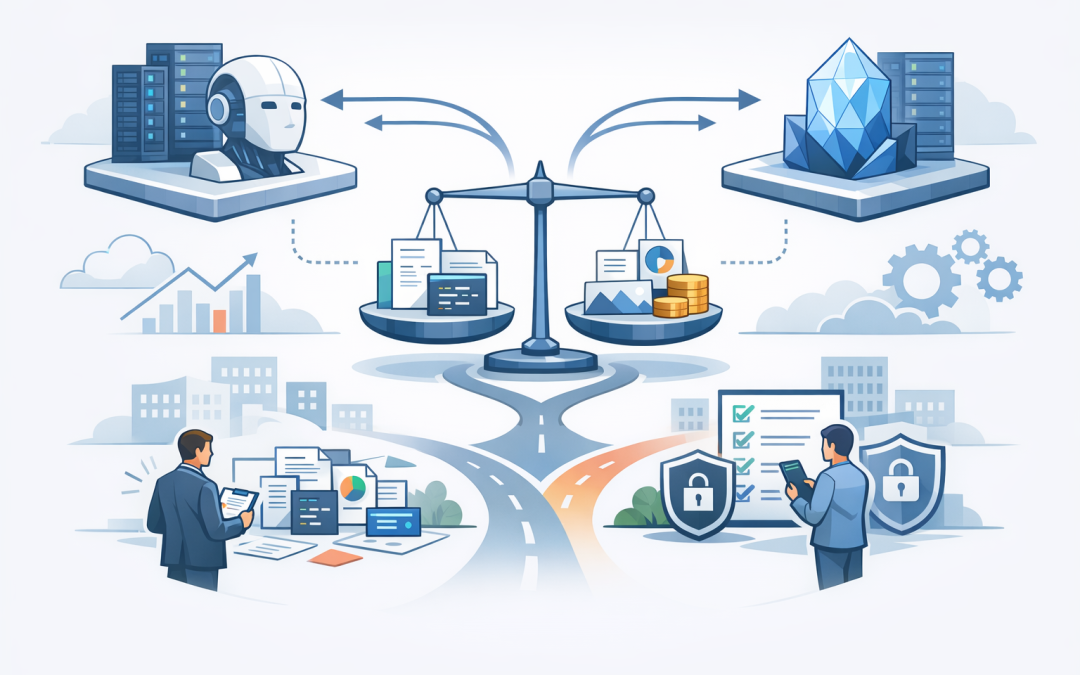
In this blog post What Kimi K3 Matching Claude Opus 4.8 Means for Business AI we will explain why the latest model results matter to business leaders, where the potential savings are, and what to check before changing your AI strategy.


Many organisations have started building important workflows around one AI provider. The concern is that pricing may rise, a model may change, or the provider may no longer meet the organisation’s security and compliance requirements.
Kimi K3 changes that conversation. Its strong results against Claude Opus 4.8 suggest that advanced AI capability is becoming available from a broader range of providers. That creates more choice, but it does not mean every business should immediately move to Kimi.
The headline is greater choice, not a new winner
Kimi K3 is a large AI model developed by Moonshot AI. Like Claude, ChatGPT and Gemini, it can understand instructions, analyse information, create content, write software and use connected business tools.
At launch, Kimi K3 entered the same performance conversation as premium models such as Claude Opus 4.8. It performed strongly on tests involving long tasks, software development, reasoning and tool use.
However, a benchmark is a controlled test. It does not tell you whether the model will correctly review your contracts, follow your internal policies or produce reliable reports from your company data.
The more useful interpretation is that businesses are becoming less dependent on a small group of AI providers. We explored the broader market implications in what Kimi K3 really means for business AI. Here, the focus is what technology and IT leaders should do next.
How the technology works in plain English
Kimi K3 is built using a mixture-of-experts design. Instead of using every part of the model for every request, it sends each piece of work to the sections most suited to handling it.
Think of it like a large consulting firm. You may have hundreds of specialists available, but you only assign the relevant experts to each project. This can provide the capability of a very large model without using the entire model for every response.
Kimi K3 has 2.8 trillion total parameters. Parameters are the internal patterns the model learned during training. A larger number does not automatically mean a better model, but it gives an indication of its scale.
It also offers a context window of roughly one million tokens. In practical terms, the context window is the amount of information the AI can consider in one session. A large context window can help with extensive policy libraries, software repositories, research material and collections of business documents.
Kimi K3 is also multimodal, meaning it can work with more than plain text. It can interpret visual information alongside written instructions, opening the door to tasks involving diagrams, screenshots, forms and document layouts.
Claude Opus 4.8 uses a different technical approach but targets many of the same demanding workloads. It is designed to spend more effort on difficult requests, use business tools and continue working across long, multi-step tasks.
AI costs could fall, but token price is only part of the bill
At launch, Kimi K3’s application programming interface, or API, was priced at US$3 per million input tokens and US$15 per million output tokens. An API is simply the connection that allows a business application to send work to an AI model.
Claude Opus 4.8 started at US$5 per million input tokens and US$25 per million output tokens. On the published rates, Kimi K3 is approximately 40% cheaper before discounts, caching and other variables are considered.
Consider a 200-person professional services firm using AI to review documents, prepare client reports and support software development. If its monthly model charges reached US$20,000 using the same mix of input and output, a 40% reduction could theoretically save around US$8,000 per month.
That saving is not guaranteed. One model may produce longer answers, require more retries or need more human checking. The correct comparison is the cost of completing an acceptable piece of work, not the price of generating one million tokens.
Model portability is becoming an important business safeguard
Most businesses would not build every critical system around a database they could never replace. AI should be treated with the same caution.
If your application only works with one model, changing providers may require months of redevelopment. This creates vendor lock-in, where switching becomes too expensive or disruptive even when a better option appears.
New AI systems should separate the business workflow from the model supplying the intelligence. This makes it possible to send routine work to a lower-cost model, complex work to a premium model and sensitive work to an approved environment.
This does not mean constantly switching providers. It means retaining the ability to switch when pricing, performance, availability or risk changes.
Benchmark parity does not equal business readiness
Kimi K3 matching or exceeding Claude Opus 4.8 on selected tests does not make the two models interchangeable. Your organisation’s own work is the benchmark that matters.
A legal team may care about accurate clause extraction. A finance team may care about spreadsheet calculations. A software team may care about whether generated code passes security testing.
Before selecting a model, test it against at least three real workflows and measure:
- How often the output is correct on the first attempt.
- How much employee review time is required.
- Whether the model follows instructions and internal policies.
- The total cost of completing each task.
- How consistently it performs over repeated tests.
Our practical AI model scorecard explains why cost, governance and operational reliability should be considered alongside raw intelligence.
Security and governance now matter even more
More model choice can reduce costs, but it also gives employees more ways to send company information outside approved systems. A capable model is not automatically a safe place for customer records, financial data or intellectual property.
Australian organisations should check where information is processed, whether prompts are retained, whether data may be used for training and what contractual protections apply. Cross-border data handling may also create obligations under the Privacy Act and the Australian Privacy Principles.
The Essential Eight, the Australian Government’s cybersecurity framework that many organisations are expected or required to follow, remains important. However, it does not replace specific AI governance.
Businesses also need rules covering approved models, acceptable information, human review and incident reporting. Microsoft Defender, which helps detect and respond to cyber threats, and Wiz, which identifies security risks across cloud environments, can support the surrounding controls, but management policies are still essential.
A practical next step for CIOs and CTOs
Do not start with a company-wide migration. Select one high-volume workflow and one high-value workflow, then compare Kimi K3, Claude and your existing model using the same information and success criteria.
- Choose tasks with a measurable cost, delay or error rate.
- Remove personal and confidential information from early tests.
- Measure accuracy, review time, speed and total cost.
- Review data location, retention and contractual conditions.
- Design a fallback option if a model becomes unavailable.
- Run a controlled 30-day pilot before expanding access.
If Claude is already part of your Microsoft environment, our guide to Claude Opus 4.8 in Azure AI Foundry explains how model choice can fit within an established Azure security and governance approach.
The business advantage will come from flexibility
Kimi K3’s performance is another sign that no AI provider will hold a permanent lead. The best model for your business may change by task, price or risk level.
The organisations that benefit will not be those chasing every new release. They will be the ones building secure, measurable AI workflows that can use different models without rebuilding everything from scratch.
CloudProInc is a Melbourne-based Microsoft Partner and Wiz Security Integrator with more than 20 years of enterprise IT experience. We help organisations assess AI models, secure their cloud environments and turn promising experiments into practical business systems.
If you are unsure whether your current AI setup is delivering value or quietly creating cost and security risk, we are happy to take a practical look — no strings attached.