
In this blog post What New Microsoft Agent Framework Releases Mean for Enterprise AI we will explain how Microsoft’s latest updates affect the way organisations should design, secure and operate AI agents.


Many businesses now have an AI assistant that works well in a demonstration but becomes unreliable when connected to real users, company data and business systems. Conversations disappear, long tasks fail halfway through, security controls vary between applications, and nobody can clearly explain why the agent made a decision.
The latest Microsoft Agent Framework releases address these operational problems. The bigger message is not simply that developers have more features. It is that enterprise agents now need to be designed as managed business systems rather than clever chatbots.
What Microsoft Agent Framework actually does
Microsoft Agent Framework is an open-source toolkit for building AI agents in .NET, Python and, with some capabilities still developing, Go. An AI agent uses a language model such as Azure OpenAI, OpenAI or Anthropic Claude to understand a request, access approved tools and data, and complete work on a user’s behalf.
The framework also supports workflows, which give agents an explicit sequence of steps to follow. This distinction matters because an agent can make flexible decisions, while a workflow provides predictable control for processes such as approving invoices, reviewing contracts or responding to security alerts. Microsoft Agent Framework reached its production-ready 1.0 milestone in April 2026 and has continued adding hosting, state management and operational controls.
We previously covered the broader shift from prototype to production in what Microsoft Agent Framework means for real-world AI delivery. The latest release stream goes further by changing how the surrounding architecture should be structured.
1. The agent should be separated from the channel
One of the most important recent additions is a channel-based hosting model. A channel is simply the route through which a person or system communicates with an agent, such as an application programming interface, an MCP tool connection or another agent using A2A.
MCP, or Model Context Protocol, provides a standard way for agents to use approved tools and information. A2A, or Agent-to-Agent protocol, allows separate agents to communicate without requiring custom integration code for every connection.
The new Python hosting packages separate the agent from protocol-specific connections for OpenAI Responses, Telegram, A2A and MCP. The business application remains responsible for authentication, authorisation, routing, storage and deployment.
This is good architecture. The same expense-review agent can be made available through an internal portal, another automated workflow and an approved agent connection without building three separate versions of its business logic.
The business outcome is lower maintenance cost and less inconsistent behaviour. Security changes can also be applied at the channel boundary instead of being copied into every agent.
2. State is now a core infrastructure decision
Agents need state, meaning the information required to continue a conversation or process. This can include previous messages, completed workflow steps, approvals, selected models and files created during a task.
The late-August releases place greater emphasis on reliable state. Python 1.16.0, released on 27 August 2026, includes protections around workflow checkpoints and service-session snapshots. The recent .NET release line also adds patterns for persistent sessions, including Azure Blob Storage, which is Microsoft’s cloud service for storing files and application data.
A checkpoint is a saved recovery point. If an agent processing a complex customer request stops after step seven of ten, a checkpoint can allow it to resume rather than repeat work, lose context or charge the business for the same model calls again.
Technology leaders should therefore decide where agent state is stored, how long it is retained, who can access it and how it is recovered. Treating memory as an afterthought can create privacy, cost and reliability problems.
3. Long-running work needs durable control
Enterprise agents increasingly perform tasks that may take minutes or hours. An agent might gather documents, ask specialist agents for input, wait for a manager’s approval and then update a business system.
The current framework includes background-agent support, configurable timeouts and more resilient hosted-agent patterns. In plain English, businesses gain better control over how long automated work can run, what happens when one component does not respond and whether interrupted work can continue.
This does not mean every process should become autonomous. High-risk actions such as changing bank details, deleting records or granting access should still require clear approval.
Our production guide for A2A and MCP governance examines these controls in more detail. The key architectural lesson is that background work needs limits, recovery rules and an accountable owner.
4. Observability belongs in the design from day one
When a traditional application fails, IT teams inspect logs. When an agent fails, they may also need to understand which model was used, what tool was called, how long each step took and whether the agent received incomplete information.
Recent releases improve support for OpenTelemetry, a common standard for recording application performance and activity. This makes it easier to send agent information into the monitoring tools an organisation already uses rather than creating a separate reporting island.
This has a direct financial benefit. Without usable monitoring, teams cannot identify expensive prompts, repeated tool calls, slow integrations or failed workflows that keep consuming cloud resources.
5. Model choice can become a routing decision
Not every task needs the most powerful and expensive AI model. A simple classification job may use a smaller model, while a complex risk review may require a more capable option.
The framework’s provider support and session-aware routing patterns make it easier to select models while preserving a consistent agent interface. That can include Microsoft Foundry, Azure OpenAI, OpenAI, Anthropic Claude and other supported providers.
The architecture should therefore place model selection behind a controlled routing layer. This reduces dependence on one model and allows cost, privacy and performance rules to determine which service handles each task.
A practical enterprise architecture
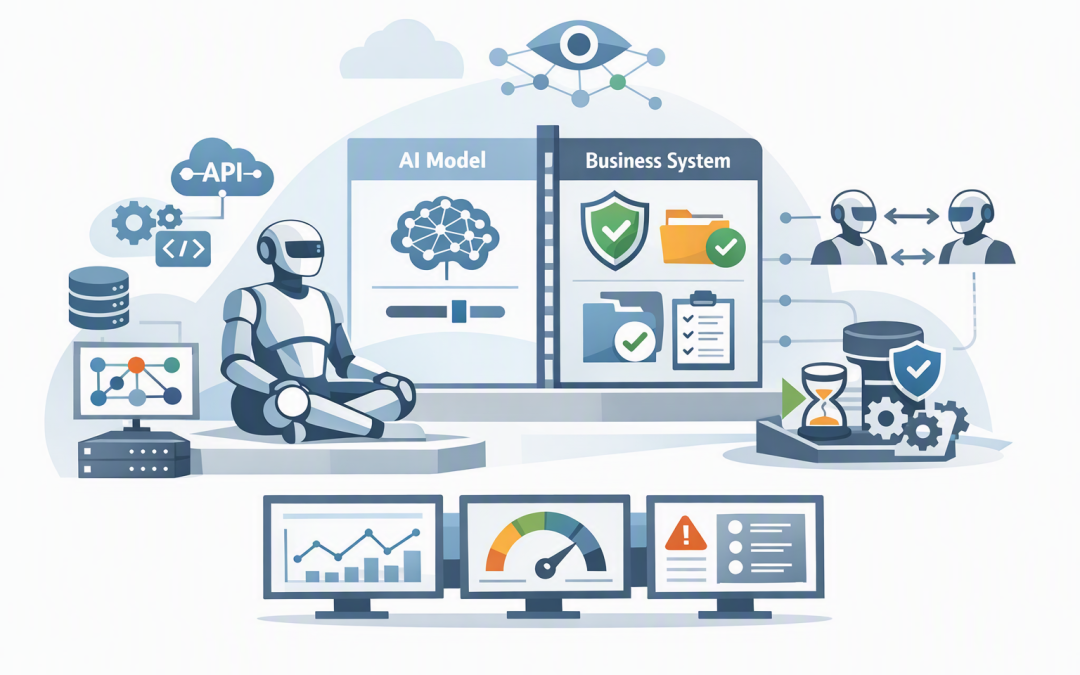
A sensible design now looks less like one large chatbot and more like a set of controlled layers:
Users and business systems
 ↓
Authenticated channel adapters
 ↓
Agent or controlled workflow
 ↓
Policy checks and human approvals
 ↓
Approved tools, agents and company data
 ↓
Persistent sessions and recovery checkpoints
 ↓
Central monitoring, cost reporting and audit logs
This separation makes each part easier to secure, test and replace. It also supports the controls behind the Essential 8, the Australian Government’s cybersecurity framework, including restricting administrative access, controlling applications and maintaining effective monitoring.
What this looks like in a real business
Consider a 200-person professional services firm building an agent to prepare client onboarding packs. The first version reads an email, searches Microsoft 365 and drafts documents.
In production, the firm discovers that different entry points create separate conversations, failed searches restart the entire process and nobody can see which model is driving costs. The problem is not the quality of the language model. It is the surrounding architecture.
By separating channels, storing sessions centrally, adding checkpoints and monitoring every tool call, the firm gains a recoverable process with clearer costs and consistent security. Human approval remains mandatory before client documents are issued.
What technology leaders should do next
- Map every channel. Document where users, applications and other agents can access the service.
- Define the system of record. Decide where sessions, approvals, files and workflow checkpoints will live.
- Separate reasoning from action. Do not allow a model decision to trigger a high-risk action without policy checks.
- Set time and cost limits. Background agents should have clear thresholds, retry rules and escalation paths.
- Centralise monitoring. Capture model usage, tool activity, failures and user identity in your existing security and operations platforms.
- Test upgrades before production. Pin software versions and review migration guidance because some integrations continue to change quickly.
If you use Microsoft Foundry for hosting, our article on what Azure AI Agent Server general availability means explains the related hosting and scaling decisions.
The main takeaway
The latest Microsoft Agent Framework releases make enterprise agent architecture more modular, recoverable and observable. That should reduce duplicated development, uncontrolled cloud spending and the risk of agents acting without adequate oversight.
CloudProInc brings more than 20 years of enterprise IT experience to these decisions, with hands-on expertise across Microsoft Azure, Microsoft 365, Microsoft Foundry, OpenAI, Anthropic Claude, Defender and Wiz. As a Melbourne-based Microsoft Partner and Wiz Security Integrator, we help organisations build practical AI systems without separating AI delivery from security and governance.
If you are unsure whether your current agent design is ready for real users, sensitive data and long-running business processes, we are happy to review the architecture with you — no strings attached.
Discover more from CPI Consulting
Subscribe to get the latest posts sent to your email.