
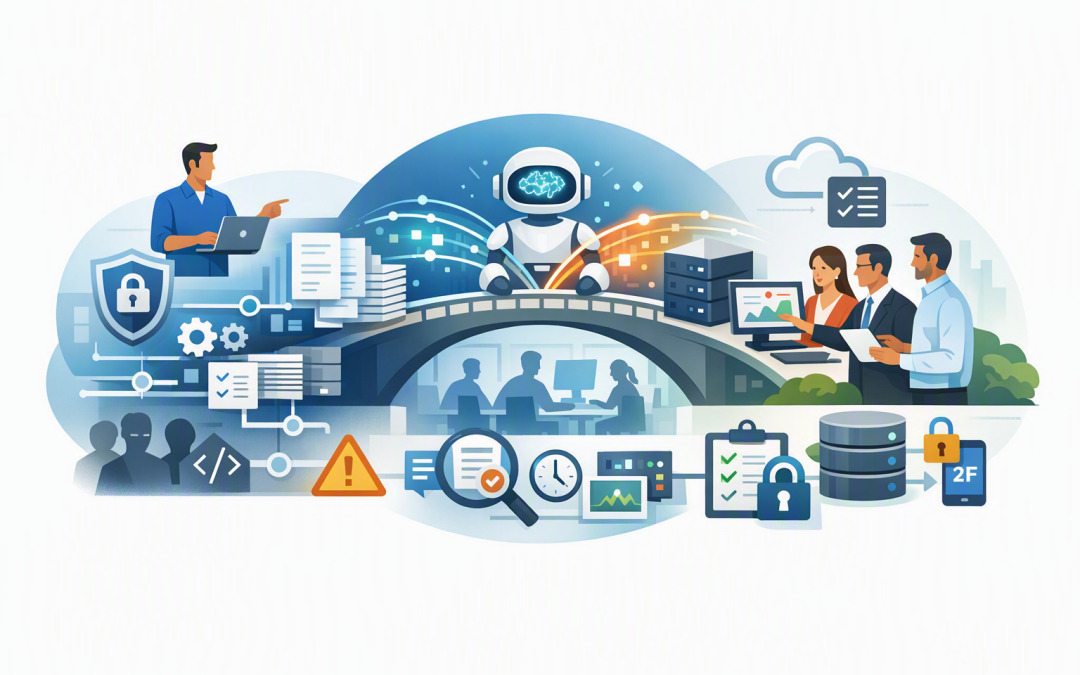
In this blog post Why Forward Deployed Engineers Make AI Transformation Succeed we will explain why promising AI trials often stall, how this role connects strategy with delivery, and what technology is required to produce secure, measurable business results.
Many businesses already have access to capable AI tools. Their real problem is turning those tools into dependable systems that employees can use without exposing sensitive data, disrupting established processes or creating another expensive platform that nobody adopts.
A forward deployed engineer helps solve that problem by working closely with business leaders, employees, IT teams and security specialists. Rather than building technology from a distant development queue, they work inside the operational problem until the AI system produces a useful and repeatable outcome.
AI transformation is an operating change, not a software purchase
Buying access to an AI model such as OpenAI or Anthropic Claude is relatively straightforward. Changing how a finance team reviews invoices, how a service desk resolves requests or how a sales team prepares proposals is much harder.
Every process contains exceptions, informal decisions and information held in different systems. Employees may also use unofficial AI tools when approved options are too difficult, creating what is sometimes called shadow AI: AI use that the business cannot properly see, manage or secure.
A forward deployed engineer maps these realities before recommending technology. This prevents the business from automating a process that is poorly understood or selecting a use case that looks impressive but saves little time.
If you want a closer look at the day-to-day responsibilities, our guide to what a senior forward deployed engineer does explains the role in more detail.
The technology behind practical AI transformation
Most business AI systems contain more than a chatbot. The visible conversation window is only the front door to several connected technologies.
The AI model
A large language model, or LLM, is the technology that interprets requests and produces responses. Models from OpenAI and Anthropic Claude can summarise documents, draft content, classify information and help employees work through complex tasks.
The model does not automatically understand your company, however. It needs clear instructions, controlled access to business information and limits on what it is allowed to do.
Business information
A technique often called retrieval-augmented generation allows an AI system to find approved information before answering a question. In plain English, the system searches your policies, product documents or knowledge base and uses the relevant material to prepare its response.
This is usually more practical than trying to retrain an AI model whenever company information changes. It can also provide a clearer connection between an answer and the source material used to create it.
Connections to existing systems
Application programming interfaces, usually shortened to APIs, allow systems to exchange information securely. They might let an AI assistant read an approved customer record, create a service ticket or prepare a draft response inside an existing workflow.
The forward deployed engineer decides where AI should only provide advice and where it may perform an action. High-risk steps, such as approving a payment, changing an employee record or sending legal advice, should generally retain human review.
Identity and security controls
AI should follow the same access rules as the rest of the business. An employee should not receive information through an AI assistant that they could not normally open in Microsoft 365, Azure or another company system.
This requires identity controls, logging, data protection and regular security testing. Microsoft Defender helps identify and respond to threats across Microsoft environments, while Wiz provides visibility into cloud risks and configuration problems that could expose data or systems.
These controls should also support Essential Eight, the Australian Government’s cybersecurity framework that helps organisations reduce common attack risks. AI does not replace basics such as multi-factor authentication, software patching, restricted administrator access and reliable backups.
Where the forward deployed engineer creates business value
Choosing the right first problem
Tech leaders are often presented with dozens of AI ideas. The forward deployed engineer helps rank them by expected value, delivery effort, data readiness and risk.
A useful first project is normally frequent, measurable and painful enough that employees want it fixed. Reducing a recurring administrative task from 30 minutes to five minutes is often more valuable than launching a broad assistant with no clear purpose.
Building around real employee behaviour
A technically accurate system can still fail if it adds steps or forces employees to leave the tools they already use. The engineer observes how work is actually completed, tests early versions with users and adjusts the design based on practical feedback.
This improves adoption and exposes issues that rarely appear in a strategy workshop. For example, the required information may arrive as scanned attachments, customer terminology may be inconsistent, or managers may apply different approval rules.
Creating evidence before expanding
AI projects need defined measurements before development starts. Depending on the use case, these might include time saved per transaction, fewer support escalations, faster customer responses, reduced rework or lower external processing costs.
The engineer also tests answer quality, security and unusual cases. Current responsible AI guidance recommends assessing risk before release, applying suitable protections and monitoring behaviour after deployment rather than treating launch day as the end of the project.
Our article on turning AI into measurable value covers how to select practical performance measures.
Building internal capability
The goal should not be permanent dependence on one specialist. A good forward deployed engineer documents decisions, trains internal staff and creates a support model that the business can maintain.
This is where the role becomes part of broader AI transformation. Successful patterns can be reused, common security controls can be standardised and future projects can move faster without repeating the same mistakes.
A practical business scenario
Consider a 180-person professional services company receiving hundreds of client documents each week. Employees manually read each document, identify important details and enter the information into a case management system.
Management initially proposes a general AI assistant. A forward deployed engineer instead studies the workflow and discovers that most delays come from three document types and a small number of repeated checks.
The first release focuses only on those documents. It extracts key information, flags missing details and prepares a draft case entry, but an employee still approves the result before anything is saved.
The system uses approved company information, existing employee access permissions and an audit trail showing what was reviewed. Performance is measured through processing time, correction rates and the number of documents handled without escalation.
This smaller approach produces evidence quickly while limiting risk. If the results are strong, the business can add more document types rather than committing a large budget before knowing whether the idea works.
When your business may need this role
A forward deployed engineer may be useful when:
- Your AI trials generate interest but never reach normal business operations.
- Business and IT teams disagree about priorities, requirements or ownership.
- Sensitive information is involved and security cannot be added later.
- You need to connect AI with Microsoft 365, Azure or existing business systems.
- Leadership cannot see clear measures of cost reduction, productivity or risk.
- Your internal team understands the business but lacks hands-on AI delivery experience.
The role is particularly valuable during the move from isolated pilots to a managed portfolio of AI systems. At that point, the organisation needs common rules for access, testing, monitoring, support and investment decisions.
Making AI transformation practical
AI transformation succeeds when the technology fits the work, employees trust it and leaders can see what the investment has achieved. A forward deployed engineer brings those requirements together while there is still time to change the design.
CloudProInc combines more than 20 years of enterprise IT experience with hands-on knowledge across Azure, Microsoft 365, OpenAI, Claude, Microsoft Defender and Wiz. As a Microsoft Partner and Wiz Security Integrator based in Melbourne, we help organisations build AI systems that are useful, secure and manageable.
If your AI plans are producing more presentations than business results, we are happy to take a practical look at the use case, risks and likely return — no strings attached.
Discover more from CPI Consulting
Subscribe to get the latest posts sent to your email.