
In this blog post Should Your AI Agent Remember Every Customer Conversation Forever we will explain why giving an AI agent unlimited memory can create more problems than it solves. Customers may appreciate not having to repeat themselves, but they will not appreciate an old complaint, incorrect assumption or sensitive detail appearing in the wrong conversation.
At a high level, AI memory allows an agent to carry useful information from one interaction to another. The goal is not to preserve every word forever. It is to remember the smallest amount of accurate information needed to provide better service.
For most businesses, the right answer is clear: your AI agent should remember important customer context, but it should not automatically retain every conversation.
What AI agent memory actually means
An AI model such as OpenAI or Anthropic Claude does not naturally remember a customer forever. It processes the information supplied during a request and generates a response.
To create memory, the business connects the agent to systems that store and retrieve information. This can include a customer relationship management system, support platform, database or a dedicated AI memory service.
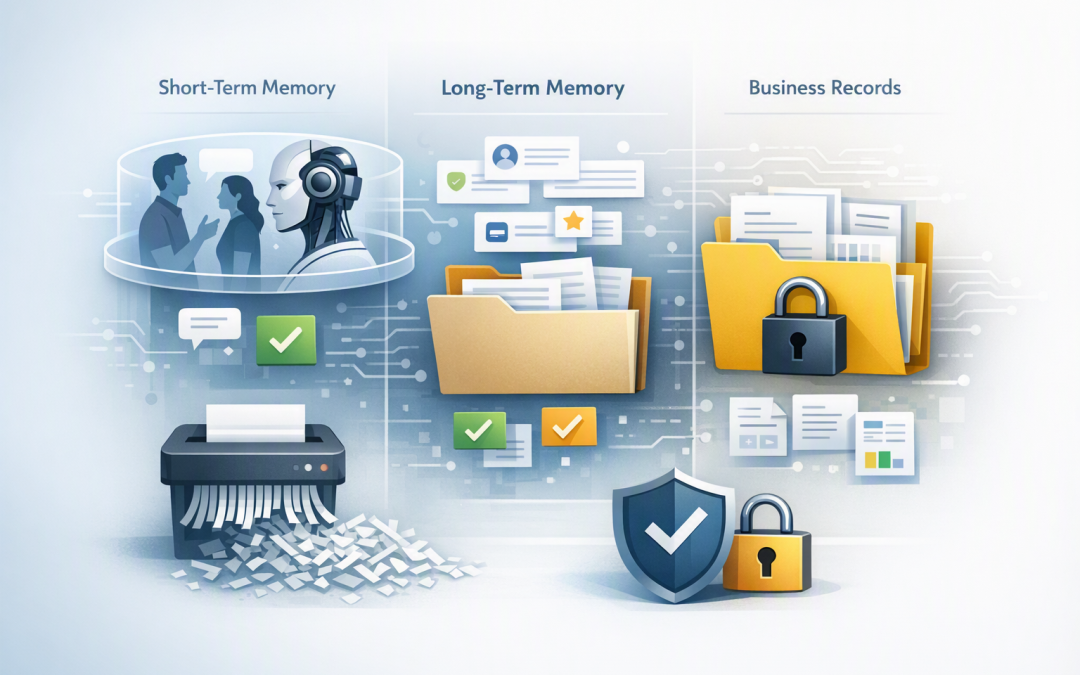
There are generally three layers:
- Session memory holds the current conversation so the customer can ask follow-up questions without repeating everything.
- Long-term memory retains selected facts across separate conversations, such as communication preferences or the status of an unresolved issue.
- Business records hold verified information such as contracts, orders, invoices and approved customer details.
Modern platforms such as Microsoft Foundry can extract useful facts from conversations and place them in a controlled memory store. When the customer returns, the agent searches that store for relevant information rather than loading every previous transcript.
This is often done using semantic search, which means matching information by meaning rather than exact wording. If a customer previously said, “Please contact me by email,” the agent can retrieve that preference even when the next conversation uses different words.
Importantly, storing memory is not the same as retraining the underlying AI model. Your customer information should remain in controlled business storage, with defined access, retention and deletion rules.
Why remembering everything creates business risk
1. Old information can produce confidently wrong answers
Customers change addresses, roles, preferences and service plans. Complaints are resolved, temporary arrangements expire and informal comments lose their relevance.
If an agent treats every past statement as permanently true, its memory becomes a source of error. It may offer an expired discount, refer to a former employee as the decision-maker or reopen an issue the customer considers closed.
The business outcome is worse service, more escalations and additional work for employees who must correct the agent.
2. Every retained conversation increases privacy exposure
Customer conversations can contain names, phone numbers, account details, health information, financial circumstances and personal opinions. People may also provide sensitive information that your business never asked them to share.
Under the Australian Privacy Principles, organisations generally need to protect personal information and destroy or de-identify it when it is no longer required, subject to applicable legal obligations. Keeping information simply because storage is available is not a strong retention strategy.
As discussed in our guide to storing AI conversation history in business systems, every retained record needs a clear purpose, owner and lifecycle.
3. More history can increase AI operating costs
AI services commonly charge according to the amount of information processed. If the agent repeatedly receives pages of old conversations, every customer interaction may take longer and cost more.
Large histories can also distract the model from the customer’s current request. More context does not always produce a better answer; relevant context does.
For a detailed look at this trade-off, see how AI conversation memory affects cost, security and service.
4. A compromised account could reveal a customer’s history
Memory becomes another valuable store of business data. If employees, contractors or compromised accounts can search it without appropriate restrictions, a small access problem can become a serious privacy incident.
This is where established security practices still matter. Multi-factor authentication, restricted administrator access and regular patching are part of Essential 8, the Australian government’s cybersecurity framework that many organisations use as a security baseline.
Essential 8 does not provide a complete AI governance framework. However, its focus on controlling access and reducing opportunities for compromise should also be applied to AI memory systems.
What should your agent remember
A practical memory policy should focus on information that provides ongoing business value. Good candidates include:
- Verified customer preferences, such as preferred language or contact channel.
- The current status of an unresolved support request.
- Products or services the customer already uses.
- Actions promised by the business and their due dates.
- Consent choices and requests not to use particular information.
- A short, factual summary of a recent interaction.
The agent should usually avoid retaining passwords, payment card details, identity documents, casual personal remarks and sensitive information that is not required for a defined service.
It should also distinguish between a customer statement and a verified fact. “I think we are on the premium plan” should not overwrite the subscription recorded in the billing system.
A better approach than storing complete transcripts
Consider a 180-person professional services company using an AI agent to answer customer questions and manage support requests. The original design stored every transcript and supplied the customer’s entire history whenever they returned.
Within months, responses became slower and less consistent. The agent referred to resolved issues, repeated outdated delivery dates and processed far more text than each new question required.
A better design would retain the full transcript only for a limited period where needed for quality review or dispute handling. It would separately store a short summary containing the issue, agreed action, owner and status.
When the customer returned, the agent would retrieve that summary and check the live support system for current information. This reduces processing costs, limits privacy exposure and gives employees a clearer record to work from.
Five questions to answer before enabling long-term memory
- What business outcome does this memory support? If the information does not improve service, reduce work or meet an obligation, do not retain it by default.
- How long is it useful? Set expiry periods for different memory types rather than choosing one permanent retention period.
- Which system is the source of truth? Orders, contracts and account status should come from verified business systems, not an AI-generated summary.
- Who can access or change it? Separate customer memories and limit employee access according to job responsibilities.
- Can the customer correct or delete it? Build practical processes for reviewing, updating and forgetting information.
These decisions should be made before development begins. Our article on why AI agents need a conversation strategy explains how clear boundaries prevent expensive redesign later.
How CloudProInc approaches safe agent memory
CloudProInc starts with the customer journey, privacy requirements and business outcome before selecting technology. The design may use Microsoft Foundry, Azure, OpenAI or Claude, but the platform should follow the policy rather than define it.
As a Microsoft Partner and Wiz Security Integrator with more than 20 years of enterprise IT experience, we examine identity controls, data storage, retention, monitoring and cloud security together. That practical approach helps prevent an impressive AI demonstration from becoming an expensive information-management problem.
The best AI agent is not the one that remembers the most. It is the one that remembers the right facts, retrieves them at the right time and safely forgets information that no longer serves a purpose.
If you are unsure whether your planned AI agent is retaining too much customer information—or not enough—CloudProInc can review the design and identify the practical risks before they reach production. No strings attached.
Discover more from CPI Consulting
Subscribe to get the latest posts sent to your email.