
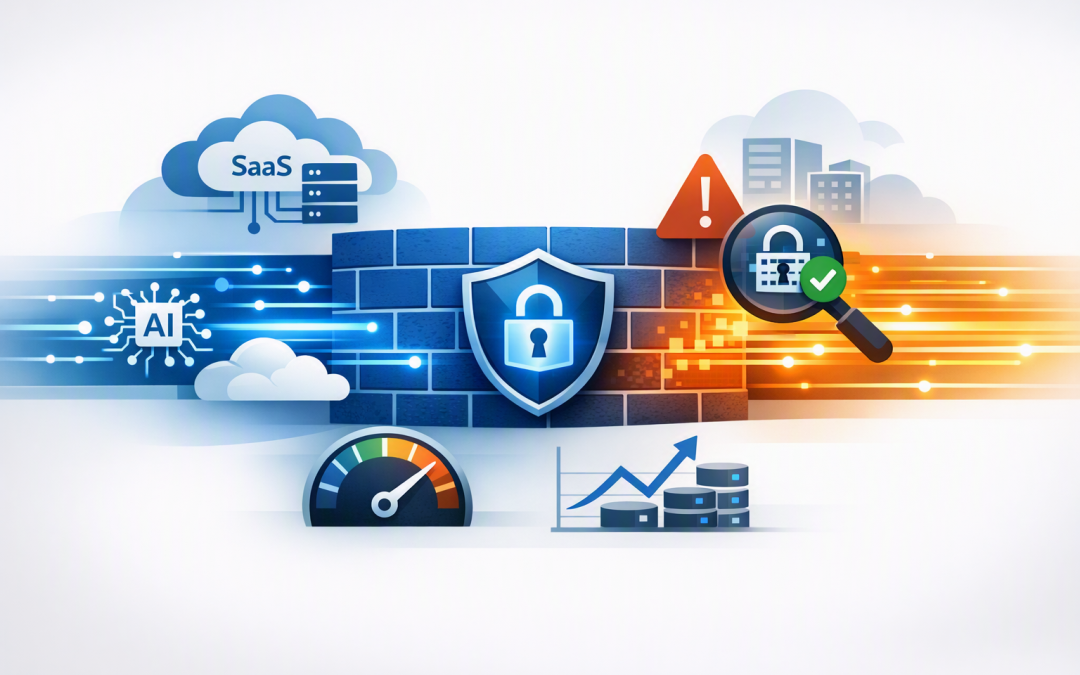
In this blog post Azure Firewall Premium Performance Gains for Secure AI and SaaS we will explain what Microsoft’s latest improvements mean for organisations trying to secure growing cloud traffic without slowing down employees, applications or AI agents.
This is becoming a common problem. You introduce stronger traffic inspection to reduce risk, then users report slow SaaS applications, AI workflows become unreliable, and the IT team starts creating security exceptions just to keep the business moving.
Azure Firewall Premium acts like a controlled security checkpoint for traffic entering, leaving and moving between Azure networks. It can inspect encrypted connections, identify known attack patterns, restrict access to approved websites and record what was allowed or blocked.
The latest performance gains give businesses more room to use these controls without turning the firewall into a bottleneck. That matters as AI agents, cloud applications and SaaS platforms generate more connections and move larger amounts of encrypted data.
What has changed in Azure Firewall Premium
In August 2026, Microsoft made a major performance optimisation generally available for Azure Firewall Premium’s intrusion detection and prevention system, or IDPS. IDPS checks network traffic for patterns associated with malware, exploits and other known attacks, and can block matching traffic automatically.
Azure Firewall Premium can now deliver up to 22 gigabits per second when both TLS inspection and IDPS in Deny mode are active. That is a 120% increase from the previous published maximum of 10 gigabits per second.
Performance for an individual TCP connection has also doubled from up to 300 megabits per second to 600 megabits per second when IDPS is operating in Alert or Deny mode. TCP is simply the common connection method used by web applications, APIs and many SaaS services.
These are maximum test figures rather than guaranteed results. Your actual performance will depend on traffic patterns, firewall rules, connection volumes, Azure architecture and which security controls are enabled.
How the technology protects encrypted traffic
Most modern internet traffic is encrypted using TLS, including Microsoft 365, customer relationship management systems, cloud storage and AI model APIs. Encryption protects information while it travels, but it can also hide malicious files or commands from basic security tools.
Azure Firewall Premium’s TLS inspection temporarily decrypts approved outbound traffic, examines it for threats and then encrypts it again before sending it to the destination. This allows IDPS to examine content that would otherwise remain hidden inside the encrypted connection.
The firewall can also apply full URL filtering. Instead of allowing or blocking an entire website, it can make decisions based on a more specific web address or path.
This does not mean every connection should automatically be decrypted. Certificate-based applications, privacy-sensitive services and some regulated data flows may require exclusions. TLS inspection must be planned carefully and supported by proper certificate management across company devices.
Why the performance increase matters for AI
Production AI systems rarely communicate with only one service. An AI agent may connect to a model, search a document index, read files from storage, call a customer system, create a support ticket and send a notification through another SaaS platform.
Every connection creates another path that must be controlled and monitored. When hundreds of employees or automated agents run these workflows simultaneously, traffic can rise quickly.
The new performance ceiling can help organisations keep IDPS in blocking mode while handling more concurrent AI activity. This reduces the pressure to bypass inspection for high-volume model endpoints or place AI workloads on less controlled internet connections.
It will not necessarily make an AI model generate answers faster. Model response time is still affected by model capacity, application design and the amount of data being processed. The benefit is that the security layer is less likely to become the limiting factor during document uploads, API calls, embedding creation and agent-to-system communication.
Network inspection is also only one part of AI security. Identity controls, private connectivity, data permissions and prompt protection remain essential. Our guides to designing secure AI agent infrastructure on Azure and security best practices for Azure AI services explain these additional layers.
What it means for SaaS connectivity
Businesses with 50 to 500 employees may use dozens or even hundreds of SaaS products. Finance, HR, sales, collaboration and industry-specific systems all compete for the same outbound connectivity.
Higher inspection performance makes it more practical to route this traffic through a central security point. IT teams can apply consistent rules, block known malicious destinations and maintain logs rather than relying on separate controls for every Azure workload.
It can also reduce the number of broad firewall exceptions created after a performance complaint. Those exceptions are often forgotten and may leave applications able to connect to destinations they do not need.
For Australian organisations working towards Essential Eight maturity, this visibility can support a layered security approach and provide useful evidence for monitoring and incident investigation. Essential Eight is the Australian government’s cybersecurity framework that many organisations now use to reduce common attack risks.
Azure Firewall Premium does not make an organisation Essential Eight compliant by itself. It should work alongside patching, application control, multi-factor authentication, restricted administrator access and reliable backups.
A practical business scenario
Consider a 200-person professional services firm running an internal AI assistant in Azure. The assistant searches company documents, communicates with an external AI model, updates the firm’s customer platform and stores approved outputs.
During busy periods, employees upload large documents while automated agents make thousands of API requests. The firm wants TLS inspection and IDPS blocking enabled, but the existing network design was sized using older performance expectations.
With the improved Azure Firewall Premium capacity, the firm may be able to retain deep inspection without introducing another security appliance or bypassing checks for AI traffic. The business outcome is not simply a faster firewall. It is fewer failed workflows, fewer risky exceptions and more confidence that AI adoption will not weaken security.
What IT leaders should review now
- Measure current traffic. Review throughput, connection counts, latency, dropped traffic and firewall scaling during busy periods.
- Confirm your inspection settings. Check whether TLS inspection and IDPS are disabled, operating in alert-only mode or actively blocking threats.
- Test realistic AI and SaaS workloads. A short speed test will not represent hundreds of users, document transfers or multiple AI agents running at once.
- Review firewall rules. Large, duplicated or poorly ordered rule sets can still affect performance and make security harder to manage.
- Check outbound connection capacity. Higher throughput does not automatically prevent SNAT port exhaustion, which occurs when cloud workloads run out of temporary outbound connection slots. High-connection environments may also need Azure NAT Gateway.
- Keep private services private. Where supported, private endpoints and virtual network integration can keep sensitive AI traffic away from the public internet. See our guide to securing hosted AI agents with Azure Virtual Network integration.
- Combine network and cloud monitoring. Azure Firewall logs, Microsoft Defender and Wiz, a cloud security platform that identifies risky configurations and exposure, can provide a clearer view of threats and control gaps.
Better performance does not remove the need for good design
The Azure Firewall Premium improvement removes part of the traditional trade-off between strong inspection and acceptable performance. It does not fix poor routing, excessive rules, missing monitoring or an AI application with overly broad access.
The right question is not simply whether the firewall is faster. It is whether your architecture can keep AI and SaaS traffic secure as usage grows, without creating unnecessary cost or frustrating the people relying on those services.
CloudProInc is a Melbourne-based Microsoft Partner and Wiz Security Integrator with more than 20 years of enterprise IT experience. We take a practical, hands-on approach across Azure, Microsoft 365, Defender, Wiz, OpenAI and Claude environments.
If you are not sure whether your current firewall design is protecting AI and SaaS traffic effectively—or quietly limiting performance—we are happy to take a look and explain the options in plain English, with no strings attached.
Discover more from CPI Consulting
Subscribe to get the latest posts sent to your email.