
In this blog post Why Provider Portability Matters for Business AI Agent Architecture we will explain how avoiding dependence on one AI provider can reduce costs, protect business continuity and give your organisation more room to adapt.
Many businesses build their first AI agent around a single model from OpenAI, Anthropic, Microsoft or another provider. The pilot works, employees like it and the business begins connecting it to real processes. Then pricing changes, a better model appears, a service becomes unavailable or a new data-handling requirement limits where the agent can operate.
Suddenly, changing providers means rebuilding much of the system. Provider portability is the architectural decision that helps prevent this problem.
What provider portability actually means
Provider portability means designing an AI agent so its underlying artificial intelligence model can be changed without replacing the entire business workflow.
The model is the part that interprets requests, generates responses and decides what action to take. The agent is the wider system around it, including business instructions, security controls, company data, software connections, memory and approval processes.
In a portable architecture, those components are not tightly tied to one model provider. Your organisation might use an OpenAI model through Microsoft Azure today, an Anthropic Claude model for a specialist task tomorrow and a smaller, lower-cost model for routine work.
This does not mean changing providers every week. It means maintaining the practical ability to change when there is a clear business reason.
The technology behind portable AI agents
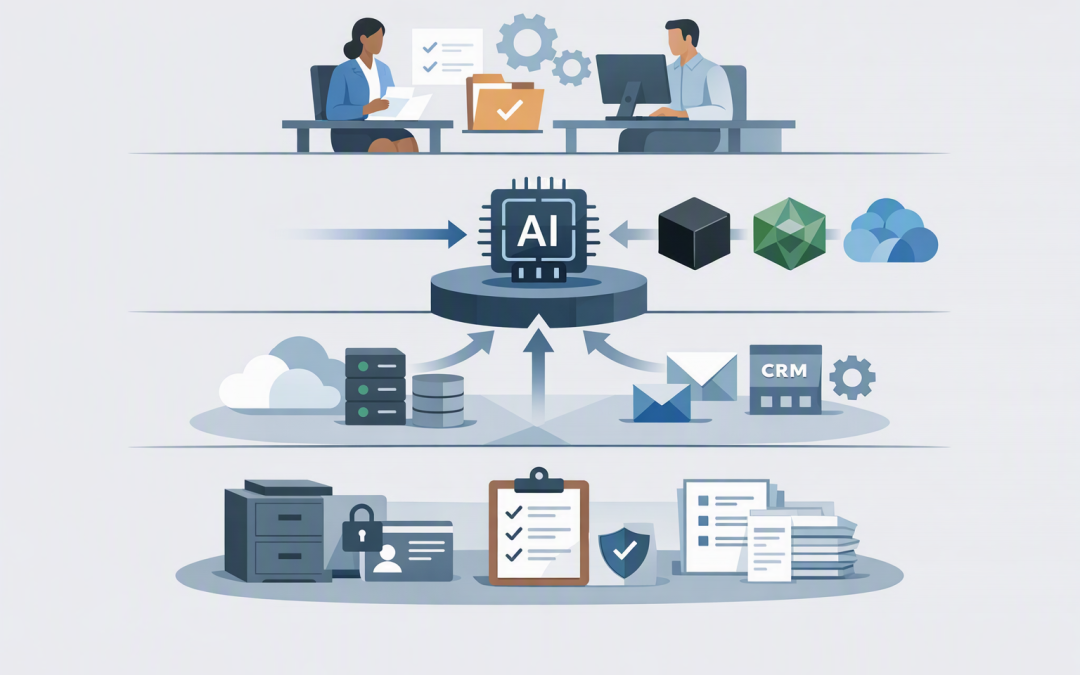
A portable AI agent is usually designed in layers. Each layer has a clear responsibility, allowing one component to change without disrupting everything around it.
1. The business workflow layer
This layer defines what the agent is supposed to achieve. For example, it may review an incoming support request, find the customer record, prepare a response and send high-risk cases to an employee for approval.
The workflow should remain owned by your business rather than being buried inside provider-specific code. That protects the process if the underlying model changes.
2. The model access layer
Instead of allowing every application to connect directly to a specific AI provider, requests pass through a controlled access layer, sometimes called an AI gateway or model adapter.
This layer translates a standard business request into the format expected by the selected model. Microsoft Foundry, for example, can provide a common entry point for supported models, while model-routing capabilities can direct different requests to models suited to their cost, speed or complexity.
A simplified configuration might look like this:
{
 "task": "summarise_customer_case",
 "preferred_model": "approved-general-model",
 "fallback_model": "approved-backup-model",
 "data_region": "Australia",
 "human_approval": true
}
The important point is not the code. It is that the business task asks for an approved capability rather than depending permanently on one product name.
3. The tools and data layer
Agents become useful when they can safely access systems such as Microsoft 365, a customer relationship management platform, a document library or a service desk.
These connections should also be separated from the model. Model Context Protocol, commonly called MCP, is an open approach for giving AI applications structured access to tools and information. It helps reduce the need to rebuild every connection for every model, although permissions and security controls still need careful design.
If several agents need to work together, Agent-to-Agent Protocol, or A2A, can provide a standard way for agents built with different frameworks to exchange tasks and results. We explain the business implications in our practical guide to the A2A protocol.
4. The memory and governance layer
Conversation history, customer context and completed actions should not exist only inside a provider’s service. Important business memory should be stored in systems your organisation controls, with appropriate retention, access and deletion rules.
This makes it easier to change models while preserving useful context. It also supports auditing, privacy management and investigations when an agent produces an unexpected result.
Our article on Microsoft Foundry Agent Memory explores how managed memory can improve agent usefulness without losing sight of governance.
Why portability matters to the business
It reduces the cost of changing direction
AI models are improving quickly, but the model is often only a small part of the total solution. The expensive work is connecting company systems, defining approvals, testing outputs, securing data and training employees.
If all that work is tied directly to one provider, moving later can become a major redevelopment project. A portable design protects more of the original investment.
It gives you better control over operating costs
The most capable model is not always required for every task. A basic document classification request may be handled by a smaller model, while a complex contract review may require a more capable one.
A model-routing layer lets the organisation match cost to business value. It can also apply spending limits, record usage by department and prevent employees or applications from using expensive models unnecessarily.
It improves business continuity
An AI provider may experience an outage, reach a usage limit or withdraw a model version. If the agent supports customer service, finance or operations, waiting for one provider to recover may not be acceptable.
Portability allows approved requests to move to a fallback model. The fallback may not behave identically, but it can keep important processes running while the primary service is unavailable.
It supports security and compliance decisions
Australian organisations may need to consider where data is processed, who can access it and how actions are logged. These requirements can change as an agent moves from a small pilot into a business-critical workflow.
Portability gives the organisation options when a provider, hosting region or contract no longer meets its needs. It should sit alongside established controls such as identity management, monitoring, secure configuration and the Essential Eight, the Australian Government’s cybersecurity framework that many organisations use to reduce common security risks.
For a closer look at these controls, see Designing Secure AI Agent Infrastructure on Azure.
A practical business scenario
Consider a 200-person professional services firm building an agent to review client emails, retrieve project information and prepare draft responses.
The first version connects directly to one model provider. Its prompts, document searches, memory and error handling all use that provider’s software tools. The pilot appears inexpensive because it was quick to build.
Six months later, the firm wants to use a different model for sensitive document analysis and a cheaper model for routine email summaries. It discovers that changing models also means rewriting integrations, retesting the entire workflow and rebuilding its reporting.
A portable version would keep the client data connection, approval process, memory and audit records separate from the model. The firm could test a new provider against the same business scenarios before moving any live work.
The outcome is not simply greater technical flexibility. It is lower migration cost, less operational disruption and stronger negotiating power when contracts are renewed.
Portability does not mean every model is interchangeable
Different models follow instructions differently. They may support different document sizes, tool-calling methods, safety controls and output formats.
A good architecture does not hide these differences or force every model into the lowest common standard. It creates a controlled adapter for provider-specific features while keeping the core business process independent.
Testing is essential. Each approved model should be measured against real business scenarios for accuracy, cost, response time, security and failure handling before it is used in production.
Five questions to ask before approving an AI agent
- Can we change the underlying model without rebuilding the complete workflow?
- Are company data, memory and audit records stored independently from the model provider?
- Can simple and complex tasks be routed to different approved models?
- Do we have a tested fallback if the primary provider is unavailable?
- Can we compare model quality and cost using the same business test cases?
If the answer to most of these questions is no, the organisation may be creating future lock-in that is difficult to see during a successful pilot.
Build for choice before AI becomes business-critical
Provider portability is easiest to introduce before an agent becomes deeply connected to daily operations. It should be part of the wider production-ready AI architecture, not an emergency project after costs rise or requirements change.
CloudPro Inc brings more than 20 years of enterprise IT experience to this work. As a Microsoft Partner and Wiz Security Integrator, our Melbourne-based team helps organisations design practical AI environments across Azure, Microsoft 365, OpenAI, Claude, Microsoft Defender and Wiz without treating security, cost control or provider choice as afterthoughts.
If you are not sure whether your current AI pilot is creating unnecessary provider dependence, we are happy to take a practical look at the architecture and explain your options — no strings attached.
Discover more from CPI Consulting
Subscribe to get the latest posts sent to your email.