
In this blog post OpenAI and Anthropic Escalate the Enterprise AI Partner War we will break down what has changed, why enterprise AI buying is suddenly becoming more partner-led, and what smart decision-makers should do before signing anything.
If you are a CIO, CTO, IT manager, or business owner, this matters more than it might seem. The real problem is not choosing between two impressive AI brands. It is avoiding an expensive pilot, a privacy headache, and months of internal confusion because nobody translated the technology into a business case your people can actually use.
At a high level, both OpenAI and Anthropic build large language models. That is software trained on enormous amounts of text so it can read, write, summarise, analyse, and help automate knowledge work. But the model itself is only one piece. To create real value in a business, it has to be connected to your files, systems, staff permissions, security rules, and day-to-day workflows.
That is where the partner war comes in. In June 2026, OpenAI formally launched its new partner network with major investment behind it. Anthropic had already launched the Claude Partner Network in March 2026 and has been expanding it with clearer partner tiers, certification, and support. In plain English, both companies are racing to make sure consulting firms, technology providers, and specialist advisers influence the enterprise AI deal before their competitor does.
What actually changed and why it matters
This is not just a marketing story. It is a signal that enterprise AI has moved from experimentation to implementation. The next battle is not over who has the cleverest demo. It is over who can get AI deployed safely, quickly, and at scale inside real businesses.
1. AI buying is becoming a partner decision, not just a software decision
Most mid-sized businesses do not fail with AI because the model is weak. They fail because nobody mapped the tool to a real process, trained staff properly, or set basic guardrails around data, access, and accountability.
That is why both vendors are investing heavily in partners. A partner is the firm that helps you choose the right use case, set it up properly, connect it to your systems, and prove the outcome. The business result is faster time to value and less money wasted on pilots that never make it past the executive presentation stage.
The catch is that more partners also means more noise. Over the next year, many businesses will be approached by providers claiming they are certified, preferred, strategic, or enterprise-ready. Those labels matter less than whether the provider can show how AI will reduce cost, improve response times, lift staff productivity, or lower operational risk in your environment.
2. Security, governance, and compliance are now part of the deal
For Australian organisations, this is where the conversation gets serious. If staff start uploading customer records, contracts, HR files, or board papers into the wrong AI environment, you do not have an innovation project. You have a privacy and compliance problem.
Enterprise AI platforms are responding with stronger admin controls, audit logs, data handling settings, and security options. That sounds technical, but the business meaning is simple. You need to know who can use the tool, what company information it can access, where the data goes, and what record exists if something goes wrong.
This matters under the Australian Privacy Principles and the Office of the Australian Information Commissioner guidance on AI. It also matters if your organisation is working toward Essential 8, the Australian government’s baseline cybersecurity framework. Essential 8 does not solve AI on its own, but the same basics still apply: strong access control, secure devices, patching, application control, and limiting access to only what is needed.
The business outcome here is risk reduction. Done properly, enterprise AI can improve productivity without creating a shadow IT problem, where staff use unapproved tools outside your visibility.
3. Microsoft customers now have more choice than many realise
Many Australian businesses assume this is a straight Microsoft-versus-everyone-else conversation. It is not that simple anymore. OpenAI remains deeply tied to Azure, Microsoft’s cloud platform, and is still the most obvious fit for organisations already standardised on Microsoft.
But Anthropic’s Claude models are also available through Microsoft Foundry, Microsoft’s environment for building and managing AI solutions. That means Azure-first organisations can now compare OpenAI and Claude inside a broader Microsoft setup, rather than treating this as a complete platform switch.
For decision-makers, that is good news. It creates more choice, reduces lock-in, and makes it easier to pick the best model for the job. One model might be better for document-heavy analysis, another for customer service workflows, another for coding or internal automation.
The business outcome is better fit and better buying power. You are less likely to overcommit to one vendor before understanding what your teams actually need.
4. The model is becoming less important than the workflow
This is the biggest mindset shift we are seeing. Many boards and leadership teams still ask, “Should we choose OpenAI or Claude?” A better question is, “Which business process are we improving, and how will we measure it?”
That is because enterprise AI now increasingly includes agents. An agent is an AI assistant that does more than answer a question. It can take steps across a process, such as reading an email, checking a policy, drafting a response, updating a system, and escalating to a person when needed.
Once you get to that stage, the real work is not the model demo. It is workflow design, approvals, data access, security controls, and staff adoption. The business outcome is simple: measurable results. That might mean fewer hours spent on proposal writing, faster customer response times, or lower support costs.
The technology behind this in plain English
Under the hood, OpenAI and Anthropic are both selling access to advanced AI models plus the surrounding controls needed for business use. Think of the model as the engine, but not the whole car.
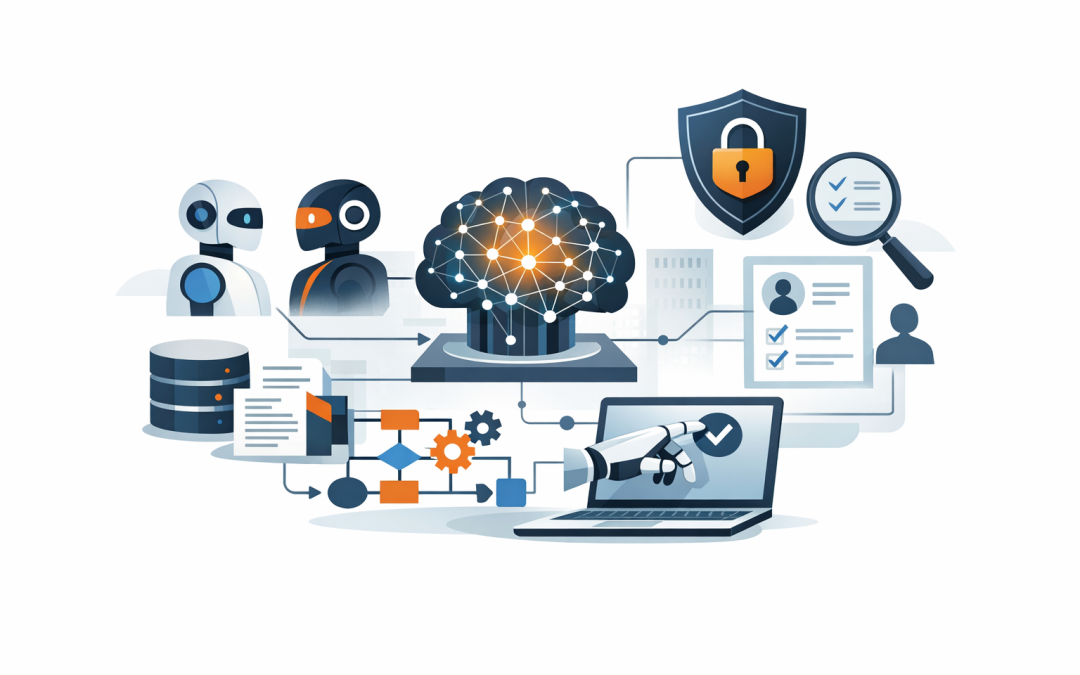
To work well in an organisation, enterprise AI usually needs five parts.
- The model — the core AI that writes, analyses, reasons, and answers questions.
- Your company data — documents, emails, knowledge bases, policies, customer records, or other approved information sources.
- Connections to business systems — secure links to tools like Microsoft 365, CRM, ticketing systems, or internal databases.
- Governance controls — rules around who can access what, what data is allowed, and what gets logged for review.
- Workflow design — the practical setup that turns a clever assistant into something that saves time or reduces errors.
This is exactly why the partner ecosystem matters so much. Most organisations do not need another AI demo. They need someone who can translate these five parts into one working outcome the business can trust.
A realistic mid-market scenario
Imagine a 220-person professional services firm in Australia. It already runs Microsoft 365, stores documents in SharePoint, uses Teams every day, and wants AI to help with proposal writing, meeting summaries, policy search, and first-draft client communications.
One provider pitches a company-wide rollout of ChatGPT Enterprise. Another pushes Claude for document analysis. A third offers a custom AI assistant with lots of promises but little clarity on data handling. The leadership team gets stuck comparing brands instead of comparing outcomes.
The better approach is to start with one controlled business case. For example, reduce proposal turnaround time by 30 percent, keep all approved content inside the Microsoft environment, restrict access based on user role, and log usage for review. Then test which model performs best for that workflow and whether the provider can implement it securely.
That is where a practical adviser beats a flashy pitch. In our experience, the winning project is usually the one with the clearest guardrails, the narrowest first use case, and the strongest link to a business metric.
What decision-makers should do in the next 90 days
- Pick the workflow before the vendor. Start with one process that is repetitive, document-heavy, and expensive in staff time.
- Set data rules early. Decide what information can and cannot be used in AI tools, especially personal, financial, legal, and HR data.
- Check the security model. Make sure identity, device security, logging, and access controls are in place. If your devices and accounts are not well managed yet, fix that first.
- Ask for proof, not partner badges. Certifications are useful, but deployed outcomes matter more. Ask how the provider measures success, manages change, and handles risk.
- Run a governed pilot. Give the pilot a business owner, a target metric, a data boundary, and a clear review point after 30 to 60 days.
The bottom line
OpenAI and Anthropic are escalating the partner war because enterprise AI is no longer mainly a technology sale. It is now a delivery sale. The vendor that wins is the one whose partner ecosystem can help customers move from interest to implementation without losing control of security, compliance, cost, or staff adoption.
For businesses with 50 to 500 employees, that creates both opportunity and risk. There will be more choice, more capability, and more competition. There will also be more hype, more overlapping advice, and more pressure to move before your business is ready.
That is why a hands-on, practical approach matters. At CloudPro Inc, we work with organisations across Azure, Microsoft 365, Intune, Windows 365, OpenAI, Claude, Microsoft Defender, and Wiz with one goal in mind: turning complex technology into a clear business outcome. As a Melbourne-based Microsoft Partner and Wiz Security Integrator with more than 20 years of enterprise IT experience, we focus on what works in the real world, not what looks good in a vendor slide deck.
If you are not sure whether your current AI plans are setting you up for real value or just another expensive pilot, we are happy to take a look and give you a straight answer.
Discover more from CPI Consulting
Subscribe to get the latest posts sent to your email.