
In this blog post How Grok Voice 2.0 Makes Customer Service Faster and Smarter we will explain why shorter response delays could improve customer satisfaction, call resolution and service costs.

Most customers can tell when a voice system is struggling. There is an awkward pause, the caller repeats an account number, and the system responds with something that sounds unrelated. Within seconds, the customer is asking for a person or hanging up.
Grok Voice Think Fast 2.0 is designed to reduce that friction. Released by xAI on 29 July 2026, it is a speech-to-speech AI model that can listen to a caller, understand the request, access connected business systems and reply using a natural-sounding voice.
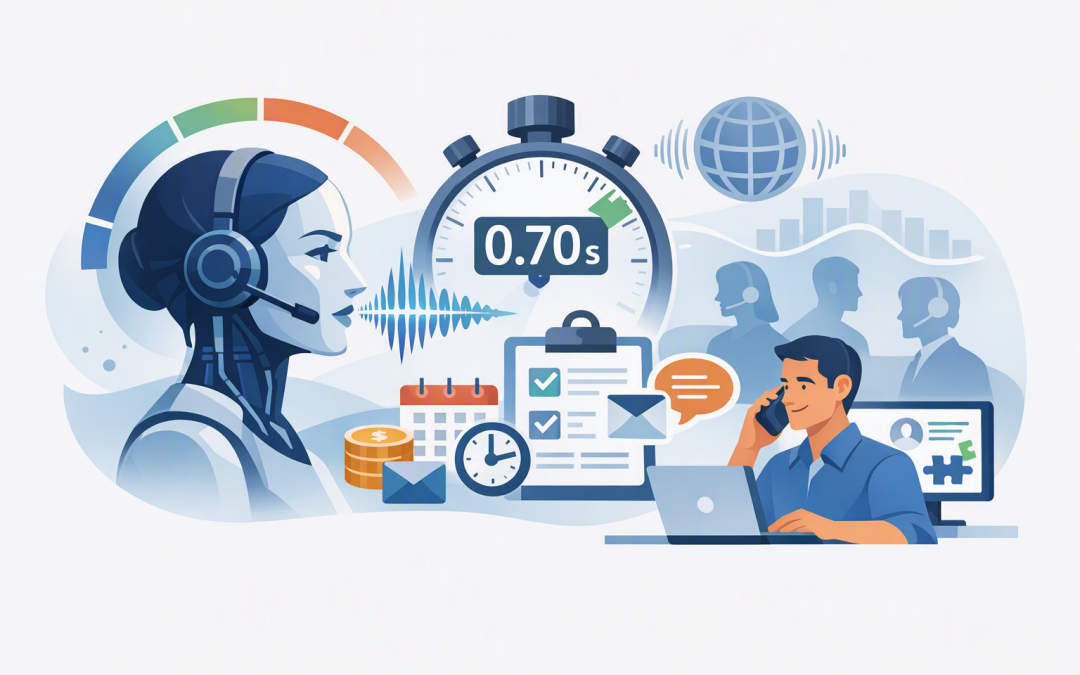
The headline improvement is speed. Its reported time to first audio has fallen from 1.25 seconds in the previous version to 0.70 seconds. That is a 44% reduction in the delay before the customer starts hearing a response. It does not mean every customer request is completed in 0.70 seconds, but it can make the conversation feel far more responsive.
Why a fraction of a second matters on the phone
Latency is the delay between the customer finishing a sentence and the system beginning its reply. On a website, a short delay may be acceptable. During a phone conversation, the same delay feels much longer.
Customers may assume the call has dropped, begin repeating themselves or talk over the AI. That creates more confusion, which produces longer calls and increases the chance that a human agent must take over.
Faster responses can therefore improve more than customer perception. They can reduce repeated questions, shorten average handling time and help the system complete more calls without human intervention.
This builds on the same principle discussed in our article about why streaming responses make OpenAI agents feel faster. People respond better when they receive immediate signs that the system has heard them and is working on their request.
How Grok Voice 2.0 works in plain English
Many older voice bots use three separate stages. One service converts speech into text, an AI model decides what to say, and another service turns the answer back into speech. Every handover adds delay and creates another opportunity for information to be lost.
Grok Voice uses a real-time speech-to-speech service. Audio travels continuously between the caller and the AI over a live connection known as a WebSocket, which is simply a connection that remains open so both sides can send information immediately.
The system also uses voice activity detection, which identifies when someone starts or stops speaking. This helps the AI decide when to respond without waiting for a long period of silence.
Importantly, the model can reason while it is speaking. It might acknowledge the request with “I can check that for you” while it looks up an order, checks an appointment or retrieves an account status from an approved business system. xAI says the new model generally completes these system lookups earlier than its predecessor.
It is more than a talking chatbot
The real business value comes from tool calling. This means the voice agent can request an action from another system rather than only answering from its existing knowledge.
Depending on the permissions you provide, it could:
- check whether an order has shipped;
- book or move an appointment;
- confirm an invoice balance;
- create a support ticket;
- send an approved confirmation message; or
- transfer the caller to the correct employee with a conversation summary.
This is also where implementation becomes more important than the model demonstration. As we explained in how OpenAI Presence moves customer service agents into production, dependable service requires controlled system access, testing, monitoring and clear escalation paths.
Better performance in difficult calling conditions
Real customer calls rarely arrive from quiet meeting rooms. People call from vehicles, warehouses, worksites, airports and busy homes. Mobile reception and traditional phone networks can also compress audio and make speech harder to understand.
xAI reports that Grok Voice Think Fast 2.0 improves transcription accuracy across 24 tested languages, with particularly large gains in noisy conditions. It has also been trained to ask one question at a time, use shorter sentences and avoid unnecessary filler.
For an Australian business, this may improve service for callers with different accents or customers who switch between languages. However, published benchmarks should never replace testing with your own customers, terminology and phone systems.
A model may perform well with a standard street address but struggle with Australian suburb names, industry abbreviations or product codes. Those are the details that determine whether a customer service deployment succeeds.
The business case must go beyond faster speech
Grok Voice Think Fast 2.0 costs US$0.08 per audio minute, compared with US$0.05 for the previous version. At 10,000 minutes per month, the model charge would be approximately US$800 before telephony, integration, monitoring and support costs.
The new model is therefore faster, but it is also 60% more expensive per minute. Technology leaders should not approve it because the demonstration sounds impressive. They should ask whether the extra cost produces measurable improvements.
The most useful measures include:
- Cost per resolved call rather than cost per minute;
- Containment rate, meaning calls completed without a human agent;
- Transfer accuracy, so customers reach the right team;
- Average handling time for both AI and human-assisted calls;
- Repeat contact rate within seven days; and
- Customer satisfaction compared with the existing channel.
xAI says testing on Starlink’s phone service produced significant improvements in sales conversion and support containment. That is encouraging, but the company has not published detailed percentages for the 2.0 comparison. CIOs should treat it as a reason to run a controlled pilot, not as a guaranteed return.
What a sensible pilot could look like
Consider a 200-person equipment services company receiving 1,200 calls each month. A large share relates to booking technicians, confirming arrival times and checking job status.
The wrong approach would be to give an AI agent broad access to the service platform and direct every caller to it on day one.
A safer pilot would begin with two or three common requests. The agent could initially receive read-only access, allowing it to check bookings without changing them. Appointment changes could require customer verification and confirmation before being submitted.
The business could test 300 to 500 calls, review every failed interaction and compare the results with its current service process. Human transfer should remain available whenever the AI is uncertain, the customer becomes frustrated or the request involves a complaint, financial hardship or another sensitive matter.
Privacy and security cannot be added later
A voice agent may handle names, addresses, payment details, account numbers and recordings. Australian organisations need to establish what information is collected, why it is required, where it is processed, how long it is retained and who can access it.
The Office of the Australian Information Commissioner advises organisations using commercial AI products to assess privacy risks and understand how providers handle personal information. Australia’s current Guidance for AI Adoption also recommends clear accountability, risk management, testing, transparency and human control.
Customers should be told when they are speaking with AI. Call recording notices and privacy information should be reviewed, while access to customer systems should follow the least-privilege principle. In plain English, the agent should receive only the access needed for its specific job.
The Essential Eight, the Australian government’s recommended cybersecurity baseline, remains relevant for protecting the devices, administrator accounts and systems surrounding the voice service. However, Essential Eight compliance alone does not make an AI deployment safe. Additional controls are required for data handling, model behaviour and system connections.
Cloud monitoring platforms such as Microsoft Defender and Wiz can help identify exposed services, risky permissions and unusual activity around the environment. Logging should also record what the agent accessed and changed without unnecessarily duplicating sensitive customer data.
Existing Grok Voice users should control the upgrade
xAI has announced that the grok-voice-latest model name will begin routing to Think Fast 2.0 on 5 August 2026. Organisations already using that automatic model name may therefore receive new behaviour and pricing without changing their application code.
Production systems should generally use a fixed model version until testing is complete. This gives the business time to compare call quality, costs, system actions and escalation behaviour before approving the upgrade.
The same discipline should apply when comparing Grok with OpenAI, Azure AI or other providers. Our practical AI model scorecard explains why security, governance, cost and operational fit matter more than choosing the model with the highest benchmark.
Grok Voice 2.0 raises expectations, not guarantees
Grok Voice Think Fast 2.0 shows how quickly AI phone service is improving. A 0.70-second response start, stronger handling of noisy audio and more reliable system actions could make voice agents useful in situations where older bots caused frustration.
The opportunity is not simply to replace contact centre staff. It is to remove repetitive calls, extend service hours and give employees more time for complex conversations that require judgement and empathy.
CloudProInc helps organisations evaluate AI voice services, connect them safely to Azure and Microsoft 365 environments, and monitor the surrounding cloud security controls. As a Melbourne-based Microsoft Partner and Wiz Security Integrator with more than 20 years of enterprise IT experience, we focus on practical pilots rather than expensive, open-ended AI projects.
If you are unsure whether Grok Voice 2.0, OpenAI or another platform fits your customer service operation, we are happy to help assess the use case, costs and risks before you commit — no strings attached.