
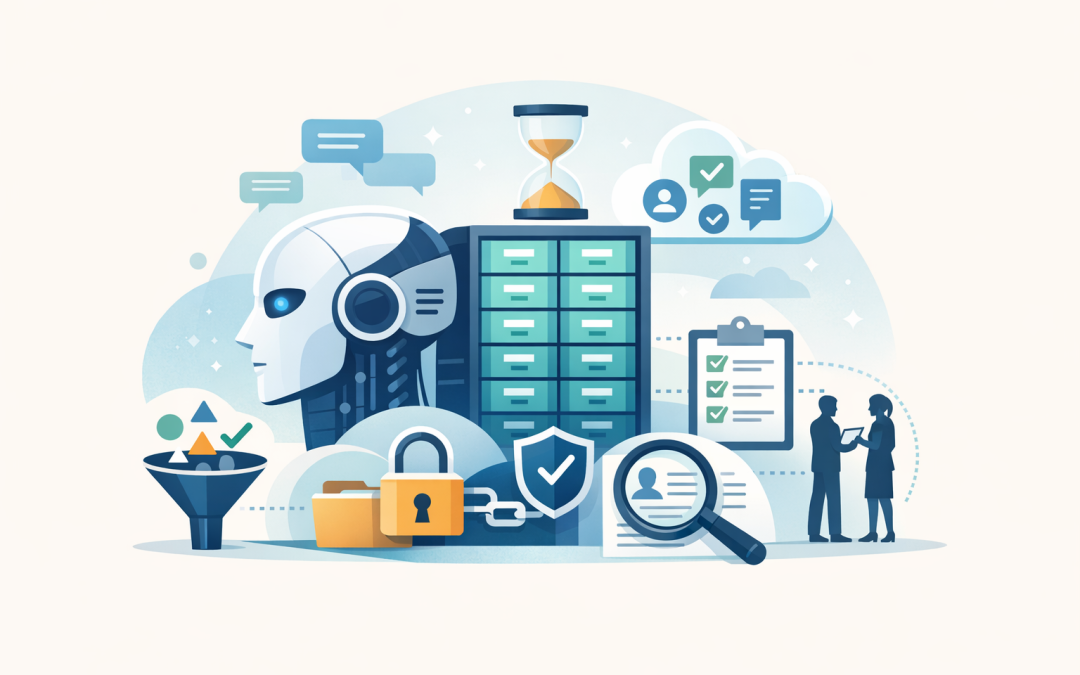
In this blog post When Your Business AI Agent Needs Long-Term Memory for Better Service we will explain how to recognise when remembering past interactions will improve business results, and when it will simply create more cost, complexity and risk.


Many AI agents perform well in a demonstration but become frustrating in daily use. They answer the first question correctly, then forget the customer’s preferences, previous decisions or work already completed when a new conversation begins.
Long-term memory addresses this problem by allowing an AI agent to retain selected information between conversations. The important word is selected. A well-designed agent should remember useful business context, not store everything indefinitely.
What long-term memory actually means
An AI agent is software that uses an AI model, such as OpenAI or Anthropic Claude, to understand requests, make decisions and complete tasks using approved business systems. It might search documents, update a customer record, prepare a report or guide an employee through a process.
Most agents already have short-term memory. This is the recent conversation history that helps the agent understand what someone means when they say, “Use the second option” or “Make that more concise.”
Long-term memory is different. It stores useful information outside the current conversation so the agent can retrieve it next week, next month or during a different workflow. Microsoft Foundry, for example, provides managed memory stores that can retain relevant facts and make them available across sessions and devices. OpenAI agent applications can also use persistent sessions or business-controlled storage to maintain continuity.
User interaction
 ↓
Memory rules decide what is worth keeping
 ↓
Approved facts are stored securely
 ↓
Relevant facts are retrieved for a future task
 ↓
The agent responds using current and remembered context
This is not the same as giving the agent unlimited access to old chats. Good memory systems extract useful facts, such as an approved preference or completed action, and retrieve only what is relevant to the current task.
Five signs your AI agent needs long-term memory
1. Employees repeatedly explain the same context
If staff begin every interaction by restating their role, customer, project or preferred format, the agent is creating work instead of removing it. This is common with internal support, sales preparation and project coordination agents.
Long-term memory can retain stable preferences such as reporting style, business unit or approval limits. The outcome is faster interactions and less time spent preparing prompts.
2. The workflow continues over days or weeks
Some work cannot be completed in one conversation. Supplier onboarding, security reviews, employee onboarding and complex customer cases often involve several people, documents and approvals.
The agent may need to remember what has been completed, what is waiting for approval and why a decision was made. That is different from simply resuming a process after a temporary interruption, which we cover in how Microsoft Foundry AI agents resume work.
The business benefit is continuity. Employees can continue the work without reconstructing the entire history each time responsibility changes hands.
3. Personalisation has measurable value
Memory is useful when knowing the person or customer changes the quality of the result. A service agent might remember communication preferences, products already purchased or troubleshooting steps that failed previously.
However, personalisation must have a clear purpose. Remembering that a customer prefers email may improve service. Storing every informal comment they have ever made probably will not.
The goal is a shorter path to a useful outcome, not collecting more information for its own sake.
4. Repeating previous work is costing money
Consider a 180-person professional services business using an AI agent to help its service team investigate common requests. Because the agent cannot remember previous outcomes, 12 employees each spend about 15 minutes a day finding old notes and explaining what was already attempted.
Across 20 working days, that represents roughly 60 hours of duplicated effort. At an assumed employment cost of A$70 per hour, the business is losing about A$4,200 each month before considering delays and customer frustration.
A carefully scoped memory system could retain the case summary, completed checks and agreed next step. The original customer or project system should still remain the official record.
5. The agent must learn from previous outcomes
Some agents become more useful when they can recall what worked before. An IT support agent could remember that a particular device issue was caused by an outdated application, while a proposal assistant could remember which wording was approved for a specific industry.
This does not mean allowing the AI to rewrite company policy. Memory should provide context, while approved systems, documents and human owners remain the source of truth.
When your agent does not need long-term memory
Memory is not automatically an upgrade. A simple agent that summarises a document, drafts a one-off email or answers questions from a current policy library may work perfectly well without it.
Avoid long-term memory when:
- The task is completed in a single interaction.
- Current information can be retrieved from an existing business system.
- Remembered details would not change the result.
- The information is highly sensitive and the benefit is minor.
- The business cannot define who may view, correct or delete the memory.
Every stored memory creates something else to secure, review and eventually remove. The cheapest and safest memory is often the information you decide not to retain.
The technology behind useful agent memory
A practical memory design usually has four layers. First, a memory filter identifies facts worth retaining. Second, a secure data store holds those facts separately from the AI model. Third, a retrieval process finds relevant information when a new task begins. Finally, access and retention rules control who can use the memory and how long it remains.
Some memory is best stored in structured fields, such as a customer’s preferred contact channel. Other context may be stored as a short summary. Modern memory systems can also use semantic retrieval, which means finding information by meaning rather than requiring an exact keyword match.
The agent should receive only the small amount of relevant context needed for the current task. Sending years of conversation history to the model can increase processing costs and make answers less reliable. Effective memory systems therefore keep information narrow, structured and connected to a defined workflow.
Memory also creates a governance obligation
Long-term memory may contain personal information, commercial decisions or security details. Australian organisations must consider the Australian Privacy Principles, which cover how personal information is collected, used, secured, corrected and retained.
APP 11 requires covered organisations to take reasonable steps to protect personal information and to destroy or de-identify it when it is no longer required, unless another legal obligation applies.
Access controls, patching, multi-factor authentication and reliable backups should also support the design. These align with the Essential Eight, the Australian Government’s cybersecurity framework for reducing common security risks, but the Essential Eight should be treated as a baseline rather than a complete AI governance plan.
For practical design controls, see how to build AI agents that remember business context safely. Microsoft environments should also consider the controls in securing long-term memory in Microsoft Foundry Agents.
Ask these questions before approving memory
- What specific problem will memory solve? Identify the repeated work, delay or service issue.
- What should the agent remember? Create a short list of approved information types.
- What must it never remember? Exclude passwords, unnecessary sensitive information and unrestricted private conversations.
- Where is the source of truth? Decide whether the memory is a convenience or an official business record.
- Who can correct or delete it? Incorrect memory can be more damaging than no memory.
- How will value be measured? Track time saved, fewer repeated questions, faster resolution or improved customer satisfaction.
You should also plan for failure. Our guide to keeping AI agents from losing critical business information explains why durable records, recovery testing and clear ownership matter.
Start with the business case, not the feature
Long-term memory is valuable when an agent supports ongoing relationships, multi-stage work or repeated decisions. It is unnecessary when the task is short, the information already exists elsewhere or the organisation cannot govern what is retained.
CloudPro Inc combines more than 20 years of enterprise IT experience with hands-on work across Microsoft Azure, Microsoft 365, OpenAI, Claude, Defender and Wiz. As a Melbourne-based Microsoft Partner and Wiz Security Integrator, we help organisations design memory around a measurable business outcome rather than adding it because it sounds advanced.
If your AI agent keeps forgetting important context, or you are unsure whether long-term memory is worth the additional risk and cost, we are happy to review the use case with you — no strings attached.
Discover more from CPI Consulting
Subscribe to get the latest posts sent to your email.