
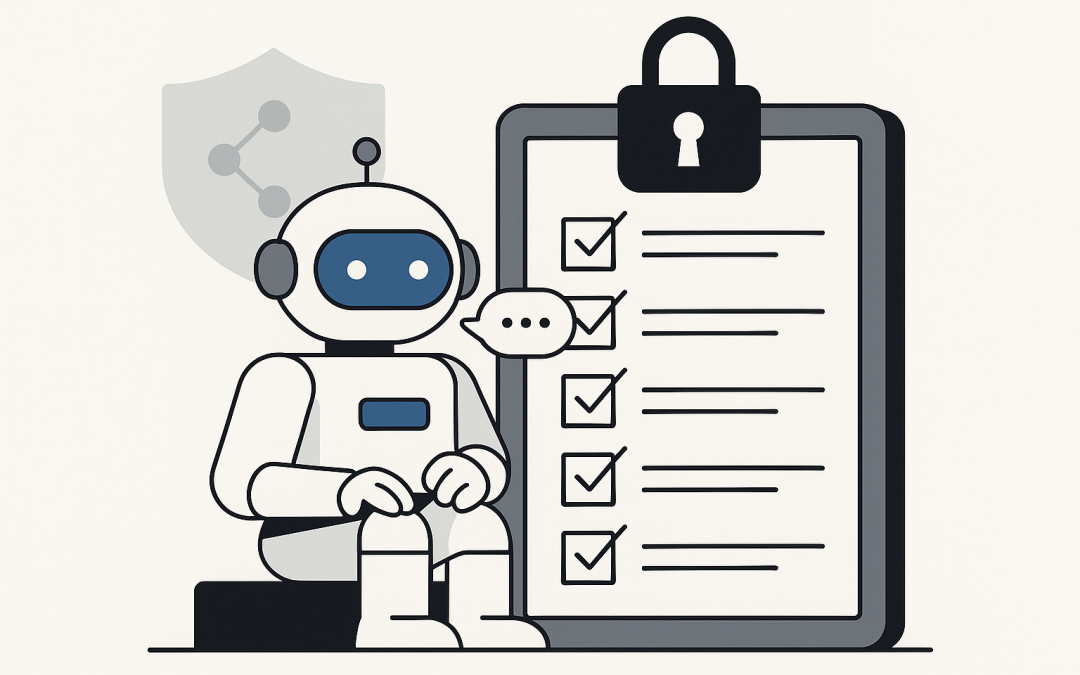
In this blog post Before You Deploy AI Agents The Enterprise Governance Checklist we will look at what AI agents are, why they create new business risk as well as new value, and the checks every enterprise should complete before rollout.
Right now, a lot of mid-size businesses are hearing the same message from software vendors, boards, and internal teams: move fast on AI or get left behind. The problem is that many companies are about to give AI far more access than they realise. Not just the ability to draft content, but the ability to read files, pull data from systems, trigger workflows, and act with a level of independence that feels helpful right up until something goes wrong.
At a high level, an AI agent is not just a chatbot with better wording. It is usually made up of a large language model, which is the AI engine that understands and generates language, plus tools it can use to access systems and take action, plus instructions and guardrails that shape how it behaves. That combination is exactly why agents can save time, but it is also why governance matters before the pilot, not after it.
The good news is that governance is getting more practical. Australian organisations now have local guidance through the Voluntary AI Safety Standard and OAIC privacy guidance, while major enterprise platforms have added stronger controls around access, connected data, logging, retention, and agent inventory. In other words, the issue is no longer whether governance is possible. It is whether you have turned the right controls on before people start using the agent in the real world.
What AI agents really are
If you want the plain-English version, an AI agent is software that can pursue a goal on a user’s behalf. It does not just answer a question. It can work through steps, decide what to do next, pull in information from other systems, and sometimes take an action such as creating a ticket, sending a message, or updating a record. That is what makes agents useful for service desks, HR requests, reporting, sales follow-up, and internal knowledge tasks. It is also what makes them very different from a basic chat window.
For a non-technical decision-maker, the most important thing to understand is this: the risk is usually not the model alone. The risk comes from the combination of the model, the data it can see, and the actions it is allowed to take. If any one of those three is poorly governed, the business can end up with bad answers, privacy problems, or expensive mistakes at scale.
Why enterprises get caught out
Most businesses do not fail with AI because the technology is weak. They fail because they treat an agent like a simple productivity feature when it is really a new operating layer sitting across email, files, line-of-business systems, and employee workflows.
That is where the costs start to creep in. An agent with broad access can surface sensitive documents to the wrong people. An agent with write access can update the wrong record or trigger the wrong process. An agent without an owner can quietly expand from a safe pilot into a messy, business-critical tool that nobody is truly accountable for.
We see this regularly in Microsoft 365 environments. Permissions that were already a bit loose become much more risky once an agent can search across them in seconds. The same applies to customer data, HR records, finance information, and internal knowledge bases. AI does not create those governance gaps, but it exposes them fast.
The governance checklist every enterprise needs
1. Start with one business process and one accountable owner
Before you approve a pilot, define the exact problem the agent is solving. Not “improve productivity.” Not “use AI in operations.” A real use case might be “answer internal IT policy questions,” “draft first responses for customer service,” or “prepare a monthly operations summary from approved reports.”
Then assign one business owner. That person is responsible for value, risk, and whether the rollout should continue, pause, or stop. If nobody owns the outcome, the project becomes a technology experiment instead of a business initiative.
- What process is the agent helping with?
- What decision is the agent allowed to support?
- What action, if any, can it take?
- How will success be measured in time saved, risk reduced, or service improved?
- What is the stop rule if results are poor?
Business outcome: less wasted spend, faster decision-making, and a much better chance that the pilot becomes something useful rather than shelfware.
2. Decide exactly what data the agent can see
This is where most organisations are too relaxed. If an agent can connect to SharePoint, Teams, email, a CRM, or a file store, you need to know what it can access before anyone clicks “enable.” In practice, that means checking permissions, classifying sensitive information, and removing broad access that employees should never have had in the first place.
For Australian businesses, privacy cannot be treated as a side issue. Many organisations are covered by the Privacy Act, including many private sector organisations with turnover above $3 million, and OAIC guidance is clear that you need enough information to understand how an AI product works, what risks it creates, and where personal information may be stored or disclosed. If the service is cloud-based, you also need to consider whether information may be handled outside Australia.
- Can the agent access personal information or sensitive commercial data?
- Do you need that data for this use case, or is it simply available by default?
- Where is the data stored and processed?
- Have you completed a privacy impact assessment, which is a structured review of privacy risk?
- Can you explain to staff and customers what the agent uses and why?
Business outcome: lower privacy risk, fewer compliance surprises, and a smaller chance of an embarrassing data exposure.
3. Control what the agent can do, not just what it can say
Many leaders focus on whether the agent gives accurate answers. That matters, but action risk is often bigger than answer risk. Reading information is one thing. Updating records, approving requests, sending messages, creating orders, or triggering workflows is another.
A good rule is simple. Start with read-only access wherever possible. Add write actions only when there is a clear business case, a rollback path, and an approval step for anything high impact. Current agent guidance from major AI vendors is consistent on this point: high-risk, sensitive, irreversible, or financially significant actions should have human oversight until reliability is proven.
- Which actions are safe to automate?
- Which actions need approval from a person?
- What happens if the agent gets it wrong?
- Can the action be reversed quickly?
- Who gets alerted when something unusual happens?
Business outcome: fewer costly mistakes, better trust from staff, and less operational disruption.
4. Put security, privacy and compliance around the rollout
This is where AI governance meets normal IT discipline. If your identities, devices, and cloud permissions are weak, your agents will inherit that weakness. That is why Essential 8, the Australian Cyber Security Centre’s baseline cyber framework, still matters so much. It is not an AI framework, but it does help protect the environments that AI agents rely on.
In practical terms, you want strong sign-in controls, tight admin rights, good device management, event logging, and clear retention rules. In Microsoft 365 environments, there are now native controls to audit Copilot and agent interactions, apply retention and deletion policies, and use data protection controls to stop certain sensitive files being processed. OpenAI enterprise environments also provide admin controls for connected apps, role-based access, connected data choices, and business-data protections by default. These controls are useful, but only if someone configures them with your risk profile in mind.
Business outcome: reduced cyber risk, better audit readiness, and fewer nasty surprises when compliance teams start asking questions.
5. Test, monitor and review the agent like a business process
One of the biggest mistakes we see is treating AI rollout as a one-off project. Agents need ongoing review because the business changes, the data changes, the prompts change, and the people using them change.
Before launch, test the agent against real scenarios, edge cases, and failure cases. After launch, review logs, user feedback, unusual behaviour, and any cases where the agent escalated to a person. Build a simple monthly governance review that checks access, outcomes, incidents, and whether the agent is still fit for purpose. The best governance model is rarely the most complex. It is the one your team can actually keep running.
Business outcome: better reliability, steadier user adoption, and less chance that a pilot drifts into unmanaged risk.
A common mid-market scenario
Consider a 200-person professional services firm rolling out an internal AI agent to answer HR and IT questions. On paper, it sounds low risk. It is only helping staff find policy documents and submit requests.
But during governance review, three issues appear. First, the agent would have inherited access to messy SharePoint permissions, including folders with salary data and board documents. Second, nobody had defined whether the agent could create or update tickets automatically. Third, there was no clear owner for privacy and audit review.
The fix was not complicated. Restrict access to approved knowledge sources. Label sensitive folders. Make ticket creation allowed, but require human approval for anything outside standard categories. Turn on logging. Name HR and IT owners. Suddenly the same agent becomes much safer, easier to defend internally, and more likely to deliver real productivity instead of hidden risk.
The bottom line
AI agents can absolutely create value for mid-size enterprises. They can remove repetitive work, speed up internal service, and help teams get more done without adding headcount. But they should never be deployed as a black box with broad access and vague ownership.
The smartest enterprises will not be the ones that launch the most agents. They will be the ones that know exactly what each agent is allowed to see, do, and influence. That is what good governance looks like. It protects the business while still letting the technology deliver value.
At CPI, this is the kind of practical work we do every day. We are a Melbourne-based Microsoft Partner and Wiz Security Integrator with more than 20 years of enterprise IT experience, helping organisations govern AI across Azure, Microsoft 365, Microsoft Intune, Windows 365, OpenAI, Claude, Microsoft Defender, and Wiz without turning the process into a bureaucratic headache.
If you are not sure whether your planned AI rollout is properly governed, or whether your current Microsoft 365 setup is exposing more than it should, we are happy to take a look and give you a straight answer.