
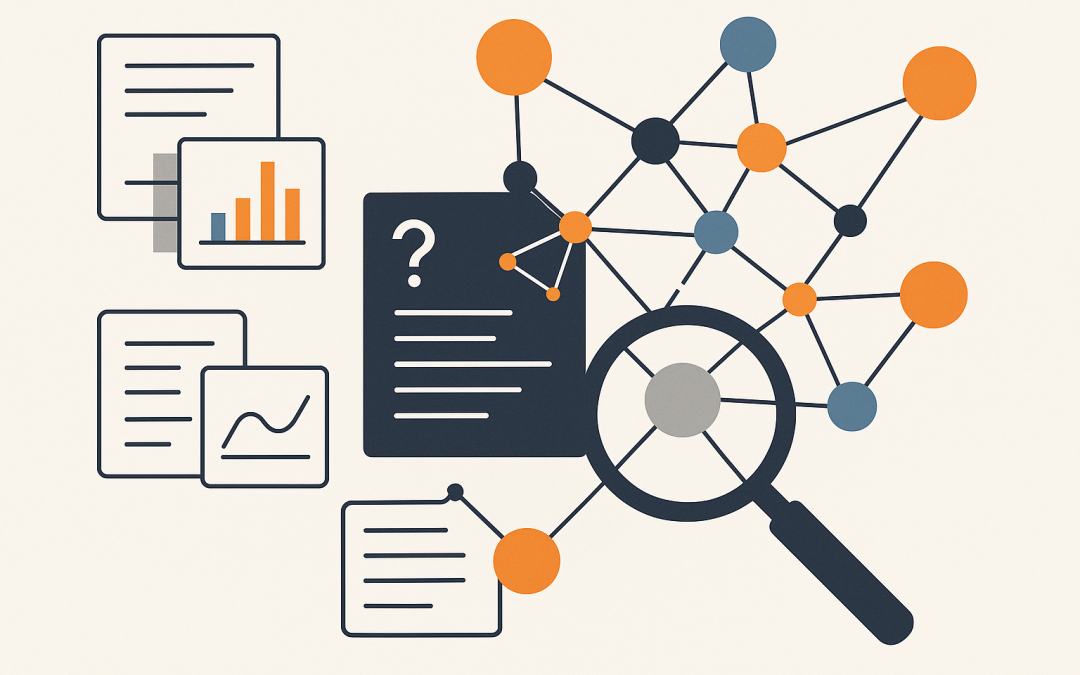
This article “GraphRAG Explained” will explain what is GraphRAG and how incorporated with LLM.
What is GraphRAG?
Graph-Based Retrieval Augmented Generation is a way to supercharge Retrieval Augmented Generation (RAG) by storing your knowledge as a graph and retrieving context via relationships—not just text similarity. Instead of pulling a few semantically similar chunks, GraphRAG traverses nodes and edges (people, products, events, their connections) to assemble a precise, multi-hop context for a large language model (LLM).
At a high level, GraphRAG blends two strengths: graphs capture structure and provenance, while LLMs generate fluent, task-aware responses. The result is a system that answers complex questions (why, how, what-if) with better grounding, transparency, and control than flat vector search alone.
Why graphs help RAG
Traditional RAG treats knowledge as independent chunks. That works for FAQs or one-hop lookups. But many enterprise questions require stitching facts across sources: “Who approved the change that caused last week’s outage?” or “Which suppliers indirectly depend on Vendor X?” A graph naturally models entities and relationships so you can:
- Retrieve by structure: follow edges across systems, time, and teams.
- Do multi-hop reasoning: chain facts without brute-forcing huge context windows.
- Preserve provenance: every node/edge can point to the exact source passage.
- Reduce duplication: unify entities, normalize synonyms, and de-duplicate facts.
- Explain answers: show paths and citations, not just paragraphs.
Architecture at a glance
- Ingest: Collect documents, tables, tickets, code, logs.
- Extract: Use LLMs and rules to identify entities, attributes, and relations; create triples or structured records.
- Build the graph: Upsert nodes/edges in a graph store; attach provenance and metadata.
- Index: Create hybrid indexes: graph indexes (labels, properties), text/keyword, and vector embeddings.
- Summarize: Generate concise node summaries and community-level summaries for scalable retrieval.
- Plan queries: Classify intent; generate Cypher/Gremlin queries; combine with vector search if needed.
- Retrieve subgraph: Pull relevant nodes, paths, and supporting passages.
- Construct context: Assemble citations and summaries into a compact prompt.
- Generate: Ask the LLM to answer using only provided context; include paths/citations.
- Evaluate & improve: Track accuracy, groundedness, path correctness, and cost/latency.
When to use GraphRAG (and when not)
- Great fit: cross-document analysis (incidents, audits), investigations (fraud, supply chain risk), research (biomed, legal), software and architecture Q&A, codebase and dependency queries, enterprise knowledge consolidation.
- Overkill: simple FAQ, short-lived contexts, or domains with minimal relationships.
- Costs: upfront schema design, extraction pipelines, and operations; LLM calls for extraction and query planning; graph storage.
Data modeling essentials
Start small and evolve. Define:
- Node labels: e.g., Person, System, Service, Document, Incident, Vendor.
- Edge types: e.g., OWNS, DEPENDS_ON, REPORTED, CAUSED, MENTIONS, CITES.
- Properties: name, ids, timestamps, categories, confidence scores.
- Provenance: source_id, passage_offset, url, revision.
- Versioning: updated_at, valid_from/valid_to; soft-delete with flags.
Indexing pipeline (LLM-assisted extraction)
Use an LLM to turn unstructured text into nodes and edges. Validate with schemas and confidence thresholds before writing to the graph.
# Pseudocode illustrating an indexing pipeline with a graph DB

from typing import List, Dict

# 1) Chunk documents with stable IDs
docs = load_documents()  # [{"id": "doc1", "text": "..."}, ...]

# 2) Prompt the LLM to extract entities and relations
def extract_graph_units(text: str) -> Dict:
    system = "Extract entities, attributes, and typed relations. Return JSON."
    user = f"Text:\n{text}\nReturn: {{nodes: [...], edges: [...]}}"
    return llm_complete(system=system, user=user)  # JSON with nodes/edges

# 3) Upsert into the graph database

def upsert_graph(payload: Dict, neo4j):
    # nodes: [{label:"Service", key:"svc:payments", props:{name:"Payments"}}]
    # edges: [{type:"DEPENDS_ON", start:"svc:payments", end:"svc:ledger", props:{...}}]
    with neo4j.session() as s:
        for n in payload["nodes"]:
            s.run(
                """
                MERGE (x:Generic {key:$key})
                SET x += $props
                WITH x
                CALL apoc.create.addLabels(x, [$label]) YIELD node
                RETURN node
                """,
                {
                    "key": n["key"],
                    "props": {**n.get("props", {}), "source_id": payload.get("source_id")},
                    "label": n["label"],
                },
            )
        for e in payload["edges"]:
            s.run(
                """
                MATCH (a:Generic {key:$start}),(b:Generic {key:$end})
                MERGE (a)-[r:REL {type:$type}]->(b)
                SET r += $props
                """,
                {
                    "start": e["start"], "end": e["end"],
                    "type": e["type"], "props": e.get("props", {})
                },
            )

# 4) Create or update embeddings (optional, hybrid retrieval)

def embed_and_store(texts: List[str]):
    vectors = embedding_model.embed(texts)
    vector_store.upsert(ids=[...], vectors=vectors, metadata=[...])

for d in docs:
    payload = extract_graph_units(d["text"])  # JSON
    payload["source_id"] = d["id"]
    upsert_graph(payload, neo4j)
    embed_and_store(split_passages(d))
Notes:
- Constrain outputs with schemas and validators; reject low-confidence edges.
- Deduplicate using canonical keys and alias tables.
- Summarize nodes and communities to keep context compact.
Query pipeline (hybrid structural + semantic)
At query time, classify the question, plan a graph query, retrieve supporting passages, and then generate the answer.
# Pseudocode for a GraphRAG query

def plan_graph_query(question: str) -> str:
    system = "You translate questions into Cypher over our schema."
    schema_hint = "Nodes: Service, Incident, Vendor; Rels: DEPENDS_ON, CAUSED, SUPPLIES"
    user = f"Question: {question}\nReturn only Cypher. {schema_hint}"
    cypher = llm_complete(system=system, user=user)
    return cypher.strip()


def retrieve_context(question: str):
    cypher = plan_graph_query(question)
    subgraph = neo4j.run(cypher)  # nodes, edges, properties

    # Also pull relevant passages via vector or keyword search
    passages = vector_store.search(question, top_k=10)

    # Build concise context with citations
    context = build_context(subgraph, passages)
    return context, cypher


def answer_with_grounding(question: str):
    context, cypher = retrieve_context(question)
    system = "Answer only from the provided context. Cite node keys and passage ids."
    user = f"Question: {question}\nContext:\n{context}\n"
    answer = llm_complete(system=system, user=user)
    return {"answer": answer, "cypher": cypher, "context": context}

# Example
result = answer_with_grounding("Which services indirectly depend on Vendor X and were affected by Incident-42?")
print(result["answer"])  # includes citations and graph paths
Example Cypher patterns
// Multi-hop dependency (up to 3 levels)
MATCH (v:Vendor {name:$vendor})<-[:SUPPLIES*1..3]-(s:Service)
RETURN DISTINCT s.name

// Root-cause chain with time window
MATCH (i:Incident {id:$id})-[:CAUSED]->(s:Service)-[:DEPENDS_ON*1..2]->(d:Service)
WHERE i.started_at > datetime() - duration('P30D')
RETURN i, s, d

// Retrieve provenance for an edge
MATCH (a)-[r:DEPENDS_ON]->(b)
RETURN a.key, b.key, r.source_id, r.evidence
Community summaries (scaling trick)
A practical GraphRAG technique is community-level summarization. Detect clusters (e.g., services that co-change or co-occur), then summarize each cluster once. At query time, retrieve a few summaries first; only expand into detailed nodes if needed. This reduces tokens and latency while preserving coverage.
Evaluation and quality
- Answer correctness: human or programmatic grading against gold labels.
- Groundedness: is every claim supported by provided nodes/passages?
- Path correctness: does the cited graph path logically support the claim?
- Coverage/Recall: fraction of necessary nodes/edges retrieved.
- Latency: ingestion, planning, retrieval, and generation breakdown.
- Cost: per query token spend and ingestion cost.
Automate with synthetic question generation over your graph, assert path and citation presence, and measure drift after updates.
Performance and cost tips
- Cache query plans and subgraphs for recurring questions.
- Use community summaries and node summaries to shrink prompts.
- Limit traversal depth; prefer k-shortest paths or weighted walks.
- Hybrid retrieval: combine graph constraints with vector re-ranking.
- Enforce budgets: max nodes/edges, max tokens, and early stopping.
- Incremental updates: stream changes, avoid full re-extraction.
- Store confidence scores and filter low-quality edges at query time.
Tooling choices
- Graph stores: Neo4j, Memgraph, TigerGraph, Amazon Neptune, ArangoDB. Choose based on query language, scale, and ops maturity.
- Frameworks: LangChain and LlamaIndex include graph and knowledge-graph RAG modules; some projects provide ready-made GraphRAG pipelines with community summaries and reporting.
- Embeddings: Use modern embedding models for passages and graph elements; store in a vector DB or in the graph as properties.
- Pipelines: Orchestrate with your favorite scheduler; enforce schema validation and retries.
Security, governance, and trust
- Apply row-/edge-level security: filter nodes and edges per user at query time.
- Mask PII and sensitive attributes; log accesses for audits.
- Track provenance per node/edge; show citations in answers by default.
- Control drift: monitor changes in extraction quality and schema usage.
Common pitfalls
- Over-extraction: Too many low-confidence edges bloat the graph. Enforce thresholds and human review for critical domains.
- Schema churn: Frequent label/property changes break prompts and queries. Version your schema and prompts.
- Unbounded traversals: Depth-unlimited queries explode token usage. Cap depth and fan-out.
- Context sprawl: Raw passages plus subgraphs can exceed limits. Summarize aggressively and re-rank.
- Opaque answers: Always include paths and citations; hide them only in UI if necessary.
A minimal checklist to get started
- Pick a sharp use case (e.g., incident root cause, supplier risk).
- Define a small schema and provenance policy.
- Build an extraction prompt with validation; process 100–500 docs.
- Upsert into a graph DB; create basic indexes and embeddings.
- Implement query planning (LLM-to-Cypher) with a handful of patterns.
- Add community and node summaries; enforce budgets and citations.
- Evaluate on a test set; iterate on schema, prompts, and ranking.
- Productionize with monitoring, ACLs, and cost controls.
Bottom line
GraphRAG elevates RAG from “find similar text” to “retrieve the right structured evidence.” If your domain is relational and your questions are multi-hop, a graph-first index can improve accuracy, explainability, and efficiency. Start small: define a schema, extract reliable edges, and wire a simple query planner. You can expand to community summaries and hybrid retrieval once the core loop is working. The payoff is a system that answers the questions your organization actually asks—grounded, traceable, and fast enough to trust.