
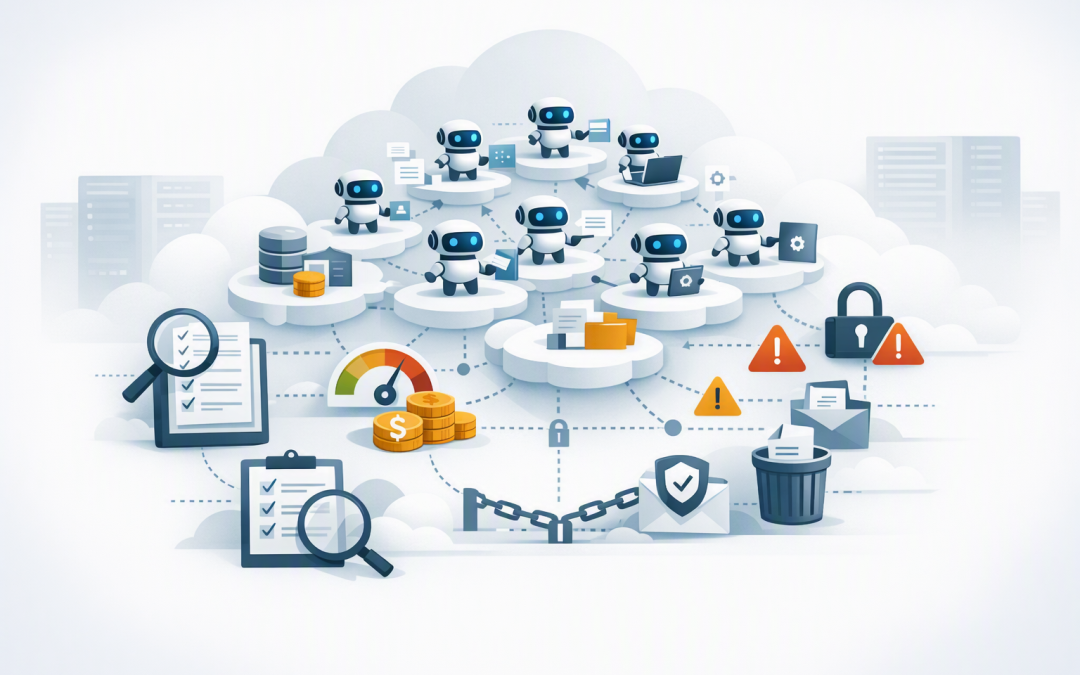
In this blog post AI Agents Are Scaling Faster Than You Can Control Their Cost we will explain why agent growth can quietly increase cloud spending, security exposure and operational risk, often before leadership realises how many agents are running.


The problem is rarely one expensive AI project. It is ten small experiments created by different teams, each connected to business data, software and paid services. Individually, they look harmless. Together, they can become an unmanaged digital workforce with no clear owner, budget or off switch.
What an AI agent actually does
An AI agent is software that uses an AI model, such as OpenAI or Anthropic Claude, to complete a goal through multiple steps. Unlike a basic chatbot that answers a question, an agent can decide what to do next, use approved tools, read information and take actions in other systems.
For example, an accounts agent might monitor an inbox, identify invoices, extract payment details, check a purchase order and enter information into a finance platform. A service agent might investigate a customer issue, search company records, update a ticket and draft a response.
Behind the scenes, the agent runs a loop. It receives a goal, reviews the available information, chooses a tool, checks the result and continues until it believes the task is complete. Each step may consume AI capacity, cloud processing, data storage and third-party service fees.
This is what makes agents useful. It is also what makes their cost and risk harder to predict than a normal software application.
Why agent growth becomes difficult to see
AI agents are now easier to create through platforms such as Microsoft Foundry, OpenAI tools and low-code automation products. A capable employee can move from an idea to a working prototype quickly, without waiting for a large software project.
That speed is good for innovation, but it can outpace normal governance. Marketing builds a research agent. Finance builds an invoice agent. Operations builds a reporting agent. An external provider creates another agent that performs almost the same task.
Before long, nobody can answer basic questions. How many agents do we have? What information can they access? Who approves changes? What does each completed task cost?
If your organisation is still moving beyond experimentation, our guide to moving AI agents from prototype to production without chaos covers the foundations. The next challenge is controlling what happens when adoption accelerates.
The first cost is uncontrolled consumption
Most AI services charge according to usage. The more information an agent reads, the more steps it takes and the more often it calls external tools, the higher the bill becomes.
A chatbot normally responds once. An agent may make 20 model requests, search several systems and retry failed actions before completing one task. If it enters a loop because a tool is unavailable or its instructions are unclear, it can continue consuming resources without producing a useful outcome.
The answer is not simply choosing the cheapest AI model. Leaders should measure the cost per successful business task. A $2 task that saves 30 minutes may be excellent value. A 40-cent task that fails repeatedly and needs manual correction may be expensive.
The second cost is duplicated work
Agent sprawl often looks productive because every department is experimenting. In reality, several teams may be paying to build, connect and support similar agents.
One team creates a document search agent for policies. Another creates one for contracts. A third builds one for customer procedures. Each project has its own data connection, instructions, security settings and support requirements.
A shared design may allow those teams to reuse approved components without forcing every workflow into one oversized agent. Our article on AI agent orchestration patterns explains practical ways to coordinate specialised agents while keeping responsibilities clear.
The third cost is amplified mistakes
An employee may make one incorrect update. An automated agent can repeat the same mistake across hundreds of records before anyone notices.
The immediate cost may be refunds, rework or lost staff time. The larger cost can be damaged customer trust, incorrect financial reporting or an important decision made using unreliable information.
This is why higher-risk actions need checkpoints. An agent can prepare a supplier payment, account change or customer refund, but a person should approve it when the value or risk exceeds an agreed threshold.
Approval should be based on impact, not whether a workflow includes AI. Reading a public document is low risk. Deleting records, changing permissions or sending external communications is not.
The fourth cost is excessive access
An agent needs access to systems to be useful. The danger appears when it receives more access than the task requires or uses a shared employee account that makes its actions difficult to trace.
Each production agent should have its own digital identity and only the minimum permissions needed. In plain English, an invoice agent should not be able to browse employee medical information or change company-wide security settings.
Platforms built around Microsoft Entra ID, Microsoft’s identity and access system, can help assign and review these permissions. Microsoft Defender can detect suspicious activity, while Wiz can help identify risky cloud connections and excessive access across the wider environment.
For a deeper discussion of data exposure, manipulated instructions and unsafe actions, read the hidden security risks of AI agents.
The fifth cost is compliance evidence
Australian organisations must increasingly show how sensitive information is protected, not simply claim that appropriate controls exist. That becomes difficult when agents are created without records of their owner, purpose, data access and actions.
The Essential Eight, the Australian Government’s cybersecurity framework that many organisations use or are required to follow, remains an important security baseline. However, AI agents also need controls covering their instructions, identities, connected tools, data sources, activity logs and human approvals.
If an agent processes personal, financial or customer information, your organisation should be able to explain where that data went, why it was used and what the agent did with it. Reconstructing that evidence after an incident is far more expensive than collecting it from the start.
What uncontrolled scaling looks like in practice
Consider a common mid-sized business scenario. A 200-person professional services firm approves six AI agents for document review, sales support and internal administration. Within several months, copied projects and department experiments increase the total to 18.
The direct AI and cloud bill rises from roughly $3,500 to $14,000 per month. More importantly, IT spends around 60 hours each month investigating failed workflows, managing access and correcting data problems.
A review finds four agents performing similar research, three using employee-level access and five with no documented owner. The technology is not the main problem. The business has scaled execution without scaling management.
After consolidating duplicate agents, introducing usage limits and requiring approval for sensitive actions, the organisation reduces monthly operating costs and gives IT a clear view of who owns every workflow.
How to regain control without stopping innovation
You do not need a six-month governance project. Start with a practical control layer that answers a few basic questions.
- Create an agent register. Record every agent, its owner, purpose, users, connected systems, data access and monthly cost.
- Assign a business outcome. Every agent should have a measurable target such as hours saved, faster response times or fewer processing errors.
- Set usage and spending limits. Define maximum steps, retries and monthly budgets so a faulty process cannot run indefinitely.
- Use separate identities. Give each production agent its own account and the minimum access required to perform its job.
- Add human approval at risk points. Pause actions involving payments, deletions, external messages, legal decisions or sensitive data.
- Monitor complete workflows. Track what the agent attempted, which tools it used, where it failed and how much the completed task cost.
- Review and retire agents. Remove experiments, duplicate workflows and agents that no longer deliver measurable value.
These controls also prevent several of the most common AI agent deployment mistakes, particularly unclear ownership and releasing automation before reliable monitoring is in place.
The real goal is controlled value
AI agents should reduce administration, improve service and help employees complete useful work faster. But an agent that cannot be identified, measured or stopped is not a productivity tool. It is an unmanaged operating cost.
CloudProInc combines more than 20 years of enterprise IT experience with hands-on expertise across Azure, Microsoft 365, OpenAI, Claude, Microsoft Defender and Wiz. As a Melbourne-based Microsoft Partner and Wiz Security Integrator, we help organisations build practical agent controls without burying teams in unnecessary process.
If you are not sure how many AI agents are already operating in your business, what they can access or whether they are delivering value, we are happy to help you take a practical look — no strings attached.
Discover more from CPI Consulting
Subscribe to get the latest posts sent to your email.