
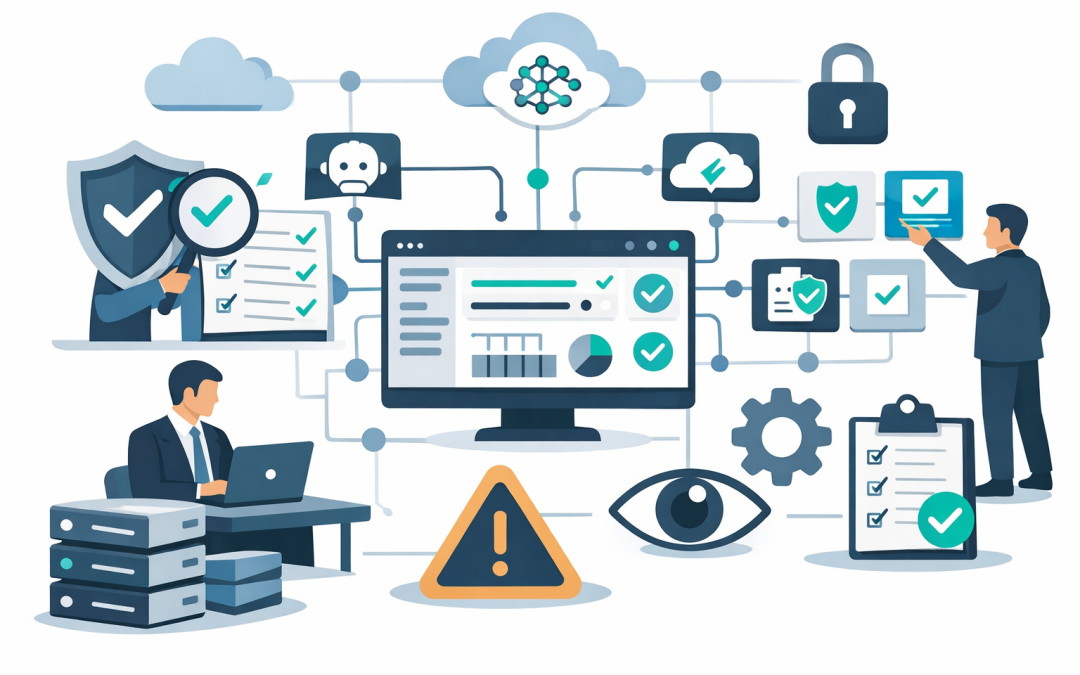
Most organisations that moved past their first AI proof of concept are now stuck in the same place. The prototype worked. The board said go. And now IT teams are buried under questions nobody planned for.
Who approves new model deployments? How does the business trace what an AI agent actually did when it gave a customer the wrong answer? What happens when three teams each deploy their own agents with no centralised oversight?
These aren’t hypothetical problems. They’re the reality facing mid-market Australian organisations right now.
The Governance Gap Is the Real Bottleneck
Access to AI models stopped being the hard part two years ago. The real barrier is governance, compliance, and operational control at enterprise scale.
Australian organisations face pressures that global vendors often underestimate. The Essential 8 maturity model sets clear cybersecurity expectations. ACSC guidelines are increasingly referenced in board-level AI discussions. Privacy legislation adds complexity around how data flows through AI systems.
When AI agents are scattered across business units with no centralised governance layer, every one of these compliance conversations becomes exponentially harder. IT leaders end up explaining governance across a dozen separate services instead of pointing to a single control surface.
What Microsoft Foundry Control Plane Delivers
Microsoft Foundry — the evolution of Azure AI Studio — now includes a dedicated Control Plane that consolidates agent management, model governance, and compliance enforcement into one interface. For CIOs and IT leaders evaluating AI platforms, this changes the conversation.
Fleet-Wide Visibility Across Agents, Models, and Tools
Foundry Control Plane provides a unified inventory of every AI agent, model deployment, and tool across all projects in a subscription. One searchable dashboard surfaces health scores, cost trends, token usage, and compliance posture.
This means an IT Director no longer needs to chase down five different teams to understand what AI assets the organisation is running. The answer is in one place.
Compliance That Integrates With Existing Security Investments
The Compliance pane integrates directly with Azure Policy, Microsoft Defender, and Microsoft Purview. Organisations can define guardrail policies once and enforce them across every agent and model deployment. Versioned policies with full auditability. Real-time compliance monitoring. Bulk remediation for noncompliant configurations.
For organisations working toward Essential 8 maturity or aligning with ACSC guidelines, this consolidation is significant. The AI compliance conversation shifts from a multi-week discovery exercise to a single dashboard review.
Model Flexibility Without Architecture Rework
Foundry Models provides access to over 11,000 models — GPT-4o, Claude, DeepSeek-R1, Phi, Llama, Mistral, and more — through a single resource. The model router automatically selects the best model per request based on quality and cost thresholds the organisation defines.
The model landscape shifts every quarter. The model chosen today may not be the best option in six months. A properly designed platform layer absorbs that churn without forcing expensive replatforming exercises.
Built-In Security Testing Most Organisations Haven’t Considered
Foundry integrates the AI Red Teaming Agent directly into the management plane. This provides automated vulnerability probing, regression testing, and drift monitoring across the agent fleet.
Most Australian organisations have not yet built offensive security testing for AI into their requirements. Microsoft shipping this as a platform capability raises the baseline significantly — and gives CIOs a concrete answer when boards ask how AI systems are being tested for risk.
Why This Matters for Australian Mid-Market Organisations
Large enterprises with dedicated AI platform teams can afford to build custom orchestration layers and hire specialists for every component. Mid-market organisations between 50 and 500 employees cannot.
For these businesses, the AI platform decision comes down to a fundamental question: build a custom stack from separate components and hope it stays maintainable? Or adopt a managed platform that handles governance out of the box?
Microsoft Foundry pushes this equation firmly toward the managed platform. The unified SDK collapses what used to be five separate packages into one project client. The single resource model eliminates the complexity of managing separate Azure OpenAI, Azure AI Services, and Azure ML resources independently.
For Australian organisations already running Microsoft 365 and Azure — which describes most of the mid-market — the integration path is straightforward. Foundry works within existing Azure subscriptions, existing Entra ID configurations, and existing network architectures. The adoption barrier is lower than any comparable alternative.
The CIO Conversation Has Changed
Six months ago, the AI conversation in most boardrooms was about experimentation and use cases. Today, boards are asking harder questions. Who governs the AI agents? How do we prove compliance? What happens when something goes wrong?
Microsoft Foundry Control Plane gives CIOs a credible, single-pane answer to all three questions. Centralised governance. Integrated compliance. Automated security testing. Fleet-wide visibility.
For organisations that need to move from AI experimentation to AI operations — with the governance rigour Australian regulations demand — this is the platform capability that was missing.
CloudProInc works with mid-market Australian organisations to evaluate, architect, and implement AI platforms built on Microsoft Foundry. If the governance and compliance conversation is becoming urgent for your organisation, our team can help map the path forward.