
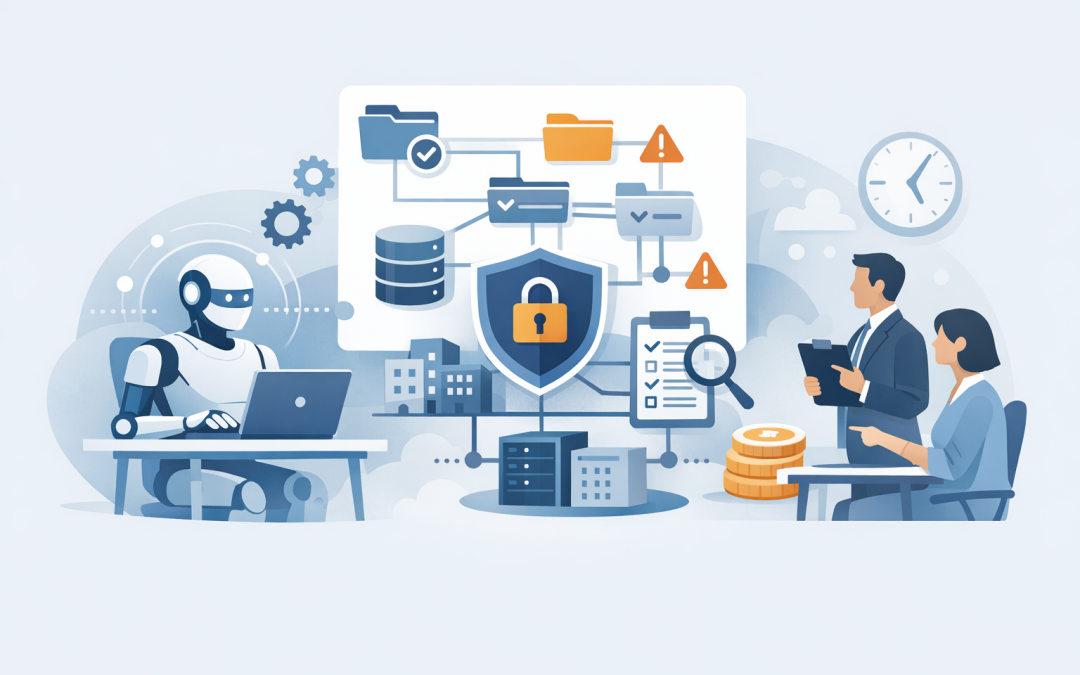
In this blog post What Every CIO Should Ask Before Buying AI Agents for Business we will unpack what AI agents really do, why so many vendor demos hide the hard parts, and the questions every CIO should ask before signing anything.
If you have sat through an AI agent demo lately, you have probably seen the same pattern. The software looks smooth, the presenter says it will save hundreds of hours, and everyone leaves the room feeling like they need to move fast or get left behind. Then the real questions start. What data will it touch? Who is accountable if it gets something wrong? How much will it cost once the pilot ends?
That is the real issue. AI agents are being sold as simple productivity tools, but in practice they can behave more like digital staff members. They may read documents, search systems, draft replies, trigger workflows, and in some cases take actions inside business applications. That can create real value, but it can also create very real financial, security, and compliance risk if you buy first and ask questions later.
What an AI agent actually is
At a high level, an AI agent is an AI system that does more than answer a question. A normal chatbot gives you a response. An agent is designed to pursue a task. It can gather information, make step-by-step decisions, use connected tools, and sometimes complete actions on your behalf.
Under the hood, the main technology is usually a large language model, which is the language engine behind tools like ChatGPT and Claude. On its own, that model predicts words and generates useful text. To turn it into an agent, vendors add instructions, memory, access to business systems, and tool connections that let it search files, update records, send messages, or launch workflows.
A simple way to think about it is this:
- The model provides reasoning and language.
- The instructions tell it what job it is meant to do.
- The data connection gives it access to company information.
- The tools let it actually do something, not just talk about it.
- The guardrails limit what it is allowed to see, say, or change.
That last point matters most for CIOs. The business risk is rarely the model itself. The risk comes from what the agent can access, what actions it can take, and how much trust the business gives it.
Why this buying decision is different from normal software
Most software behaves predictably. You configure it, and it follows the rules. AI agents are different. They work with probabilities, which means they can be helpful, impressive, inconsistent, and wrong all in the same afternoon.
That does not mean they should be avoided. It means they should be bought with the same discipline you would apply to a new finance system, outsourced service desk, or cyber security platform. At CloudPro Inc, this is the conversation we have with mid-sized organisations across Australia all the time. The goal is not to block innovation. The goal is to make sure the value is real and the risk is controlled.
The questions every CIO should ask vendors
1. What exact business problem does this solve
This sounds obvious, but it is where many AI projects go off the rails. “Improving productivity” is not a business case. “Reducing service desk ticket handling time by 25 percent” is. “Cutting quote turnaround from two days to two hours” is. “Reducing manual onboarding steps for HR and IT” is.
Ask the vendor to name the specific workflow, the people involved, the current time or cost, and the expected improvement. If they cannot describe the before-and-after clearly, you are probably looking at a demo problem, not a business problem.
Business outcome: clearer return on investment, faster internal buy-in, and less money wasted on shiny pilots.
2. What data will the agent read, and what systems can it act in
This is where the risk profile becomes real. An agent that drafts internal meeting summaries is one thing. An agent that can read customer contracts, access payroll information, update CRM records, and send emails is something else entirely.
Ask for a plain-English map of access. What files can it see? What applications can it connect to? Can it create, edit, approve, delete, or send? Can it act across Microsoft 365, line-of-business apps, cloud platforms, or browser sessions?
If the vendor says the agent can “operate autonomously,” ask what that means in practice. In plain English, can it actually do things without a person checking first? If yes, what things?
Business outcome: lower chance of data leaks, accidental changes, and surprise exposure of sensitive information.
3. What controls stop it from making the wrong decision
A useful agent should not be trusted the same way as a fully trained employee on day one. Important actions need boundaries. That could include approval steps, spending limits, restricted actions, escalation rules, and session isolation, meaning the agent is kept inside a tightly controlled environment.
Ask whether the product supports human approval for high-risk tasks. In other words, can the agent prepare the work, but require a real person to approve a payment, publish a policy, send an external message, or change a customer record? That one design choice can be the difference between a useful assistant and an expensive incident.
This is also where your wider cyber security posture matters. In Australia, many organisations are expected to align with the Essential 8, the Australian Government’s baseline cyber security framework. Any agent you introduce should fit within your identity controls, logging, device security, and access restrictions, not work around them.
Business outcome: reduced operational risk, fewer costly mistakes, and better alignment with compliance expectations.
4. Where does our data go, and will it be used to train anything
This is one of the first questions boards and legal teams ask, and rightly so. You need a clear answer on data handling, retention, and location. Where is data stored? How long is it kept? Is any of it used to improve the vendor’s models? Can retention be limited? Can sensitive information be blocked from entering the system?
For Australian organisations, privacy cannot be treated as a side note. If an agent touches employee, customer, or financial information, your obligations do not disappear because the vendor calls it AI. The same common-sense questions still apply. Do we need this data? Is access limited? Is there a safer way to deliver the outcome?
Also ask about data loss prevention, which means controls that stop sensitive information being copied, shared, or sent where it should not go. If the vendor cannot explain this simply, that is a warning sign.
Business outcome: lower privacy risk, fewer legal surprises, and stronger board confidence.
5. How will we monitor what the agent did
If something goes wrong, can your team reconstruct what happened? A serious enterprise-grade product should provide logs that show what the agent saw, what tools it used, what decisions it made, and what actions followed.
You want the same level of accountability you expect from a finance system or security platform. If the vendor can only show a chat transcript, that is not enough. You need auditability, meaning a reliable record for investigation, troubleshooting, and internal review.
This becomes even more important as agents become more capable. Some can now work across multiple steps and use software tools in ways that look surprisingly human. That increases value, but it also increases the need for visibility.
Business outcome: faster incident response, better governance, and less dependence on vendor promises.
6. What will this really cost after the pilot
Many AI tools look inexpensive in a trial. The real cost often shows up later through usage charges, premium model fees, integration work, support overhead, and the internal time needed to clean data and redesign processes.
Ask the vendor for three numbers, not one. What does it cost for a pilot? What does it cost at one team? What does it cost at company-wide adoption with realistic usage? Then ask what assumptions sit behind those numbers.
A good vendor should also tell you where the product is likely to not be cost effective. That answer usually tells you more than the glossy slide deck.
Business outcome: fewer budget blowouts and a better chance of proving value quickly.
7. What is our exit plan if this does not work
This is the question too many buyers leave until late. If the project underdelivers, can you switch it off cleanly? Can you export your prompts, workflows, logs, and knowledge assets? Can another platform take over, or are you locked into one vendor’s ecosystem?
AI agents are moving fast. Products, pricing, and capabilities are changing quickly. A sensible CIO buys for value today without creating a trap for tomorrow.
Business outcome: stronger negotiating position, lower lock-in risk, and more flexibility as the market matures.
A practical scenario
Consider a 220-person professional services firm. A vendor proposes an AI agent to handle proposal drafting, meeting follow-ups, document search, and CRM updates. The pilot price looks modest, and the demo is excellent.
But once the CIO asks the right questions, the picture changes. The agent needs access to client folders, email, calendars, the CRM, and the document management system. It can draft proposals, but it may also pull outdated pricing, surface confidential files to the wrong team, or write back to the CRM without proper validation. Suddenly the decision is not about “trying AI.” It is about data governance, commercial risk, workflow design, and accountability.
In that situation, the best next step is usually not a full rollout. It is a controlled use case with limited access, clear approval steps, and defined success measures. That approach may feel slower, but it almost always delivers better results.
The bottom line
AI agents are not just another software subscription. They are a new operating layer that can influence how work gets done across your business. Bought well, they can reduce repetitive work, speed up service, and help your team focus on higher-value tasks. Bought badly, they can create cost, confusion, and risk at machine speed.
The best CIOs are not asking whether AI agents are exciting. They are asking whether the controls, economics, and operating model make sense for their business.
As a Melbourne-based Microsoft Partner and Wiz Security Integrator with more than 20 years of enterprise IT experience, CloudPro Inc helps organisations assess tools like these in a practical way across Microsoft 365, Azure, cyber security, and AI platforms including OpenAI and Claude. If you are not sure whether the AI agent your team is considering will save money or simply introduce new risk, we are happy to pressure-test the proposal with you, no strings attached.