
In this blog post Copilot, Codex, Claude Code and GitHub Agents Cut PR Cycle Time 30% we will walk through a practical way to shorten your pull request (PR) cycle time without asking your developers to “work harder” or your tech leaders to accept more risk.
If your PRs drag on for days, the problem is rarely “slow developers”. It’s the hidden work around the code: clarifying requirements, creating branches, writing tests, updating docs, responding to review comments, fixing lint issues, and doing the same small changes three times because someone missed a detail.
The good news is that modern AI coding tools have moved beyond autocomplete. With the latest wave of AI agents, you can delegate chunks of PR work to an assistant that can draft changes, run checks, open a PR, and iterate based on reviewer comments. Used well, that’s where a ~30% reduction in PR cycle time becomes realistic.
High-level concept first: from “AI suggestions” to “AI agents”
Most teams started with AI inside the editor: it suggests the next line of code, or answers questions when a developer asks. That helps, but it doesn’t change the PR bottlenecks.
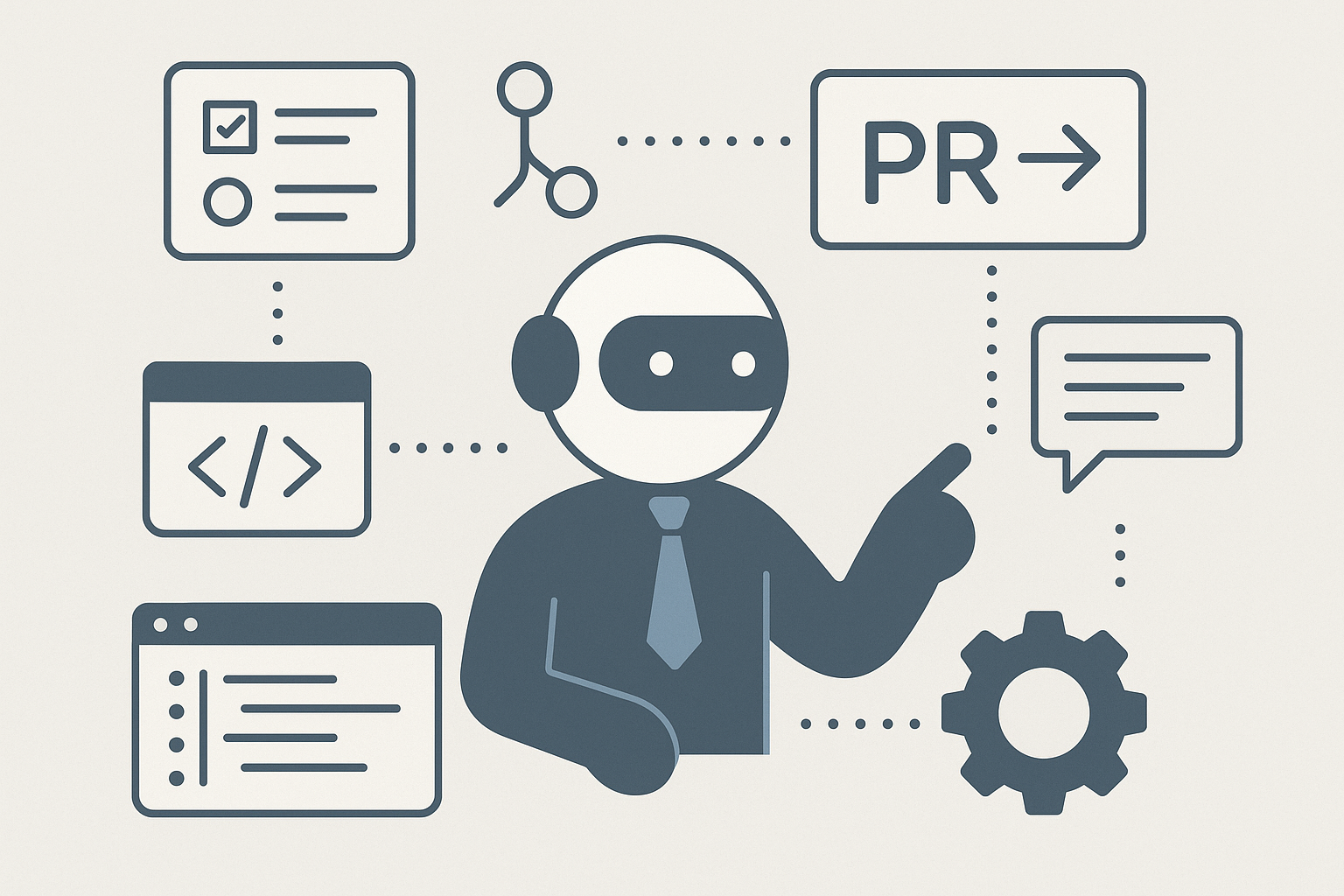
AI agents change the workflow. Instead of helping one developer type faster, an agent can pick up a task (often from an issue), make the changes in a safe workspace, create a PR, and then respond to review feedback. Your developers become reviewers and decision-makers more often than “human keyboards”.
The technology behind it (in plain English)
Under the hood, these tools use large language models (LLMs). Think of an LLM as a system trained on huge amounts of text and code, so it can predict useful next steps and generate working drafts.
What makes the new generation different is the agent wrapper around the model. That wrapper gives the AI a structured way to do real work:
- Context gathering: it reads your repository files, and sometimes the issue/PR discussion, to understand what “done” looks like.
- Tool use: it can run tests, linting, and build commands (the same automated checks your developers run).
- Workspace isolation: it works in a separate, temporary environment so experiments don’t break a developer’s laptop.
- PR workflow integration: it creates branches, commits, and a pull request, and then iterates based on review comments.
This is why teams see cycle time improvements: the agent reduces the “glue work” between coding and shipping.
Where the 30% PR cycle-time win usually comes from
PR cycle time (from first commit to merge) is often dominated by coordination, not coding. Here are the areas where AI agents reliably help.
1) Turning issues into a clean first draft PR
When you assign an AI agent a well-scoped issue, it can create the initial PR with sensible commits, a summary, and (often) baseline tests.
Business outcome: fewer half-finished PRs sitting “in progress”, and less senior developer time spent getting juniors unstuck on setup and boilerplate.
2) Faster iteration on review comments
Most PR delays happen after the first review. Someone asks for naming changes, edge-case handling, missing tests, documentation updates, or refactors. An agent can take a review comment and implement it quickly, especially for repetitive changes across multiple files.
Business outcome: fewer days lost to “I’ll address comments later” and fewer context switches for developers.
3) Automating tests and small-but-important quality work
Agents can run test commands, fix straightforward failures, and increase test coverage on touched code paths (within reason). They’re also good at updating changelogs, READMEs, and internal docs that teams often forget until the last minute.
Business outcome: less rework, fewer escaped defects, and fewer Friday afternoon “quick fixes”.
4) Parallelising the boring tasks
This is the quiet superpower. A developer can delegate two or three small tasks in parallel (for example: update dependencies, add tests, refactor a module) while continuing higher-value design work.
Business outcome: more throughput without hiring, and less burnout from constant “small tasks” that never end.
5) Standardising team conventions
Agents can follow repository instructions (for example: how you name files, how you format logging, how you structure tests). This is not magic, but it’s useful when the rules are written down.
Business outcome: fewer subjective review debates and a smoother onboarding path for new developers.
How the main tools fit together
There’s a lot of noise in the market, so here’s a practical way to think about the four names in this article.
Microsoft Copilot subscription (for the business workflow)
Microsoft 365 Copilot (Copilot in Word, Outlook, Teams, Excel) is best for the work around engineering: writing clearer requirements, summarising meetings, drafting release notes, turning support tickets into structured bug reports, and creating executive-friendly updates.
It won’t replace developer tooling, but it can reduce the “unclear ticket” problem that causes PR churn.
GitHub Copilot Agents (for PR-native work)
GitHub Copilot coding agent is designed to work inside the PR workflow. In plain English: you can ask it to create a PR, or assign it an issue, and it will do the work in the background and open a PR for review.
This is the most direct lever for PR cycle time because it lives where your PR process already lives.
OpenAI Codex (for delegated engineering tasks)
Codex is an AI software engineering agent that can take tasks like “fix this bug”, “add this feature”, or “propose a PR” and run them in a separate environment. It’s well-suited to asynchronous work where you want an agent to go off, do the first pass, and come back with a change set.
Claude Code (for deep codebase work and refactors)
Claude Code is popular for codebase exploration, refactoring support, and multi-step tasks where the developer wants a strong back-and-forth with an assistant that can understand intent and structure. Teams often use it alongside GitHub Copilot rather than instead of it.
A real-world scenario we see in 50–500 person organisations
Picture a 200-person company with a small internal dev team (say 10–20 developers). They’re shipping customer-facing features weekly, but their PRs regularly sit in review for 2–4 days.
When we map the workflow, we usually find the same pattern:
- Tickets are vague, so the first PR draft misses edge cases.
- Review feedback is valid, but the developer doesn’t get back to it for a day because they’re pulled into meetings.
- Docs and tests are an afterthought, so they’re added late and cause more review rounds.
In one common rollout approach, the team:
- Uses Microsoft 365 Copilot to tighten tickets and acceptance criteria (clearer “what done looks like”).
- Uses GitHub Copilot coding agent to create the first PR draft for well-scoped tasks (bug fixes, small features, test additions, docs updates).
- Uses Codex or Claude Code for the heavier tasks (multi-file refactors, migrations, or tasks that require more exploration).
The net effect is that humans spend more time making decisions and less time pushing the PR machinery forward. That’s where the 30% cycle time reduction typically comes from: fewer handoffs, fewer context switches, and fewer “waiting on someone to do the small stuff”.
Practical steps to implement this safely (without breaking your SDLC)
If you try to “turn it all on” at once, you’ll get messy results. Here’s a calmer approach.
Step 1: Pick the right PR types for agents
Start with low-risk, high-volume work:
- Test additions for existing functions
- Documentation updates
- Small bug fixes with clear reproduction steps
- Refactors that are behaviour-preserving (rename, extract function, tidy modules)
Step 2: Define “Definition of Done” in the repo
Agents do best when your expectations are written down. Add a short document or CONTRIBUTING guide that states:
- How to name branches and commits
- What tests must be added
- Code style expectations
- What must be included in PR descriptions
Step 3: Keep humans accountable for approvals
AI can draft work. People still own risk. Keep your existing branch protections, required reviews, and CI checks.
This is also where security matters: treat agent output like any other contributor’s code. Review it. Test it. Scan it.
Step 4: Measure cycle time and rework
Don’t chase “more code”. Track outcomes:
- PR cycle time (open → merge)
- Number of review rounds per PR
- Defects found post-merge
- Developer time spent on rework vs net-new delivery
A quick example prompt pattern your team can reuse
The biggest difference between “meh results” and “wow results” is giving the agent a clear target and constraints.
Task: Create a pull request for issue #123.

Goal:
- Fix the bug where invoice totals are incorrect when a discount is applied.

Constraints:
- Do not change public API shapes.
- Add/adjust tests to cover the discount edge cases.
- Update any relevant documentation.

Acceptance criteria:
- All tests pass.
- New tests fail before the fix and pass after.
- PR description includes: what changed, why, and how to test.
Where CloudProInc fits (and why it matters)
Most teams don’t need “more AI tools”. They need a workflow that reduces cycle time without increasing risk.
CloudProInc is Melbourne-based, with 20+ years of enterprise IT experience, and we spend a lot of time helping teams make these tools practical. That includes choosing the right Copilot subscriptions, making GitHub agent workflows safe, and aligning the rollout with the security and compliance expectations Australian organisations are now working under (including Essential 8, the Australian Government’s cybersecurity framework that many organisations are expected to follow).
Wrap-up
If your PRs feel slow, it’s usually not a talent problem. It’s a workflow problem.
Copilot, Codex, Claude Code, and GitHub’s coding agent can remove a surprising amount of PR friction: first drafts arrive faster, review comments get resolved sooner, tests and docs stop being “later”, and developers spend more time on decisions than on busywork.
If you’re not sure whether your current PR workflow is costing you weeks every quarter, we’re happy to take a look at your repo process and suggest a low-risk pilot — no strings attached.
Discover more from CPI Consulting
Subscribe to get the latest posts sent to your email.